PIX, STF, social networks: understand the US criticism for proposing a 25% tariff and Brazil's arguments
Brazil denies that PIX threatens American companies
Brazil forwarded, this Wednesday (th), a response to the United States regarding the investigation carried out by the Donald Trump government that accuses the Brazilian government of adopting practices that "encumber or restrict" trade with North Americans.
The Brazilian reaction attempts to prevent the United States from putting into practice the proposal for additional tariffs of 25% on Brazilian products, in response to alleged unfair trade practices, described by the Office of Trade.
In the document, signed by Chancellor Mauro Vieira, Brazil states that the American government's criticisms of PIX and the decisions of the Federal Supreme Court (STF) are not related to trade, but to disagreements over internal policies.
In the Brazilian government's view, if the pace and conduct of anti-corruption processes, the confidentiality of court orders issued in accordance with domestic law or the structure of a digital payments system were sufficient, in themselves, to justify an action based on Sec. 301, "the law would no longer have a clear limit on what can or cannot be used to apply sanctions".
With this, he sent a 29-page document in which he rebutted North American criticism point by point.
See, in this report, what the USA criticized, and Brazil's defense arguments (click to follow the content).
Digital commerce and payment services (PIX)
Regulation of social networks and STF
Unfair preferential tariffs
Access to the ethanol market
Property protection intellectual
Fighting corruption
Illegal deforestation
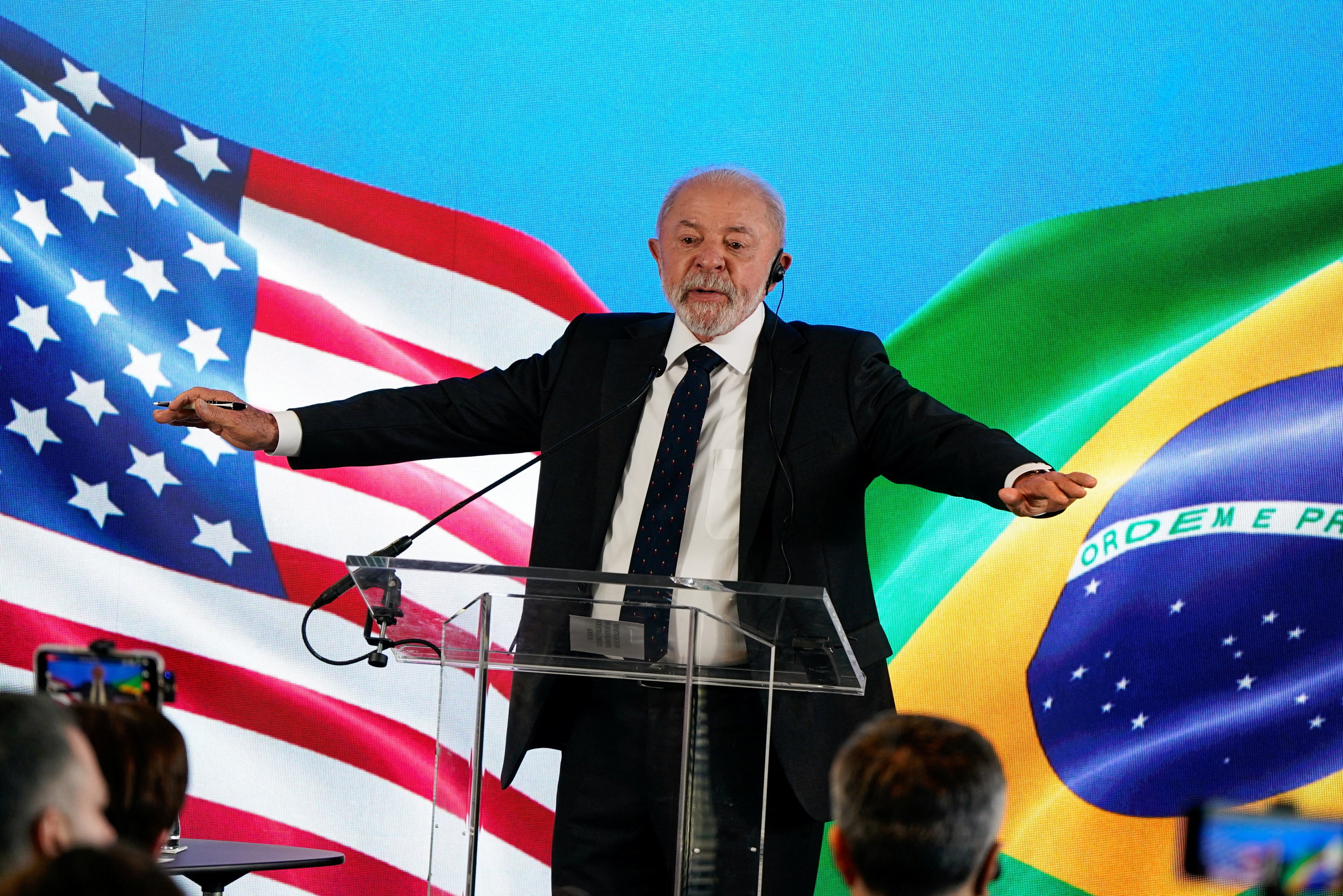
Brazilian President Luiz Inácio Lula da Silva gestures as he speaks to reporters after his White House meeting with US President Donald Trump at the Brazilian Embassy in Washington, DC, USA, on May 7, 2026
REUTERS/Elizabeth Frantz
Digital commerce and payment services (PIX)
➡What the States say United:
The USTR states that the Central Bank favors PIX, an instant payment system, to the detriment of American providers.
According to the North American report, the BC acts at the same time as a regulator and operator of the system, imposing its use and limiting the fees charged by competitors.
➡What Brazil says:
The Brazilian government disputes this statement. It highlights that PIX is an open access public infrastructure, available under non-discriminatory conditions for companies that meet the participation requirements, regardless of the origin of capital.
The government also highlights that American companies already operate normally in the Pix ecosystem, citing Google Pay Brazil and Visa as examples, and argues that the system has increased competition, reduced costs and created new opportunities for banks, fintechs and technology companies.
In addition, the document compares PIX to FedNow, an instant payments system operated by the Federal Reserve, the monetary authority of the United States.
According to the defense, the fact that a central bank operates a public payments infrastructure does not in itself characterize an unfair commercial practice.
Regulation of social networks
➡What the United States says:
The USTR states that Brazilian courts issued confidential orders for American social media companies to remove political content and suspend profiles of US residents - in some cases, with global reach -, in addition to prohibiting the disclosure of these decisions.
The body also criticizes the application of high fines, restrictions on assets and bank accounts and, in at least one case, the complete blocking of a website.
This, according to the Americans, constitutes censorship and an attack on freedom of expression.
Rumble was blocked in Brazil in February 2025 by order of Minister Alexandre de Moraes, of the Federal Supreme Court.
Rumble is a video platform similar to Google's YouTube, including in terms of visuals. Launched in 2013, the social network is quite popular among conservatives in the USA.
She says her mission is to "protect a free and open internet" and has already been involved in several controversies.
STF Minister Alexandre de Moraes
Luiz Silveira/STF
In reaction, the Rumble platform and the Trump Media group sued the Florida Court against Minister Moraes.
The two companies appealed to try to block the application of restriction and blocking orders issued by Moraes in Brazil, under the argument that they amount to censorship and violate US constitutional guarantees.
As the action was filed only against Moraes, the AGU requested the formal entry of the Brazilian State into the process.
➡What Brazil says:
Regarding these determinations against social networks, the government states that the decisions were taken within the scope of regular judicial processes, related to electoral integrity, criminal investigations and the protection of fundamental rights.
Furthermore, it contests the assessment that the secrecy of these decisions would be a problem.
According to the text, confidentiality is provided for in Brazilian legislation to protect investigations, privacy and other public interests, and the parties continue to have the right to due legal process.
The statement also says that the USTR did not present evidence that American companies receive different treatment from Brazilian companies or other foreign companies. For the government, the rules apply equally to all platforms operating in the country.
"The conduct highlighted by the USTR is not specifically directed at North American companies due to their origin, nor does the USTR identify any rule of Brazilian law that imposes a different liability regime for foreign or US-owned platforms", says the document.
The text continues: "Brazil's previous statements highlighted exactly that the applicable legal framework is, in its wording, neutral, it applies equally to national and foreign entities and does not create a liability regime specifically applicable to people, companies or the United States government itself."
Unfair preferential tariffs
➡What the United States says:
The American government contests the trade agreements maintained by Brazil with Mexico and India.
According to the USTR, the country grants lower tariffs to hundreds of products from these markets in sectors in which both are considered advanced and globally competitive producers.
➡What Brazil says:
The Brazilian government claims that its trade agreements with countries such as Mexico and India are legitimate, long-standing and negotiated within recognized regional structures and compatible with the rules of the World Trade Organization (WTO), including differentiated treatment for developing countries.
According to the statement, as a member of Mercosur, Brazil preferably adopts tariff negotiations through regional arrangements permitted by multilateral norms.
In the document, Brazil also says that the United States' dissatisfaction with the economic profile or competitiveness of Brazilian trading partners does not transform these agreements into practices subject to sanctions.
"Section 301 does not authorize the United States to treat legitimate preferential arrangements as 'unreasonable' solely because the United States would prefer not to face competition from the beneficiaries of these arrangements in the Brazilian market," says the text. ethanol
➡What the United States says:
The American body argues that Brazil abruptly interrupted, in 2017, the balanced tariff treatment applied to ethanol and, since then, has not offered reciprocity to fuel exports from the USA.
➡What Brazil says:
Brazil notes that the USTR does not maintain that Brazil's current tariff on ethanol violates any bilateral commitments with the United States.
Nor does it identify a tariff that is applied in a discriminatory manner exclusively to North American ethanol.
The American Commerce Office points, in the report, to the decline in US ethanol exports to Brazil and the continued access of Brazilian ethanol to the United States market as evidence that Brazil's acts, policies and practices would be unreasonable and would burden or restrict United States trade. 301".
"The tariff applies equally to all countries that do not benefit from a preferential agreement and, therefore, does not discriminate against the United States."
Protection of intellectual property
➡What the United States says:
The US points out flaws in the application of criminal and customs laws against counterfeiting products, in addition to slowness in analyzing patents and continuous actions to combat piracy.
The report also criticizes the time required for patent analysis by the National Institute of Industrial Property (INPI), especially in the biopharmaceutical sector, which can take up to 109 months.
➡What Brazil says:
The Lula government argues that this approach is problematic, considering that the USTR itself recently recognized Brazil's advances in the area of intellectual property protection.
"The rebuttal statements presented by Brazil after the hearing highlighted that the USTR itself, in Special Report 301 of 2025, removed Brazil from the Priority Watch List in recognition of 'concrete progress' in the application of intellectual property."
"Brazil demonstrated that relevant indicators showed significant improvement as a result of administrative reforms and measures to reduce accumulated assets implemented through Brazil's National Intellectual Property Strategy and related initiatives."
Fighting corruption
➡What the United States says:
The American representation concluded that Brazil does not adopt sufficient measures to combat bribery and corruption.
The document cites the annulment of Operation Lava Jato processes by the STF in 2023, the "without transparency" renegotiation of leniency agreements and the country's fall in Transparency International's Corruption Perception Index.
➡What Brazil says:
According to the government, the report does not adequately address the broader history of combating corruption presented by Brazil to the USTR. country maintains a comprehensive anti-corruption regime, anchored in both domestic law and international commitments, including the OECD Anti-Bribery Convention, the Inter-American Convention against Corruption, the United Nations Convention against Corruption and the United Nations Convention against Transnational Organized Crime".
Illegal deforestation
➡What the United States says:
The document states that, although Brazil has a legal framework to combat illegal deforestation, the country has historically failed to apply it effectively, allowing the problem to continue.
➡What Brazil says:
Brazil explained that, since January 2023:
it has increased the resources allocated to the main bodies responsible for combating deforestation illegal;
expanded field operations;
strengthened satellite monitoring;
suspended previous freezes that affected environmental fines; and
intensified the use of existing legal and administrative instruments.
According to the most recent budget data from the Integrated Planning and Budget System (SIOP), the allocation of resources to the area "went from R$ 181.8 million in 2022 to R$ 340.99 million in 2026, an increase of 87.6% in the period, totaling R$ 1.345 billion accumulated between 2022 and 2026".
Source: G1