Pentagon chief criticizes NATO allies and announces review of US forces in Europe
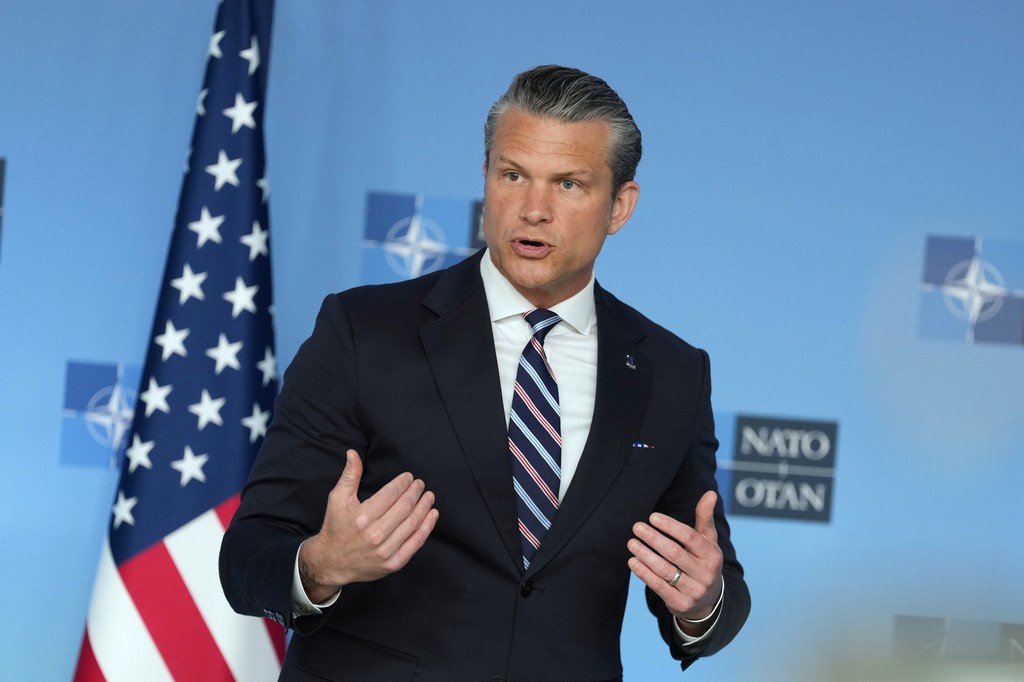
U.S. Secretary of Defense Pete Hegseth speaks during a press statement as he arrives for a meeting of NATO defense ministers at the organization's headquarters in Brussels, Thursday, June 18, 2026.
AP Photo/Virginia Mayo
U.S. Secretary of Defense Pete Hegseth lashed out at NATO allies on Thursday, announcing a six-month Pentagon review of American forces in the Europe, which will depend on how quickly they assume responsibility for their own security.
"This will be a real review. It will be designed to ensure that NATO is moving quickly and irreversibly toward the leadership of Europe, taking primary responsibility for the defense of Europe," he told his NATO colleagues in Brussels.
Hegseth sharply criticized European allies for not providing U.S. forces with access to bases in Europe to launch attacks against Iran, calling it a "disgraceful."
"These allies put America's sons and daughters, our sons and daughters, at risk by denying predictable access, basing and overflight that should never have been questioned," he said.
Hegseth said earlier on Thursday that America's allies in Europe must take the lead in defending their own continent and help transform NATO into "a truly hard-line military alliance."
Now on g1
At the NATO defense ministers' meeting NATO, Hegseth called for an overhaul of the 32-nation organization to transform it into a "NATO 3.0" capable of deterring any threat.
His remarks came just weeks after the United States informed its allies that it would no longer supply certain warships and aircraft if any of them were attacked. European allies and Canada are trying to figure out how to fill those gaps.
"NATO 3.0 is the post-Cold War recognition that (NATO) needs to return to being a true hard-line military alliance, with real military capabilities capable of deterrence here on the continent and taking the lead in the conventional defense of Europe," Hegseth said.
As part of that, he told reporters that the United States would invest $1.5 trillion in its own defense in 2027, sending "a message to the world" that America is building an "arsenal of freedom."
Hegseth said that arsenal "first and foremost protects America and American interests, but it also sustains the strength of NATO and our allies."
He said he would tell U.S. allies that they "have to be willing to stand up and do something in a strong way" about defending their own continent. working on contingency plans to defend Europe after the U.S. signaled it would no longer provide aircraft carriers, support ships, aerial refueling planes and dozens of fighter jets, among other military assets, in a crisis.
The Trump administration insists it needs to be able to plan for two simultaneous conflicts and wants more military resources available if a confrontation with China emerges in the Indo-Pacific region.
Under Article 5 of NATO's founding treaty, the 32 allies promise that an attack against one of them will be considered an attack against all. This does not oblige them to provide military support, although many likely would.
In effect, the United States is reducing the way it could help if an ally triggers Article 5. The country has by far the largest armed forces in NATO and does not intend to withdraw its nuclear weapons from Europe, which are key to the alliance's deterrence.
Source: G1