PCC and CV terrorists: How government and opposition reacted to the classification
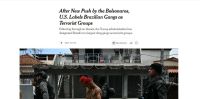
The PCC (First Capital Command) and the CV (Red Command) were classified as terrorist organizations by the United States. The decision, announced by the US State Department, generated immediate reactions from Brazilian politicians on both sides of the political spectrum, while the federal government chose, at first, not to issue any official statement.
According to CNN political analyst Jussara Soares, there was an emergency meeting involving departments such as the Ministry of Defense, the Ministry of Justice and Itamaraty to define how the government would react to the decision.
The conclusion was that no public demonstration would be made initially. According to Jussara Soares, the government is trying to calibrate its response so as not to appear as if it is adopting a discourse in defense of criminal factions.
Government fears diplomatic and economic consequences
The Brazilian government has always acted against this classification. During a visit to Washington, President Luiz Inácio Lula da Silva (PT) even asked that the measure not be adopted, on the grounds that it could open gaps for United States interventions in Brazil and impact the country's economy, if sanctions were applied to entities with some connection to the factions.
The decision puts on a collision course the positions of the US State Department and the Brazilian government, which wanted equal collaboration in the fight against money laundering and the financing of organized crime.
CNN's senior international analyst, Américo Martins, highlighted that the decision, taken unilaterally by the United States Department of State, will have profound implications for relations between the two countries. "This decision will have a huge impact on relations between Brazil and the United States in several aspects," he said.
Américo Martins also pointed out that, with the new classification, investigations that were previously shared with Brazilian authorities are now being treated under the American national security sphere, which could compromise the existing collaboration in the fight against organized crime. At the limit, according to him, the measure would even allow military actions by the United States in Brazilian territory or in the country's territorial waters.
Impact on the financial system worries the market
CNN Politics analyst Teo Cury detailed the economic risks of the decision. According to him, the classification opens up loopholes for the application of sanctions to Brazilian financial institutions that, directly or indirectly, consciously or unconsciously, allow these organizations to operate.
"A factionalist who maintains a relationship with a bank can cause that bank to be sanctioned and its resources frozen", he explained. He also pointed out uncertainties about who would have the authority to define links with the factions - whether it would be the Brazilian justice system or the North American government - generating legal uncertainty and economic instability.
Brazilian financial institutions would have already raised a warning sign regarding this scenario.
Opposition celebrates and government base criticizes
Among the first to speak out was senator and presidential candidate Flávio Bolsonaro (PL-RJ), who shared the State Department's note stating it was "a great day".
In a video, he defended the measure, thanked the United States government and stated that, on a trip to the country, he would have done more for public safety in Brazil than the PT did in 17 years.
The senator also accused the current government of not controlling its own territory or the country's prisons and of colluding with organized crime.
The governor of the state of São Paulo, Tarcísio Gomes de Freitas (Republicans), also praised the classification, stating that "PCC and Comando Vermelho are not factions, they are terrorists armed against the Brazilian people and operating beyond our borders."
Tarcísio congratulated Flávio, to whom he attributed the articulation for the classification to happen.
On the government side, Lindbergh Farias (PT-RJ) published a long text stating that the decision "will have negative consequences for Brazil, the economy and foreign investments" and that it represents "a brutal attack on the country's sovereignty".
The federal deputy also accused the Bolsonaro family of not wanting to combat organized crime, but rather to make Brazil vulnerable and open space for foreign military intervention.
The deputy and former Minister of Institutional Relations, Gleisi Hoffmann (PT-PR), in turn, called the Bolsonaros "traitors to the country" for celebrating what she classified as United States interference in Brazil, and defended measures such as the anti-faction law and the approval of the PEC (Proposed Amendment to the Constitution) for Public Security.
The texts generated by artificial intelligence on CNN Brasil are made based on video cuts from the newspapers in its programming. All information is investigated and checked by journalists. The final text is also reviewed by the CNN journalism team. Click here to find out more.
Source: CNN