'PCC and CV are not factions: they are armed terrorists', says Tarcísio after US decision
PCC is mapped in 28 countries and expands drug and weapons trafficking
After the United States Department of State classified the Primeiro Comando da Capital (PCC) and the Comando Vermelho (CV) as terrorist organizations, the governor of São Paulo Tarcísio de Freitas (Republicans) praised the measure on social media, attributing senator Flávio Bolsonaro (PL) to the coordination with the White House.
Flávio Bolsonaro met with the US Secretary of State, Marco Rubio, this Wednesday (27). According to the parliamentarian, Rubio was in favor of classifying Brazilian factions as terrorist organizations.
"PCC and CV are not factions: they are terrorists armed against the Brazilian people and operating beyond our borders. Those who dominate territories, impose curfews, kill innocent people and defy the State practice terror. Brazil can no longer be held hostage by criminals. Terrorists must be behind bars, without relativization. Congratulations to senator @FlavioBolsonaro for the firm and necessary articulation", he wrote Tarcísio.
Post by governor Tarcísio de Freitas
Reproduction/Instagram
When announcing the measure, the US stated that CV and PCC are among "the most violent criminal organizations in Brazil" and said that the groups "command thousands of members" and are responsible for "brutal attacks" against police officers, public authorities and civilians.
In a statement, the Brazilian Public Security Forum (FBSP) stated that the measure is a sovereign decision of the government North American and concerns the way in which the USA intends to deal, within its own legal parameters, with the transnational impacts of criminal organizations.
Despite this, he regretted that a topic with "profound implications" for Brazil's sovereignty and autonomy, in addition to possible effects on the economy, the financial system and regional and international cooperation mechanisms, had been "captured by the electoral dispute".
Also according to the Forum, the measure has been encouraged as a solution to a "much more complex" problem. without considering the risks of unilateral initiatives from other countries for an economy the size of Brazil.
Why the PCC is not considered a terrorist in Brazil
The PCC, the largest criminal faction in Brazil, with around 40 thousand members, 2 thousand abroad, is not considered a terrorist group - neither in Brazil nor in other countries where it operates, such as Paraguay, Portugal and Italy.
What defines a terrorist group?
The Brazilian Anti-Terrorism Law (Law 13,260/2016) defines terrorism as the practice of violent acts with the purpose of provoking social or generalized terror, motivated by reasons of xenophobia, religion, political ideology or prejudice.
In other words, motivation is what differentiates a terrorist group from a criminal faction. Terrorists often pursue ideological or political ends, while factions such as the PCC aim for profit, especially through drug trafficking, weapons and financial crimes.
How is the PCC treated legally in Brazil?
The PCC is considered a criminal organization under the terms of Law 12,850/2013, which specifically deals with groups with a hierarchical structure focused on committing crimes. This law allows actions such as telephone interceptions, plea bargains and international cooperation agreements - often used to combat the faction.
And abroad?
Some countries, such as the United States, maintain their own list of international terrorist organizations, but so far the PCC is not part of this list.
However, international intelligence reports already classify the faction as a transnational threat and recommend constant monitoring.
READ ALSO: PCC has more than 2 thousand members spread across the world, the majority in prisons; see countries
What does the federal government think?
In May, the Brazilian government told the acting head of coordination of the United States Department of Sanctions, David Gamble, that the PCC and the Red Command are not classified as terrorists.
According to the national secretary of Public Security, Mario Sarrubbo, the factions do not fit the definition of terrorism, under the terms of the Brazilian Constitution.
"The concept of terrorism is diverse, in that these criminal organizations do not have any bias ideological, they do not have any political or religious bias, they do not want to change the system, quite the opposite, they intend to commit criminal offenses, money laundering. Brazil today suffers, as in fact many countries in the world do, with this problem of criminal organizations", stated the secretary.
Thus, according to Brazilian law, it would not be appropriate to classify these organizations as terrorist organizations.
Why does the designation matter?
Classification as a terrorist group can trigger specific laws, harsher penalties, blocking of financial resources and faster international cooperation. However, experts warn that using this designation without clear criteria can be problematic, with the risk of trivializing the concept and abuse against certain social groups.
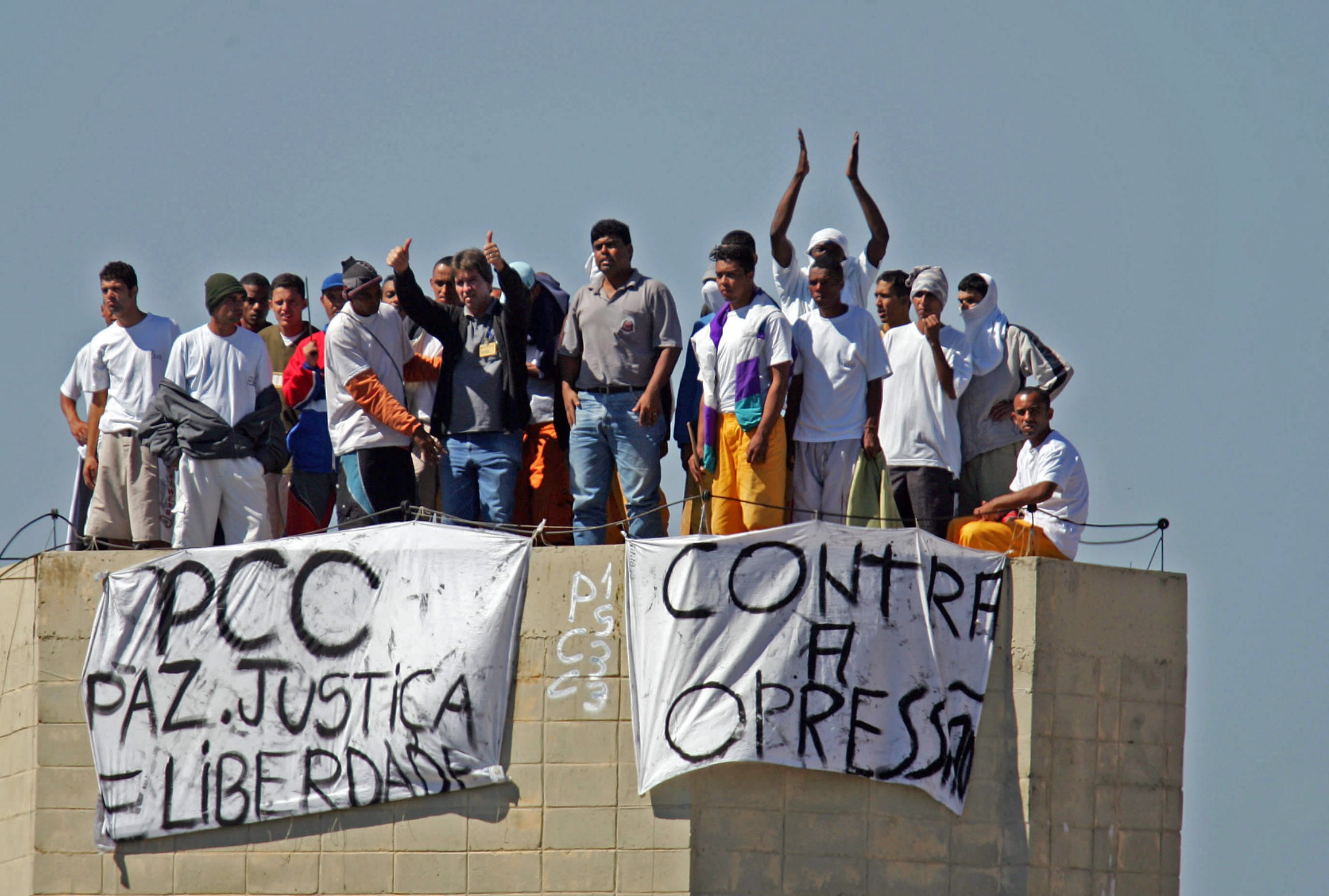
Inmates riot at the Junqueirópolis Penitentiary, in São Paulo, on May 14, 2006. The riot began at 7 am, when family members were coming in for a visit. The rebels climbed to the roof and attached banners to the water tank with the words: 'PCC, peace, justice and freedom' and 'Against Oppression'
Alex Silva/Estadão Conteúdo/Arquivo
See how PCC members are distributed around the world
Arte/g1 Design
Source: G1