One of the most mysterious and remote nations in the world opens to tourism
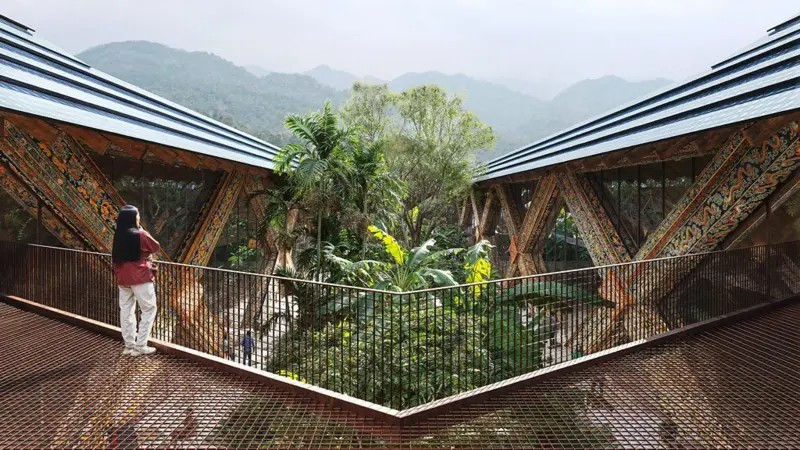
A rendering of the treetop suspension bridge at the new Gelephu International Airport
BIG via BBC
On a hot morning earlier this year, Bhutan's king, Jigme Khesar Namgyel Wangchuck, stood in an open area amid the jungle in the town of Gelephu, near the border with India.
Alongside 12,000 volunteers, he cut down palm trees and cleared vegetation to help make way for a new airport that promises to change the way tourists visit this remote kingdom.
Scheduled to open in 2029, Gelephu International Airport has already won the Future Project of the Year award at the 2025 World Architecture Festival.
Its hollow-frame wooden terminal will be constructed from Bhutanese wood, designed to naturally regulate humidity and refer to the mountainous landscapes on which it is located. The space will also have areas for gong baths, yoga and meditation.
But, with a planned capacity for 123 flights per day, the airport's main objective is to serve as a gateway to the ambitious Gelephu Mindfulness City, a project that aims to transform the country and make one of the most difficult to access destinations in the world much more accessible for foreign tourists.
Hidden among the mountainous valleys of the highest mountain range on the planet, the last Buddhist kingdom in the world spent much of its history practically isolated.
Bhutan has the tallest sacred monument of the Buddhist faith: Tiger's Nest
A remote and exclusive kingdom
For centuries, the country remained closed to the outside world and only began allowing tourists to enter in 1974, when it adopted the "High Value, Low Volume" policy, created to protect its cultural heritage and avoid the impacts of excessive tourism.
Until the pandemic, most foreign tourists were required to book their trip through a tour operator licensed in the country. Bhutan and pay a minimum daily rate of between US$200 and US$250 (R$1,010 to R$1,260) per day, an amount that included accommodation, food, guide, internal transport and the country's sustainable development fee.
Since 2022, the single fare system has been replaced by a Sustainable Development Fee of US$100 (R$505) per adult, per night, while other travel costs are now organized separately.
Even with the new airport, Bhutan is determined to maintain its unique model of controlled, high-value tourism.
As a result, Bhutan has historically gained a reputation as a remote and exclusive destination - and getting there has always been part of its allure.
Bhutan has historically been a remote and difficult-to-reach destination
Getty Images via BBC
Paro, in western Bhutan, is the country's only international airport. But as it is served by just two airlines - Drukair and Bhutan Airlines - and typically receives around eight flights a day, tourists from North America and Europe often spend several days traveling, with stops in cities such as Bangkok, Kathmandu and Delhi.
Tickets aren't cheap either: return flights from these hubs can exceed £890 ($1,200). And arriving in Paro is, in itself, a dramatic experience.
Located at an altitude of 2,243 meters, surrounded by mountains of up to 5,500 meters, Paro airport is considered one of the most challenging in the world.
As it is located in a narrow and winding mountain valley, landings and takeoffs require several sharp turns, forcing pilots to carry out the entire approach visually, without the aid of radar or computerized systems.
Less than 50 pilots in the world are qualified to land there, and the airport received only 88,546 visitors in 2025.
Most tourists who disembark in Paro follow a well-known route through Thimphu, the Punakha Valley, the Phobjikha Valley and Bumthang, all with five-star luxury hotels.
Those who arrive in the country rarely explore the biodiversity of southern Bhutan.
The new airport is expected to open up this wilder and less-visited region to a new generation of spiritually-seeking tourists, as well as serve the Mindful City of Gelephu - a special administrative region that King Jigme Khesar Namgyel Wangchuck hopes will be home to 1 million Bhutanese and foreign residents by 2060.
Gelephu is also expected to gain a 69km rail link to Assam, India, helping to form the first railway in history of the country.
Representation of the 'Gelephu City of Mindfulness', which is being planned as an independent city within the kingdom
BIG via BBC
A new way to experience Bhutan
The idea of transforming Gelephu into a major economic and tourist center was conceived by King Jigme Khesar Namgyel Wangchuck more than a decade ago, but Covid-19 ended up acting as a catalyst for the project.
During the pandemic, the country practically closed its doors until September 2022, which brought down the tourism industry and worsened the exodus of young people that was already underway.
By developing an independent city within the kingdom, combining business-friendly incentives for international companies with a focus on sustainability and spirituality, the country - famous for its Gross National Happiness - hopes that the new city will not only generate jobs and attract investors, but also take tourists beyond the traditional circuit of the west of Bhutan, boosting the less visited south of the country.
"The City of Mindfulness of Gelephu will create many employment and investment opportunities," said Lotay Tshering, who led the Bhutanese government during the pandemic and is now governor of the city, in an interview with BBC Travel.
"But we need flights coming... we need passengers."
When completed, the new airport is expected to become the country's main aviation hub.
"Our vision is for Gelephu to act as a stopover for foreign tourists," said Tshering Dolkar.
"Instead of connecting through Hong Kong or Bangkok, tourists can choose to pass through Gelephu and stay for a few days on a jungle safari or meditation retreat."
Wildlife, trails and family accommodations
The Bhutan tourists will find in Gelephu is a far cry from the monastery-covered cliffs or prayer flags flapping in the wind that made the kingdom famous.
The landscape there is lush, fragrant and subtropical - with cardamom and orange plantations, agricultural areas crossed by rivers, palm trees and hot springs frequented by Bhutanese for generations.
Gelephu is a hotspot of exceptional biodiversity, home to golden langurs, tigers, rhinos and elephants
Alamy via BBC
Gelephu is surrounded by two national parks, including Royal Manas National Park - the first in the country - where tourists will soon be able to see elephants, tigers, rhinos, leopards and more than 360 species of birds up close. Among them is the white-bellied heron, a critically endangered species whose half of the world's population lives in Bhutan.
"Southern Bhutan, where mountains give way to jungle, is a hidden sanctuary for nature," said Matthew DeSantis, founder of Thimphu-based luxury tour operator MyBhutan.
"The south has become a refuge for endangered species. It is one of the wildest places on the planet."
As with most of Bhutan's projects, the country is developing Gelephu's tourism infrastructure with a focus on spirituality. Buddhist masters have been invited to submit proposals for retreat centers and temples to be built in the Gelephu City of Mindfulness.
At the same time, Bhutan's central monastic body has proposed the construction of a dzong - the country's signature monastic and administrative fortress - with accommodation for guests and spaces dedicated to dance and sacred Buddhist studies.
Authorities also hope the new airport will attract trekkers.
The recently announced 168km Lotus-Born Trail, scheduled to open in 2028 near Gelephu, will connect Bhutan's subtropical south to the country's spiritual heart.
Starting from low-altitude forests inhabited by golden langurs and one-horned rhinos, the eight-day route climbs almost 3,500 meters, passes through rhododendron forests to reach the alpine ridges of central Bhutan and follows in the footsteps of Guru Rinpoche, responsible for bringing Buddhism to the country.
In other parts of the region, instead of the traditional trails through the mountains of Bhutan, visitors will find activities such as rafting, bird watching and a newly opened tiger watching trail within the Royal Manas National Park.
Instead of luxury hotels, there are family accommodations and ecological camps. In 2024, Bhutan's first high-end sport fishing lodge will also open in Manas.
According to Tshering Dolkar, the revitalization of the Historic Center of Gelephu is also underway, including a gastronomic project inspired by the cultural diversity of southern Bhutan.
According to her, travelers will be able to try dishes such as thali and dal trays, typical of the Lhotshampas - an ethnic group that lives in the south of the country - as well as more recipes
Nearby, art-filled streets will feature Bhutanese murals produced by the VAST collective, while a Cultural Heritage Village will highlight the country's 13 traditional arts and crafts, from basket making to thangka painting.
Southern Bhutan has not always been an easily accessible region for foreigners - or even for its own Bhutanese. Malaria, monsoons, wild elephants and tigers have caused the country's population to concentrate in the central valleys and highlands.
When the British attempted to control the region in the 1860s, they were repelled after five months of conflict against the Bhutanese in the so-called 'Duar War', ending their ambitions over the territory. As a result, the south remained largely untouched.
"There are not many truly preserved jungles left in the world," said Lotay Tshering.
"Here there is still a raw jungle, with tigers living freely in the wild. This is our treasure."
Back in Gelephu, work on the country's new airport and the futuristic city designed by King Jigme Khesar Namgyel Wangchuck continues. When the project finally opens, it is expected to not only transform how the world knows Bhutan, but also how the country sees itself.
"We have the opportunity to try new things," the king told BBC Travel. "I hope this work generates benefits for future generations."
*This text was published by BBC Travel. Read the original English version here.
Source: G1