On the 250th anniversary, Trump reignites the debate: what are the limits of power in the USA?
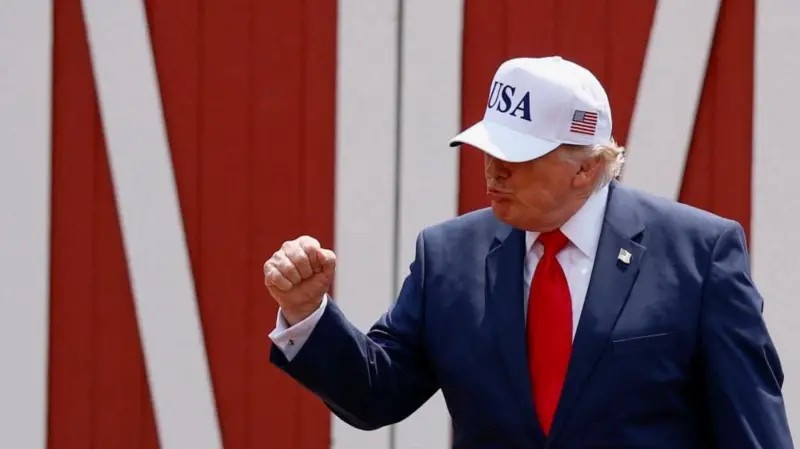
250th anniversary celebration of US independence turns into 'culture war'
US President Donald Trump appears to relish his notorious displays of personal power.
He has surrounded himself with a cabinet and other officials who praise him in public. He attacks world leaders who have lost his approval. And he pressures some of the biggest American companies to do what he wants.
As he approaches the halfway point of his second term in the White House, Trump declared in an interview that "there are no limits" to his power.
This sentiment seems to be the antithesis of the so-called American experiment, which began 250 years ago, when the country declared independence from British monarchical power.
What would those revolutionaries think about the current American head of state? Not much, according to critics.
Millions of people have marched in anti-Trump protests in the United States and other countries, carrying signs reading "no kings," "democracy, not monarchy" and "we have a Constitution, not a king." the war in Iran. And it kept most lawmakers in the dark about the military operation in Venezuela that led to the capture of then-president Nicolás Maduro.
Trump also used emergency powers to circumvent the need for legislation to impose trade tariffs on the entire world. The Supreme Court later ruled that the measure was unconstitutional.
By using the United States Department of Justice to investigate and prosecute people considered his adversaries, such as former FBI director James Comey, Trump is accused of ignoring the traditional separation between the White House and federal prosecutors, which has existed since the Watergate scandal in the 1970s, during the Richard Nixon administration (1913-1994).
"I don't feel like a king," Trump recently declared, when asked about the protests. "I need to go through hell to get the measures passed."
It's clear that Trump was elected on the promise of creating profound and fundamental changes in almost every area of US politics and government.
Many voters who voted for Trump in 2024 against former President Joe Biden no doubt expected radical changes regarding immigration, trade and relations with historic American allies.
Four in five Republicans support the work done by Trump, according to the institute's most recent polls YouGov.
But, among all American voters, his approval fell below 40%, a level significantly lower than at the beginning of the current president's second term.
The American Supreme Court ruled that the import tariffs created by President Donald Trump in 2025 were unconstitutional
AFP
Donald Trump is not the first American president to try to expand his powers, according to professor of History and public affairs Julian Zelizer, from Princeton University, in the States United.
But he highlights that he cannot remember "another president who has gone so far and who was so passionate about power."
Joshua Treviño, director of the conservative think tank America First Policy Institute, warns us not to confuse Trump's carefully crafted image with the expansion of the powers of the presidency.
"It is easy to confuse the aesthetics with the substance of President Trump," according to him.
Treviño quotes Franklin D. Roosevelt (1882-1945) and Richard Nixon as past presidents who tried to expand the powers of the Executive.
"I would vehemently reject the idea that Donald Trump was doing something qualitatively unique in American history," he highlights.
In addition to Nixon, Franklin D.
Roosevelt was another former American president who tried to expand the powers of the Executive
Universal History Archive via Getty Images
The exact limits of a single politician's power have long generated heated debates in the United States.
As early as the 18th century, the country's founding fathers were very concerned about the excessive concentration of power in the hands of a single head of state. So much so that some of them wanted an executive committee to govern the country, instead of a president.
Others advocated granting more powers.
"You are afraid of the one and I am afraid of the few", wrote the second American president, John Adams (1735-1826), to the third president, Thomas Jefferson (1743-1826).
"We are in perfect agreement that the many must have complete, fair and perfect representation. You are apprehensive about the monarchy; I, with the aristocracy. Therefore, I would have granted more power to the president and less to the Senate," Adams explained in 1787. They even thought about calling him "His Greatness."
The Second Continental Congress put the United States Declaration of Independence to a vote in 1776
Getty Images
George Washington (1732-1799), Benjamin Franklin (1706-1790) and Thomas Jefferson may have widely debated these constitutional issues at the Middleton Tavern, a bar older than the country itself on the coast of Annapolis, today in the State American from Maryland.
The place is proud to say that they all drank there in the early days of the new republic.
That's where I meet Lorraine Ross, celebrating her 60th birthday. She says she also wants to celebrate the United States' birthday, but she is worried about the future of the country.
"I'm not going to run around and say 'hurray, USA, we're free,'" she says.
Ross says she is particularly concerned about the cuts in financial assistance to needy families and children with special needs.
She shows her irritation with Congress for "simply letting [Trump] out of control, ignoring all the laws" that restricted the behavior of American presidents in the past.
Other Americans I spoke to at the tavern simply look forward to the Independence Day (July 4th) festivities. The Trump administration has promised that they will be the biggest and best celebrations ever.
John Knox says he doesn't want to get caught up in the politics surrounding the current president. He came from Atlanta, Georgia, to visit the site.
For him, if people disagree with Trump, the time to express their dissatisfaction is the mid-term elections in November, not during the 4th of July celebrations.
Craig Graul with his wife Annette and their dog Rip in Keystone, in the US state of South Dakota
BBC
In another part of the country, military planes fly over a scenic landscape in Keystone, in the State of South Dakota, as US Secret Service officials prepare for the president's visit to the site on Friday (3/7).
It was there that Donald Trump spent the eve of the celebrations of the 250th anniversary of American independence, visiting Mount Rushmore, where the faces of four presidents were carved in granite.
Trump was the subject of memes that placed him on the mountain, alongside former presidents George Washington, Thomas Jefferson, Abraham Lincoln (1809-1865) and Theodore Roosevelt (1858-1918).
Many of his supporters approve of this idea. And there is even a bill in the US Congress for Trump to be added to that iconic monument.
Mount Rushmore is a monument to the presidency of the United States
Getty Images
Terry Davis and Tim Burke are part of a group of old friends who cross the central region of the United States, traveling between one national park and another.
They tried to get tickets to watch the president's fireworks on Friday night (3/7), without success.
I ask if they can imagine Trump's face added to the Mount Rushmore national monument. Davis, 72, responds that Trump should be the biggest face, front and center on the monument.
"I've never been so excited about any other president in the past, until he took the reins of this country," he says.
The bikers highlight what they still see as Donald Trump's political outsider status. And they are happy to see the president use his powers to stand up to Democrats and a federal government that they consider too invasive.
"Long after he leaves the presidency, 20 or 30 years from now, I believe historians will say that he was one of the greatest presidents in the history of our country, for all that he did for the nation," says Burke.
A leader 'must be particularly aware of his own shortcomings,' said the first American president, George Washington, in his speech from inauguration
Universal Images Group via Getty Images
What the American president does with his powers does not only impact the country's current citizens. He can also define how future presidents will use the same power.
For Julian Zelizer, "each chapter in the expansion of presidential power has long-term consequences."
"It creates real precedents that previously did not exist, which future presidents will be able to use. And it also fuels a process of normalization, which means that everything simply becomes part of what we expect presidents to do."
The model of the American president was established in 1789, when the country inaugurated George Washington as the first president of the country.
In his inauguration speech, Washington seemed restrained in relation to the power he received. He said a leader "must be particularly aware of his own shortcomings."
It's hard to imagine Trump, who has declared himself "the greatest president in history," expressing a similar sentiment
Source: G1