Nuclear weapons in space could be detected by satellites
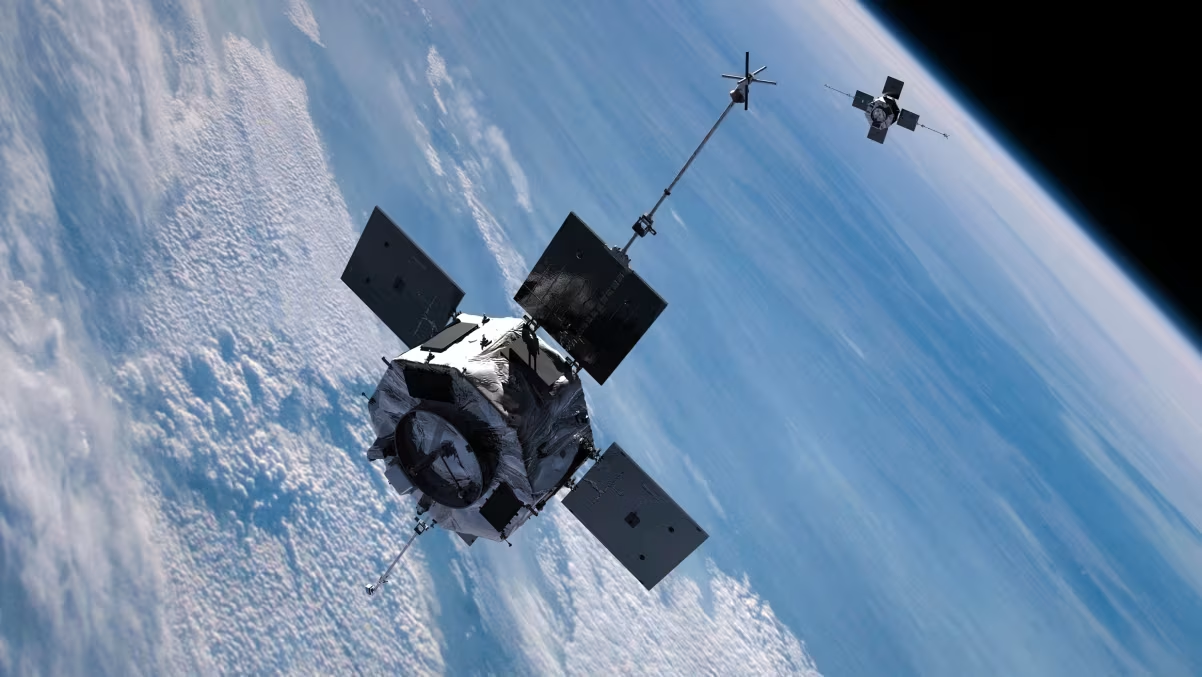
New technology has revealed that the presence of nuclear weapons in space can be detected by small satellites. The discovery could allow verification of compliance with the Outer Space Treaty, which prohibits the storage of atomic bombs and other weapons of mass destruction anywhere in Earth's orbit.
The agreement was negotiated during the Cold War, when only the Soviet Union and the United States had the capacity to explore space. Until then, however, there were no methods capable of monitoring compliance with this prohibition.
According to researcher Areg Danagoulian, author of the method presented in the study, the simulations indicate that satellites carrying nuclear weapons would emit a characteristic neutron signal. This would occur due to the interaction between the weapon's uranium components and the protons trapped in the Earth's magnetic field.
North Korea's alleged nuclear weapons test - KRT via Reuters
Brazil wants to generate infinite energy with "artificial sun" | CNN PRIME TIME
The calculations presented in the research suggest that a small satellite equipped with commercially available components would be capable of detecting these signals.
Also according to Danagoulian, in a hypothetical scenario involving a satellite with a nuclear weapon in low Earth orbit, the small satellite could identify a thermonuclear weapon at a distance of up to 4 kilometers after about a week of observations.
To confirm the results, however, it will still be necessary to test the feasibility of the approach in practice. The study was published by the journal Nature and can be accessed at this link.
US Navy nuclear test, Bikini Atoll, Marshall Islands - FPG/Getty Images
The Outer Space Treaty of 1967
Outer space is not a lawless vacuum. Activities in space are governed by the 1967 Outer Space Treaty, which is currently ratified by 111 nations. The agreement was negotiated in the shadow of the Cold War, when only two nations - the Soviet Union and the United States - had the means to explore space.
While the Outer Space Treaty offers broad principles to guide the activities of nations, it does not offer more detailed rules. Essentially, the agreement guarantees freedom of exploration and use of space for all humanity. There are only two caveats to this, which caused multiple gaps to emerge.
The first reservation establishes that the Moon and other celestial bodies must be used exclusively for peaceful purposes. The remainder of the space is omitted from this general prohibition. The only guidance on this is found in the treaty's introduction, which recognizes a "common interest" in the "progress of the exploration and use of space for peaceful purposes."
The second caveat says that those conducting activities in space must do so with "due regard to the corresponding interests of all other Member States of the Treaty."
The lights of Europe at night, observed from space - Disclosure/Nasa
A major problem arises from the fact that the agreement does not provide clear definitions for either "peaceful purposes" or "due consideration".
Although the treaty specifically prohibits storing nuclear weapons or weapons of mass destruction anywhere in space, it does not prohibit the use of conventional weapons in space or the use of Earth-based weapons against space assets. It is unclear whether some weapons (such as China's nuclear-capable hypersonic missile) should fall under the treaty's ban.
The vague military limitations built into the treaty leave enough room for interpretation to result in conflict.
Source: CNN