
Leia a noticia completa
On July 9, 2025, the President of the United States, Donald Trump, sent a letter to President Luiz Inácio Lula da Silva (PT) announcing a 50% tariff on Brazilian products exported to the American market. The document marked an escalation in trade tensions between the two countries. A year later, the Brazilian government is trying to prevent new tariffs against Brazil from coming into force.
Over the last 12 months, some of the tariffs were revised, others maintained and new charges were announced by the American government.
Now on g1
See below the main chapters of the trade dispute between the two countries:
The letter that started the crisis
The offensive gained strength with the letter sent by Trump to Lula on July 9, 2025. In document, the American president announced a 50% tariff on Brazilian products and justified the decision with political and commercial arguments.
Among the reasons cited were the trial of former president Jair Bolsonaro in the Federal Supreme Court (STF), criticism of the Brazilian Court's actions in relation to digital platforms and allegations that the commercial relationship between the two countries would be unfavorable to the United States.
READ ALSO: Letter from Trump: read the full text, which alleges political and commercial reasons for 50% tariff on Brazil
Trump sends letter to Lula and announces 50% tariff on Brazilian products
Reproduction
At the time, economists and representatives of the productive sector pointed out that the decision had a strong political component and warned of risks to Brazilian exports and jobs linked to trade with the United States.
When justifying the measure, Trump also stated that the US trade relationship with Brazil is "unfair". "Our relationship, unfortunately, has been far from reciprocal," he wrote.
In the document, Trump also states that he ordered the opening of an investigation against Brazil for unfair or unfair trade practices. The investigation was officially opened days later, on July 15, 2025.
The increase in tariffs
The letter did not appear in isolation. Months earlier, in April 2025, Trump had already announced so-called reciprocal tariffs for several countries, imposing an additional 10% tax on Brazilian products.
With the July announcement, part of Brazilian exports began to face a much larger surcharge. Around 22% of Brazilian exports were subject to an additional tariff of 40%, in addition to other charges applied to certain sectors.
Among the most affected segments were industrial products, machinery, equipment, soluble coffee and products linked to the steel and aluminum chain.
In June, the Republican raised taxes on steel and aluminum, based on Section 232 - an instrument separate from IEEPA. The charges, which until then were 25%, are now 50%, according to a decree signed by President Donald Trump. The measure affects Brazil.
In June this year, the United States concluded an investigation that accuses the Brazilian government of adopting practices that "encumber or restrict" trade with the North Americans. Among them are PIX, illegal deforestation, piracy and failures in the application of anti-corruption laws.
As a result of the investigation, the US Trade Office (USTR) proposed the application of 25% tariffs on Brazilian goods. The body, however, included a list of exceptions for products considered strategic by the US, such as meat, fruit, coffee, aircraft, rare earths, among others.
The report cites topics such as the operation of PIX, the regulation of digital platforms, trade agreements signed by Brazil, combating illegal deforestation, access to the ethanol market, protection of intellectual property and anti-corruption policies.
In addition, the investigation also concluded that the European Union and 59 countries, including Brazil, failed to prohibit and monitor the import of goods produced with forced labor.
In response, the American government proposed the application of additional tariffs of 12.5% on all products from these countries.
These tariffs have not yet come into force. The Brazilian government is still trying to prevent them from taking effect.
Under American law, the formal investigation must be completed and a series of public consultations must be carried out before the measures come into force. The legal deadline for defining and possibly applying measures against Brazil is July 15th.
The combination of tariffs proposed by the United States on Brazilian products could increase the total charge to 37.5%, if the measures are implemented.
Behind the scenes, the assessment of members of the Palácio do Planalto and Itamaraty is that the recommendation made by the USTR has a political nature and disregards the technical arguments presented by the negotiators over the last year.
These interlocutors point out as an example the fact that the documents referring to the beginning of the trade investigation, in July 2025, and the recommendation for tariffs, from June 2026, to be "practically equal".
Therefore, with reservations, members of the government say they do not believe in a complete reversal of tariffs, only in a possible reduction or announcement of exceptions.
READ ALSO
Brazil calls US investigation 'arbitrary' and says that 12.5% tariff violates WTO rules
US Tariff: Brazilian government will follow negotiating, but believes that everything has already been said; expects an increase in the number of exceptions
The Brazilian government's reaction
In a public demonstration after Trump's announcement, the president stated that Brazil would not accept being "tutored by anyone" and informed that any unilateral increase in tariffs would be responded to based on the Economic Reciprocity Law.
The Brazilian government also reinforced that issues related to the trial of those involved in the acts of January 8 and the ongoing proceedings in the STF are the exclusive jurisdiction of the Brazilian Justice.
Throughout the period, representatives of the government and business began to defend the diversification of markets and the expansion of trade agreements as a way of reducing dependence on the American market.
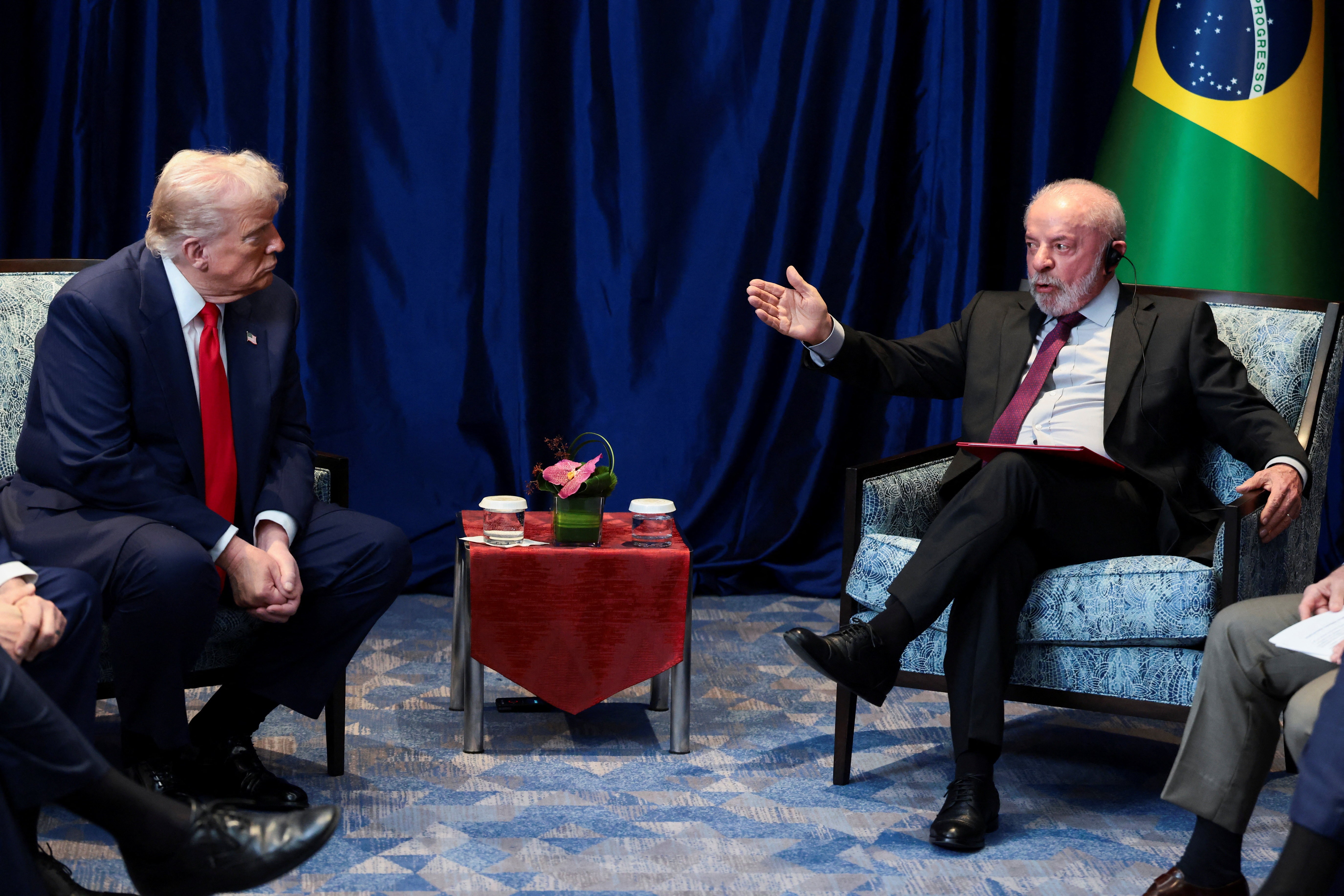
To try to reverse the measures, President Lula met with President Trump on more than one occasion. Furthermore, members of the two governments met several times to discuss the issue.
The presidents of the United States, Donald Trump, and Brazil, Luiz Inácio Lula da Silva (PT), speak to journalists before a meeting in Kuala Lumpur.
Evelyn Hockstein/Reuters
In October last year, the two met in Malaysia. After the meeting, Lula stated that the meeting was "surprisingly good" and that he had the impression that there would soon be no problem between the countries.
"If it depends on Trump and me, there will be an agreement", said the president.
The two heads of states met in May this year. President Lula went to the White House, in Washington, in the United States.
Retreats and changes in tariffs
In November last year, after a meeting between the Brazilian Minister of Foreign Affairs, Mauro Vieira, and the US Secretary of State, Marco Rubio, to discuss the tariffs, the American government announced the withdrawal of the 40% tariff on some Brazilian products.
The measure benefited beef, coffee, açaí, cocoa and several other products. There are more than 200 items that were added to the previous list of almost 700 exceptions to the tariffs imposed on Brazil.
In the previous week, the Trump administration had already reduced import tariffs on around 200 food products, for several countries. In the case of Brazil, the rate had fallen from 50% to 40%.
In February of this year, the American Supreme Court concluded that the International Emergency Economic Powers Act (IEEPA), used by Trump to justify part of the tariffs, did not authorize the president to create the charges in the way he had done.
The decision overturned a significant portion of the tariffs announced by the American government, including measures that had affected Brazilian products.
In response, Trump resorted to another legal instrument to maintain his trade policy and announced a new global tariff of 10%, valid for 150 days. This measure should be valid until the end of this month.
See timeline below:
In April 2025, when announcing the so-called reciprocal tariffs for several countries, Trump applied an additional tax of 10% on Brazilian products imported by the USA.
In June of the same year, the Republican raised the taxes on steel and aluminum to 50%, based on Section 232 - an instrument separate from IEEPA.
On July 9, 2025, Trump sent a public letter to President Lula and announced a 40% tariff on Brazilian products, raising the total rate on several items to 50%. The rate was scheduled to come into effect on August 1, 2025. The measure, however, was accompanied by an extensive list of exceptions.
On July 15, 2025, following a request from Trump, the US government opens a trade investigation against Brazil.
In October 2025, Lula met with President Trump in Malaysia to discuss tariffs on Brazilian products.
In November, after Trump began direct negotiations with President Luiz Inácio Lula da Silva (PT) and ministers from both countries met, the US removed the 40% tariff on new items, including coffee, meat and fruit.
In February 2026, the Supreme Court invalidated the use of IEEPA for broad rates. Thus, the "reciprocal" rate of 10% and the 40% surcharge on Brazil fell. Steel and aluminum were not affected as they are based on Section 232.
On the same day, Trump announced a temporary global tariff of 10% for 150 days, based on a provision in the 1974 trade law, which is in addition to existing tariffs. (these tariffs remain in effect until the end of July).
In May 2026, President Lula went to the USA to meet with Trump.
In June 2026, the USA concluded that Brazil had 'unreasonable' practices and proposed a 25% tariff on national products.
In the same month, the USA proposed a surcharge on 59 countries and the European Union for failing to combat forced labor; Brazil is on the list with a 12.5% surcharge.
Source: G1


Toque agora.
As músicas que o Mundo está tocando agora
-
1
 Balancê
Sara Tavares
Balancê
Sara Tavares
-
2
 Majestade
Carlos A. Moyses
Majestade
Carlos A. Moyses
-
3
 It's A Great Day (for Me To Whoop Somebody's Ass)
Paul Thorn
It's A Great Day (for Me To Whoop Somebody's Ass)
Paul Thorn
-
4
 Paraíso
Danilo Santos
Paraíso
Danilo Santos
-
5
 Yesterday
Petula Clark
Yesterday
Petula Clark
-
6
 Maybe someday
The Cure
Maybe someday
The Cure
-
7
 Un Trocito De Cielo
Jaci Velasquez
Un Trocito De Cielo
Jaci Velasquez
-
8
 Call Me Up
Ezio
Call Me Up
Ezio
-
9
 Por Onde Anda Você?
Nina Fernandes
Por Onde Anda Você?
Nina Fernandes
-
10
 Con El Cielo
Hillsong Worship
Con El Cielo
Hillsong Worship
-
11
 Vem Com Teu Fogo
Adorazione
Vem Com Teu Fogo
Adorazione
-
12
 Excelente
Lucas Santos Tiago
Excelente
Lucas Santos Tiago
-
13
 Fake Amor
Melody
Fake Amor
Melody
-
14
 Rock And Roll In The Hay
Brad Cotter
Rock And Roll In The Hay
Brad Cotter
-
15
 Nunca Había Sentido Tanto Miedo
Alejandro Neri
Nunca Había Sentido Tanto Miedo
Alejandro Neri
-
16
 Hipnose
Manu Gavassi
Hipnose
Manu Gavassi
-
17
 Hey, Good Lookin'
Dean Martin
Hey, Good Lookin'
Dean Martin
-
18
 Augusta, Angélica e Consolação
Tom Zé
Augusta, Angélica e Consolação
Tom Zé
-
19
 Enquanto Cê Não Vem
Eu, Trovador
Enquanto Cê Não Vem
Eu, Trovador
-
20
 Pelo Teu Nome
Leonardo Campos
Pelo Teu Nome
Leonardo Campos

Historias das musicas em destaque
 Historia da musica
Learn to play Yesterday, by Petula Clark, and discover a beautiful classical interpretation
07/07/2026
Singer Petula Clark built a career marked by elegant interpretations and hits that spanned decades. His version of "Yesterday" presents...
 Historia da musica
Learn to play Call Me Up, by Ezio, and discover folk music full of personality
07/07/2026
The Ezio group is recognized for its compositions that combine folk, rock and sophisticated melodies. The song "Call Me Up" draws atten...
 Historia da musica
Learn to play Maybe Someday, by The Cure, and improve on the guitar
07/07/2026
Among alternative rock's most influential bands, The Cure has built a career full of memorable songs. "Maybe Someday" is one of the son...
 Historia da musica
Learn to play It's a Great Day for Me to Whoop Somebody's Ass by Paul Thorn
07/07/2026
With great humor and a vibe that mixes country, blues and rock, "It's a Great Day for Me to Whoop Somebody's Ass", by Paul Thorn, becam...
 Historia da musica
Learn to play Balancê, by Sara Tavares, and discover all the richness of Lusophone music
07/07/2026
Singer Sara Tavares marked international music with her unique identity, mixing African, Portuguese influences and contemporary sounds....
 Historia da musica
Learn to play Majestade, by Carlos A. Moyses, on the guitar with more emotion and technique
07/07/2026
Some songs manage to cross generations carrying messages of faith, hope and adoration. "Majesty", performed by Carlos A. Moyses, is one...
 Historia da musica
Learn to play Quem Você Exalta, by ExaltaSamba, on the guitar
07/07/2026
For those who like samba and pagode, "Quem Você Exalta", by ExaltaSamba, is a great song to develop new guitar skills. With a character...
 Historia da musica
Learn to play Con el Cielo, by Hillsong Worship, and strengthen your worship repertoire
07/07/2026
Hillsong Worship's "Con el Cielo" is an excellent choice for musicians who enjoy congregational worship and want to develop a solid gui...
 Historia da musica
Learn to play Por Onde Anda Você, by Nina Fernandes, and improve on the guitar
07/07/2026
The song "Por Onde Anda Você", performed by Nina Fernandes, conquers with the delicacy of the melody and the way it conveys feelings th...
 Historia da musica
Learn to play Para Só, by Danilo Santos, on the guitar with more emotion and technique
07/07/2026
If you're looking for an exciting song to expand your guitar repertoire, "Para Só", by Danilo Santos, is an excellent choice. The song...
Mais noticias para voce
 Noticia
09/07/2026
Electrical discharge kills young man in park that hosted COP30 in PA
A young man died after suffering an electric shock on Wednesday night (8), in Parque da Cidade, in Belém, Pará. According to witnesses, the victim was at the sk...
 Noticia
09/07/2026
IBGE competition: after extension, registrations for more than 8 thousand places end this Thursday
IBGE extends registrations for competition with more than 8 thousand temporary vacanciesAfter being extended, registrations for the simplified selection process...
 Noticia
09/07/2026
Why do most Brazilians work today, but São Paulo has time off? Understand reason and rules
The Constitutionalist Revolution of 1932 is remembered to this day in São PauloWhile millions of Brazilians leave their homes normally to go to work this Thursd...
 Noticia
09/07/2026
Who will control the Strait of Hormuz? Understand what is behind the new wave of attacks between the US and Iran
United States resumes bombing targets in IranThe new attacks by the United States against Iran this Wednesday (8) are set against a dispute that goes beyond bom...
 Noticia
09/07/2026
France and Morocco face each other on the 1st day of the 2026 World Cup quarterfinals; see timetable
Kylian Mbappé, from France, celebrates the team's first goalREUTERS/Bernadett SzaboThe quarter-finals of the 2026 World Cup begin this Thursday (9) with the gam...
 Noticia
09/07/2026
Itamaraty maps more than 40 American companies and associations that do not want tariffs on Brazilian products
The Ministry of Foreign Affairs mapped 43 American companies and trade associations that ask that Brazilian products not be taxed based on the open investigatio...
Participe da conversa
Seu comentario ajuda a manter a discussao viva e ainda convida outros leitores a continuar navegando pelo portal.
Seja o primeiro a comentar esta noticia.