
Leia a noticia completa
Calculations in Peru: Sánchez turns around and passes Keiko Fujimori by a small margin in the final stretch
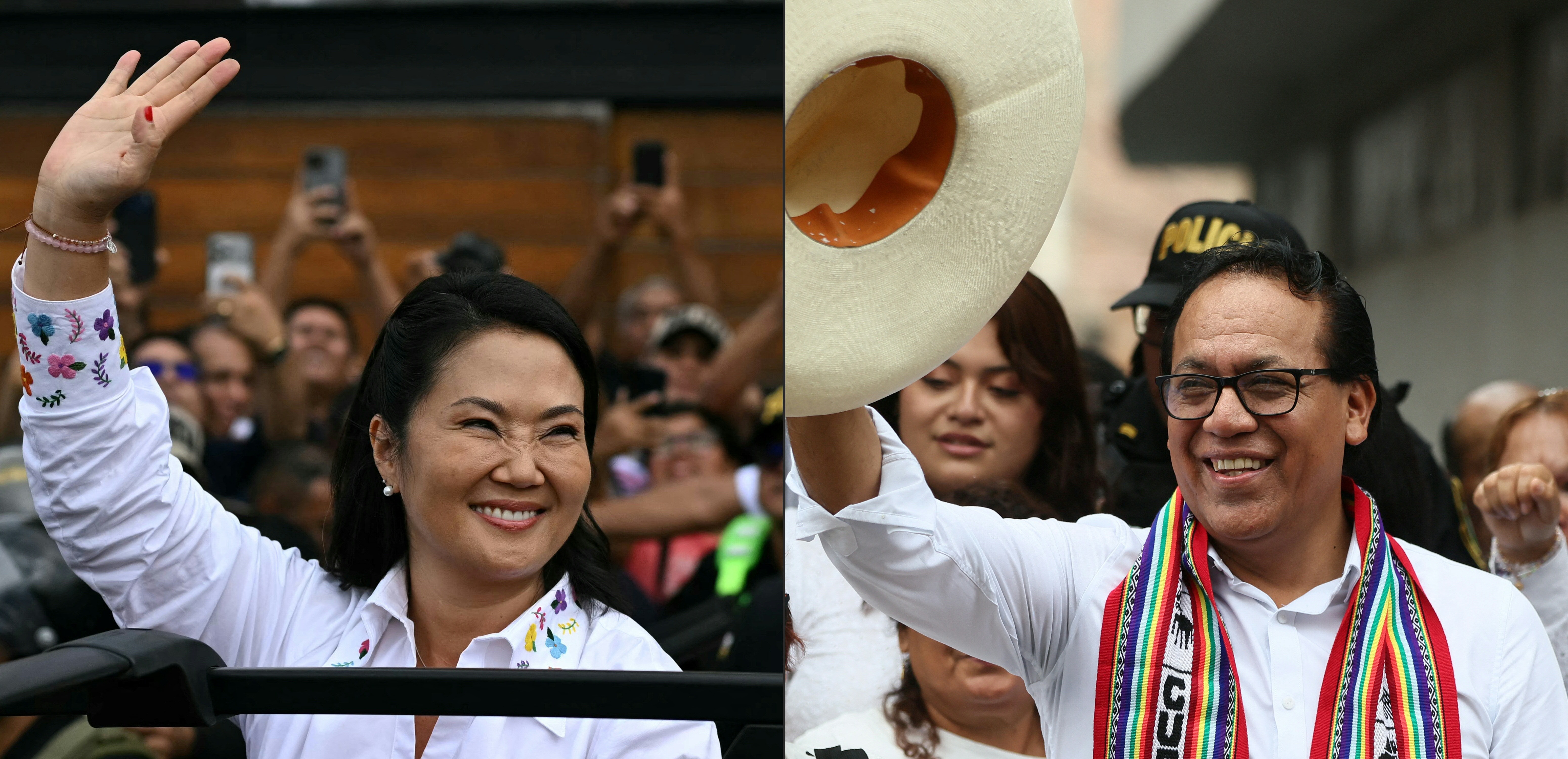
Peru presidential candidate Keiko Fujimori said this Tuesday (9) she was hopeful of winning her country's elections. The conservative disputes the position with the leftist Roberto Sánchez in the 2nd round of the election, which took place on Sunday (7).
Favorite g1 on Google and follow the main news of the day
✅ Follow the g1 international news channel on WhatsApp
Until the last update of this report, with 95.9% of the votes counted, Sánchez had 50.057% of the votes, slightly ahead of Fujimori, with 49.943% - in absolute terms, the difference is around 20 thousand votes.
In a statement to the press, Fujimori said she thought that the counting of votes abroad, still pending, could favor her. The same could happen with polls yet to be opened in the capital - Sánchez is strongest in Peru's rural strongholds.
"There is a lot of hope, especially in the foreign vote and in the minutes observed, because the vast majority of them are from the capital, where we have more support", declared Fujimori. "But I think it would be very premature to declare a winner."
The right-wing candidate also said that she will wait for the announcement from the National Office of Electoral Processes (ONPE) - Peruvian research institutes are making projections in parallel to the official count.
"The margin is very tight. That's why, from the first moment, we understood that there was a technical tie, so the logical and responsible thing was for both candidates and both parties to wait for the results from the institutions, in addition to the research institutes", declared Fujimori.
Turnaround
In the early afternoon of Monday (8), Sánchez took the lead in the count, according to the latest update from ONPE.
According to the official count from the country's electoral body, after several hours with the conservative candidate leading the count, the left-wing deputy turned around at 2:58 pm (Brasília time). final, as he is strong in rural electoral areas, the last to be counted.
Keiko, daughter of convicted former president Alberto Fujimori, was placed first in the first round, with 17.2% of valid votes. Sánchez won 12% of the valid votes in the first vote, which had a record 35 candidates.
The polling stations were closed at 5pm local time (7pm Brasília time) on Sunday (7), after a journey without major incidents, unlike the chaotic first round, marked by technical failures and allegations of fraud.
Counting of votes for president in Peru
Arte/g1
Fragmented first round
Montage shows candidates for the presidency of Peru Keiko Fujimori (right) and Roberto Sánchez in 7 June 2026, the day of voting for the second round
ERNESTO BENAVIDES / AFP
The country went to the polls amid a fragmented political scenario and with a record number of candidates.
Lucas Berti, political scientist, researcher on Peru at the South American Political Observatory and executive coordinator of the International Relations and Global South Group, states that, in fact, what happened in these elections is a consequence of disbelief in institutions.
"It is a symptom of a process of institutional delegitimization that has been happening in recent years in the country. And this, to the extent that the elected presidents are unable to govern", he stated.
9 presidents in 10 years
Peru has had 9 presidents in 10 years. To give you an idea, presidential terms in Peru are 5 years. In other words, in democratic stability, the country would only have two presidents in the same period. However, the reality was different, and some leaders did not last even 5 days in office.
"In these years, the leadership that lasted the longest was that of Dina Boluarte, who remained in power for almost three years.
But, by displeasing the opposition led by Keiko's Fujimorist coalition in Congress, it also fell," says Berti
Furthermore, article 113 of the Peruvian Constitution states that a president can be overthrown due to "permanent moral or physical incapacity" - and those who evaluate this diagnosis are the parliamentarians.
So, for example, if Congress simply doesn't like a law that the president is trying to pass, they can activate that article, vote and, in less than 24 hours, overthrow a president who was elected by the majority of the population.
For political scientist Berti, this ease of the process demonstrates the institutional fragility at play in Peru. According to him, in recent years, the Fujimorist coalition, with an absolute majority in Congress, has been articulating powers, whether in the Legislature, in the courts or in the judicial system.
Since 2008, Alberto Fujimori's daughter has led this Fujimorist current by founding the Fuerza Popular party and trying to reach the Executive Branch in Peru. But that doesn't happen, explains Berti.
"Keiko lost the last three elections (2011, 2016 and 2021) in the second round, by very tight margins. And now in this election, in 2026, it goes to the second round with a greater margin of votes. Some institutes give an advantage to Keiko, others to Sánchez. Which indicates one thing: the election will be difficult and the result is still open", says Berti.
Democracy in crisis: 'chronic distrust'
The consequence of this struggle between the Executive and Legislative branches in the country resulted not only in a deep political crisis, but also in the way the population sees democracy.
"The credibility of institutions is very low if we look at the last 10 years. And distrust in Congress exceeds 90%, especially during the process that would result in the fall of former president Dina Boluarte, in 2025", explains Berti.
The most recent data from the Latinobarómetro survey, which measures the level of democracy in Latin American countries, shows that Peru faces one of the lowest levels of trust in institutions compared to other countries in Latin America. There is what can be classified as "chronic distrust".
According to the data, 90% of Peruvians have little or no confidence in the government and Congress; and only 10% say they are satisfied with democracy. Furthermore, the survey also noted another dangerous feeling: indifference to politics or the type of government regime.
"There is a great ease in creating parties in Peru and they are parties called 'little institutionalized'. These are parties that do not have effective roots in a society, which is not a party that enters the dispute for 20, 40 years. But rather parties that appear and disappear, just as there is no loyalty between the candidates and the parties, which also change coalitions easily", explains Berti.
This whole scenario reinforces in voters the logic that candidates often arrive at an election without a solid base or without a known party. This ends up generating a reading of distrust and, often, disbelief and fear of the ease with which these elected people can fall.
Unicameral system x bicameral
Unlike Brazil, Peru did not have the so-called bicameral system - in which the Legislative Power is exercised by the Senate and Chamber of Deputies. In Peru, the Congress was made up of just one of them, in which 130 parliamentarians served.
However, this year's elections in Peru also reestablished the bicameral legislative system, with a Chamber and Senate, for the first time in decades. The Andean country once again has a Chamber of Deputies, with 130 seats, and a Senate, with 60 seats.
Under the new system, the removal of a president will require approval in both Houses, with the Senate being the final body to determine the president's future.
Context: Until 1992, the country had a Chamber of Deputies and a Senate.
That year, then-president Alberto Fujimori (1938 -2024) carried out a "self-coup": among other measures, he closed Congress, sent soldiers into the streets and promulgated a new Constitution the following year. In the text, which was approved by a referendum, it was determined that the country would no longer have a Senate, and the rule was in force until this year.
*With information from Thais Fascina, from GloboNews
Source: G1




Toque agora.
As músicas que o Mundo está tocando agora
-
1
 Kleine Wolke Über Einem Französischen Mädchen
Echt
Kleine Wolke Über Einem Französischen Mädchen
Echt
-
2
 Majestade
Carlos A. Moyses
Majestade
Carlos A. Moyses
-
3
 Balancê
Sara Tavares
Balancê
Sara Tavares
-
4
 Paraíso
Danilo Santos
Paraíso
Danilo Santos
-
5
 Clay
Manatee Commune
Clay
Manatee Commune
- 6 S Engelbewaarder Sasha & Davy
-
7
 Topla Je Smrt
Metalsteel
Topla Je Smrt
Metalsteel
-
8
 Quem é você
Exaltasamba
Quem é você
Exaltasamba
-
9
 It's A Great Day (for Me To Whoop Somebody's Ass)
Paul Thorn
It's A Great Day (for Me To Whoop Somebody's Ass)
Paul Thorn
-
10
 Maybe someday
The Cure
Maybe someday
The Cure
- 11 M Amongst Majestic Mountains Mendy Chanin
- 12 F Subject ffleetwood_macsay_that_you_love_me.crd
-
13
 Call Me Up
Ezio
Call Me Up
Ezio
-
14
 Yesterday
Petula Clark
Yesterday
Petula Clark
-
15
 Por Onde Anda Você?
Nina Fernandes
Por Onde Anda Você?
Nina Fernandes
-
16
 Con El Cielo
Hillsong Worship
Con El Cielo
Hillsong Worship
-
17
 Mundo Malo
Paulino Bernal
Mundo Malo
Paulino Bernal
-
18
 Un Trocito De Cielo
Jaci Velasquez
Un Trocito De Cielo
Jaci Velasquez
-
19
 Vem Com Teu Fogo
Adorazione
Vem Com Teu Fogo
Adorazione
-
20
 Excelente
Lucas Santos Tiago
Excelente
Lucas Santos Tiago
/https://s02.video.glbimg.com/x720/14761409.jpg)
Historias das musicas em destaque
 Historia da musica
Learn to play Yesterday, by Petula Clark, and discover a beautiful classical interpretation
07/07/2026
Singer Petula Clark built a career marked by elegant interpretations and hits that spanned decades. His version of "Yesterday" presents...
 Historia da musica
Learn to play Call Me Up, by Ezio, and discover folk music full of personality
07/07/2026
The Ezio group is recognized for its compositions that combine folk, rock and sophisticated melodies. The song "Call Me Up" draws atten...
 Historia da musica
Learn to play Maybe Someday, by The Cure, and improve on the guitar
07/07/2026
Among alternative rock's most influential bands, The Cure has built a career full of memorable songs. "Maybe Someday" is one of the son...
 Historia da musica
Learn to play It's a Great Day for Me to Whoop Somebody's Ass by Paul Thorn
07/07/2026
With great humor and a vibe that mixes country, blues and rock, "It's a Great Day for Me to Whoop Somebody's Ass", by Paul Thorn, becam...
 Historia da musica
Learn to play Balancê, by Sara Tavares, and discover all the richness of Lusophone music
07/07/2026
Singer Sara Tavares marked international music with her unique identity, mixing African, Portuguese influences and contemporary sounds....
 Historia da musica
Learn to play Majestade, by Carlos A. Moyses, on the guitar with more emotion and technique
07/07/2026
Some songs manage to cross generations carrying messages of faith, hope and adoration. "Majesty", performed by Carlos A. Moyses, is one...
 Historia da musica
Learn to play Quem Você Exalta, by ExaltaSamba, on the guitar
07/07/2026
For those who like samba and pagode, "Quem Você Exalta", by ExaltaSamba, is a great song to develop new guitar skills. With a character...
 Historia da musica
Learn to play Con el Cielo, by Hillsong Worship, and strengthen your worship repertoire
07/07/2026
Hillsong Worship's "Con el Cielo" is an excellent choice for musicians who enjoy congregational worship and want to develop a solid gui...
 Historia da musica
Learn to play Por Onde Anda Você, by Nina Fernandes, and improve on the guitar
07/07/2026
The song "Por Onde Anda Você", performed by Nina Fernandes, conquers with the delicacy of the melody and the way it conveys feelings th...
 Historia da musica
Learn to play Para Só, by Danilo Santos, on the guitar with more emotion and technique
07/07/2026
If you're looking for an exciting song to expand your guitar repertoire, "Para Só", by Danilo Santos, is an excellent choice. The song...
Mais noticias para voce
 Noticia
08/07/2026
"We will not give in", says Iran negotiator after exchanges of attacks with US
Iran's main negotiator, Mohammad Bagher Ghalibaf, who also holds the position of president of Parliament, listed the main violations of the ceasefire agreement...
 Noticia
08/07/2026
Support channels: what defines customer-focused banking service?
The concept of customer-focused banking has evolved from reactive support to a strategy of anticipating needs. In a scenario where technology redefines interact...
 Noticia
08/07/2026
Kuwait responds to Iran's 'hostile missile and drone threats', army says
Kuwait's air defenses are responding to "hostile threats from missiles and drones", the country's armed forces reported in the early hours of Wednesday (8). In...
 Noticia
08/07/2026
Cuba restores electricity grid, but power cuts continue amid US-imposed fuel blockade
HAVANA, July 7 (Reuters) - Cuba said it had reconnected most of the country to the national electricity grid on Tuesday, although millions of people remained wi...
 Noticia
08/07/2026
UK announces $50 billion NATO initiative for long-range strike weapons
7 Jul (Reuters) - Britain, France, Germany and other European countries will spend more than $50 billion over the next 10 years to develop long-range precision...
 Noticia
08/07/2026
Iran launches missiles at US military bases in Bahrain and Kuwait after bombing
USA bombs targets in Iran after ships are attacked in the Strait of HormuzIran launched retaliatory attacks against Bahrain and Kuwait in the early hours of Wed...
Participe da conversa
Seu comentario ajuda a manter a discussao viva e ainda convida outros leitores a continuar navegando pelo portal.
Seja o primeiro a comentar esta noticia.