Moon moves away from Earth about 4 cm per year; understand phenomenon
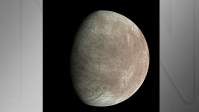
Information from NASA confirms that the Moon, which is, on average, 238,855 miles (384,400 kilometers) from Earth, is moving away from our planet. The celestial body gains about an inch (approximately 2.5 cm) in distance per year.
According to the American agency, the Moon is less than a third as wide as the Earth, with a radius of about 1,080 miles (1,740 kilometers).
As NASA explains, the Moon probably formed after a body the size of Mars collided with Earth billions of years ago. Debris from the collision accumulated and gave rise to our natural satellite, initially about 239,000 miles (384,000 kilometers) away.
The newly formed Moon was in a molten state, but after approximately 100 million years, most of the global "magma ocean" crystallized, forming the lunar crust.
Structure
The lunar core is proportionally smaller than that of other rocky bodies. The solid, iron-rich inner core has a radius of about 149 miles (240 kilometers), surrounded by a liquid iron layer about 56 miles (90 kilometers) thick.
The mantle is probably composed of minerals such as olivine and pyroxene, formed by magnesium, iron, silicon and oxygen.
The lunar crust is about 40 kilometers thick on the side facing Earth and up to 60 kilometers on the opposite side. It contains oxygen, silicon, magnesium, iron, calcium and aluminum, as well as small amounts of titanium, uranium, thorium, potassium and hydrogen.
In the past, the Moon had active volcanoes, but today they have all been inactive for millions of years.
Orbit and rotation
The Moon rotates at the same speed as it orbits the Earth, which is why the same side always faces us. Some people call the side we never see the "dark side," but that's misleading.
As the Moon orbits the Earth, different parts receive sunlight at different times. This change in illumination is what causes the Moon's phases. During a full moon, the visible side of the Moon is fully illuminated by the Sun. During a new moon, the opposite side receives sunlight while the side facing Earth remains in darkness.
The Moon completes an orbit around the Earth in 27 Earth days and rotates about itself in the same period. As the Earth also moves around the Sun, it appears to us that the Moon takes about 29 days to complete one cycle.
Water on the Moon
During the first lunar explorations and analyzes of samples brought back by the Apollo and Luna missions, it was believed that the Moon was completely dry. The first definitive discovery of water took place in 2008, when the Indian Chandrayaan-1 mission detected hydroxyl molecules scattered across the lunar surface and concentrated at the poles.
Missions such as Lunar Prospector, LCROSS and Lunar Reconnaissance Orbiter have shown that there are large concentrations of water ice in the permanently shadowed regions of the lunar poles.
*Under supervision of Manuella Dal Mas
Source: CNN