Man buried in 4,500-year-old oven is a mystery for archaeologists
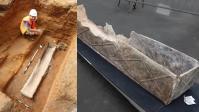
A man, apparently 25 years old, was found dead in an oven pit created approximately 4,500 years ago in Gerstewitz, district of Burgenland, Saxony-Anhalt, Germany.
The discovery was made by German archaeologists and released on June 15 by the State Office for Monument Preservation and Archeology of Saxony-Anhalt and the State Museum of Prehistory.
Experts are investigating whether the man was the victim of a murder, a ritual or whether he was hastily buried at the site.
The body was found in a crouched position, lying on its right side. The upper part was visibly displaced, suggesting that it may have originally been deposited on a layer of organic matter.
The unusual burial site draws the attention of researchers, as oven pits generally do not contain human remains. Additionally, the individual's skull shows signs of injury.
Laboratory analyzes should provide more information about the mysterious burial discovered in Gerstewitz.
See dinosaurs and archaeological discoveries
-
Change imageChange image
1 of 40
Discoveries 2026 (1) - New research shows that Tyrannosaurus rex (T.rex) takes around 35 years to reach maximum size, weighing up to eight tons - ROGER HARRIS/SPL - Getty Images
-
Change imageChange image
2 of 40
Discoveries 2026 (2) - Through remains in the intestine of a 14,000-year-old Siberian wolf pup, scientists found traces of a "meal" that allowed them to sequence the genome of the woolly rhinoceros, from the ice age - Mietje Germonpré
-
Swap imageSwap imageSwap image
3 of 40
Discoveries 2026 (3) - Halafian pottery from an excavation in Arpachiyah, Iraq. Images of plants painted on ceramics made up to 8,000 years ago may be the oldest example of human mathematical thought - Yosef Garfinkel
-
Change imageChange image
-
Swap imageSwap imageSwap image
4 out of 40
Discoveries 2026 (4) - Scientists analyze a cheetah mummy around 2,000 years old that was found in caves in northern Saudi Arabia. The discovery made it possible to collect the animal's DNA - Communications Earth and Environment/Ahamed Boug/Disclosure
-
Change imageChange image
5 out of 40
Discoveries 2026 (5) - Researchers from the Chinese Academy of Social Sciences have found 3,000-year-old pits with the remains of big cats, which suggest the existence of an ancient "zoo" in China - Chinese Academy of Social Sciences
-
Swap imageSwap imageSwap image
6 of 40
Discoveries 2026 (6) - The outline of a hand made with red pigment on the wall of a cave in Indonesia, at least 67,800 years ago, may be the oldest cave art in the world, according to a new study from Griffith University. - Maxime Aubert/Griffith University
-
Change imageChange image
-
Swap imageSwap imageSwap image
7 out of 40
Discoveries 2026 (7) - Archaeological study of ancient works shows unusual treatment practices during the Renaissance: one of them was rubbing human feces on the head to try to reverse baldness - John Rylands Research Institute and Library/University of Manchester
-
Change imageChange image
8 out of 40
Discoveries 2026 (8) - Monumental pools, a sanctuary possibly dedicated to the cult of Hercules and two tombs from the Republican era were discovered during preventive archaeological excavations in Rome. - Special Superintendence of the Ministry of Culture of Rome
-
Swap imageSwap imageSwap image
9 out of 40
Discoveries 2026 (9) - Zooarchaeologist at the National Archaeological Museum of the Bulgarian Academy of Sciences, Stella Nikolova, found dozens of dog skeletons with cut marks in Bulgaria. The discovery reveals that people ate dog meat 2,500 years ago - Stella Nikolova / BNSF
-
Change imageChange image
-
Swap imageSwap imageSwap image
10 out of 40
Discoveries 2026 (10) - Researchers discovered in a quarry in southern China, a collection of fossils around 512 million years old. The discovery contains 153 species, from 16 different groups, at least 59% of the new animals are of unknown origin and have not been cataloged by humans until now - Han Zeng
-
Change imageChange image
11 out of 40
Discoveries 2026 (11) - A group of paleontologists from UFSM (Federal University of Santa Maria) published a study on the discovery of a new reptile species from a 240 million year old fossil. The fossil skull measuring just 9.5 millimeters, found in the municipality of Novo Cabrais, in the interior of RS, revealed a new species of parareptile. Paleontologists named it Sauropia macrorhinus - Illustration by Caetano Soares/UFM
-
Swap imageSwap imageSwap image
12 out of 40
Discoveries 2026 (12) - A new species of amphibian from the Jurassic Period - which received the scientific name Nabia civilcientrix - was identified in the Lourinhã region, in Portugal. The small fossils were discovered in an investigation by paleontologist Alexandre Guillaume. The study was published in the Journal of Systematic Palaeontology. - Illustration by Eva Carret
-
Change imageChange image
-
Swap imageSwap imageSwap image
13 of 40
Discoveries 2026 (13) - Archaeologists have discovered a 1,400-year-old Zapotec tomb in southern Mexico, adorned with intricate carvings, which has been called "the most significant archaeological discovery of the last decade." It is believed that a sculpture of a man's head inside an owl's beak represents the individual buried in the tomb - Disclosure / Luis Gerardo Peña Torres INAH
-
Change imageChange image
14 out of 40
Discoveries 2026 (14) - Researchers have found the skeleton of a Stone Age person buried 12,000 years ago in a cave in Italy. According to the study, the skeleton was that of a teenager with a rare form of dwarfism. - Adrian Daly
-
Swap imageSwap imageSwap image
15 out of 40
Discoveries 2026 (15) - Archaeologists working near Cambridge, England, discovered a pit full of skeletons, around 1,200 years old, which reveal violent deaths - David Matzliach/Cambridge Archaeological Unit
-
Change imageChange image
-
Swap imageSwap imageSwap image
16 of 40
Discoveries 2026 (16) - A tiny, herbivorous dinosaur discovered in northern Spain could change scientists' understanding of the evolution of plant-eating dinosaurs. The new species - named Foskeia pelendonum - lived around 120 million years ago, during the early Cretaceous, and measured just over half a meter in length - Martina Charnell
-
Change imageChange image
17 of 40
Discoveries 2026 (17) - Researchers in Turkey have discovered physical evidence that the Romans used human feces in medical treatments, according to a study published in the Journal of Archaeological Science: Reports. - Cenker Atila
-
Swap imageSwap imageSwap image
18 of 40
Discoveries 2026 (18) - Scientists unearthed, in the Canadian province of Nova Scotia, the skull of a creature that lived around 307 million years ago. The animal is considered one of the oldest herbivorous terrestrial vertebrates ever known and represents a crucial moment in the evolution of animal life on dry land. The creature, called Tyrannoroter heberti, had a slightly triangular-shaped skull - Reproduction/Field Museum
-
Change imageChange image
-
Swap imageSwap imageSwap image
19 of 40
Discoveries 2026 (19) - Excavations revealed the existence of a cemetery intended to house the destitute in Le Mans, in northwestern France. The discovery was made after analyzing a map of the city dated 1736 - Inrap
-
Change imageChange image
20 out of 40
Discoveries 2026 (20) - Artist's reconstruction of a juvenile Haolong dongi from the Early Cretaceous of China. Scientists have identified a new species of dinosaur that has characteristics never before documented. The fossil, dated to approximately 125 million years old, belongs to an exceptionally preserved juvenile iguanodontian, including parts of the skin - Fabio Manucci
-
Swap imageSwap imageSwap image
21 of 40
Discoveries 2026 (21) - Archaeologists in Spain have discovered a 2,200-year-old elephant bone and believe it belonged to an animal that served as a "war machine" in an army sent to invade the Roman Republic. - Agustín Lopez Jimenez
-
Change imageChange image
-
Swap imageSwap imageSwap image
22 of 40
Discoveries 2026 (22) - A small object called the Adorante figurine, discovered in a cave in Germany in 1979 and produced around 40,000 years ago by some of the first people to establish a distinct culture in Europe, features intriguing sequences of carvings and dots. Numerous other objects produced by this same culture bear similar markings. - Photo: Landesmuseum Wuerttemberg/Hendrik Zwietasch/Disclosure via REUTERS
-
Change imageChange image
23 of 40
Discoveries 2026 (23) - In the white expanse of Taylor Valley, in East Antarctica, an image seems to have come out of a science fiction film: a thick, dark red liquid runs down the pristine face of Taylor Glacier, falling towards Lake Bonney. Known as "Blood Waterfalls," this visually shocking phenomenon is actually an iron-rich brine. - National Science Foundation/USA
-
Swap imageSwap imageSwap image
24 out of 40
Discoveries 2026 (24) - Researchers found in Patagonia a well-preserved and almost complete skeleton of one of the smallest known dinosaurs in the world, called Alnashetri cerropoliciensis. It was about the size of a crow and probably hunted small animals such as lizards, snakes, mammals and invertebrates. - Gabriel Diaz Yantein, National University of Rio Negro/Disclosure via REUTERS
-
Change imageChange image
-
Swap imageSwap imageSwap image
25 out of 40
Discoveries 2026 (25) - The first pelycosaur fossils in Brazil were found in the interior of Piauí by a team coordinated by professor at the Federal University of Piauí (UFPI), Juan Carlos Cisneros. The discovery was disclosed in an article published in the scientific journal Journal of Vertebrate Palaeontology - Archive/ Juan Carlos Cisneros
-
Change imageChange image
26 of 40
Discoveries 2026 (26) - Paleontologists have identified a new species of large prehistoric marine reptile, which lived in the oceans about 70 million years ago. The animal, called Pluridens imelaki, was discovered in fossil deposits in Morocco - Diversity
-
Swap imageSwap imageSwap image
27 out of 40
Discoveries 2026 (27) - Analysis of a large tibia unearthed at a remote site in northwestern New Mexico in the 1970s shows that it belongs to a close relative of Tyrannosaurus rex, which lived millions of years before this enormous meat-eating dinosaur, and was potentially a direct ancestor. - Chase Stone
-
Change imageChange image
-
Swap imageSwap imageSwap image
28 out of 40
Discoveries 2026 (28) - Brazilian scientists have identified a new species of giant dinosaur with links to a similar animal found in Spain, reinforcing the knowledge that land routes connected parts of South America, Africa and Europe around 120 million years ago. Named Dasosaurus tocantinensis, the species is one of the largest found in the South American country - Reproduction
-
Change imageChange image
29 out of 40
Discoveries 2026 (29) - One of the three missing pages of Archimedes' Palimpsest manuscript, written in the 10th century, was found in the Museum of Fine Arts in Blois, located in central France. The discovery was made by Victor Gysembergh, a researcher at the CNRS (National Center for Scientific Research) at the Léon Robin Center for Research into Ancient Thought - National Center for Scientific Research
-
Swap imageSwap imageSwap image
30 out of 40
Discoveries 2026 (30) - A fossilized skull and jaw found in Niger belonged to a creature that had a large bony crest on the top of its head and lived about 95 million years ago. Named Spinosaurus mirabilis, it is the first species of Spinosaurus to be identified in more than a century - Dani Navarro/University of Chicago
-
Change imageChange image
-
Swap imageSwap imageSwap image
31 of 40
Discoveries 2026 (31) - Gough's Cave dog jaw (14,300 years old) in side view. Dogs have been loyal companions to humans since we made them our first domesticated animals, long ago descended from gray wolves - although the exact when, where and why remain unanswered. New genetic research is now offering valuable information, including the identification of the oldest known dog, dating back to 15,800 years ago - The Trustees of the Natural History Museum, London
-
Change imageChange image
32 out of 40
Discoveries 2026 (32) - A remarkable collection of fossils from China is revealing that animal life diversified in Earth's primordial seas millions of years earlier than previously thought, into a variety of forms, including ancient members of a group that eventually gave rise to vertebrates, including humans. Paleontologists have unearthed nearly 700 fossils of small, soft-bodied animals that lived approximately 546 to 539 million years ago during the Ediacaran Period, revealing a drastic transformation in animal life at the time. Many of them are strange and hardly recognizable as animals to a layman - Xiaodong Wang Disclosure
-
Swap imageSwap imageSwap image
33 out of 40
Discoveries 2026 (33) - The dice had a different appearance than the polyhedral dice we are used to playing with today. The oldest data identified in the study was known as "binary data." These artifacts - found at Folsom Period archaeological sites in Wyoming, Colorado and New Mexico - date to approximately 12,800 to 12,200 years ago - Robert Madden
-
Change imageChange image
-
Swap imageSwap imageSwap image
34 out of 40
Discoveries 2026 (34) - Researchers from the Federal University of Santa Maria (UFSM), in Brazil, have identified a new species of 230-million-year-old reptile with a beak similar to that of a parrot, discovered in the state of Rio Grande do Sul - Reuters
-
Change imageChange image
35 out of 40
Discoveries 2026 (35) - Researchers studying a 250-million-year-old fossil have found the first evidence that the ancestors of mammals laid eggs, and the discovery also sheds light on a remarkable story of survival. The fossil, found in South Africa, belongs to a rolled-up embryo of a Lystrosaurus, an ancestor of mammals famous for surviving an extinction event that occurred 252 million years ago known as the "Great Extinction", according to a study published in the journal PLOS One - Julien Benoit
-
Swap imageSwap imageSwap image
36 out of 40
Discoveries 2026 (36) - Like the Strait of Hormuz, the Strait of Gibraltar, which lies between the southern tip of Europe and the northwestern tip of Africa, has a history of navigation and conflicts in its waters. Spanish archaeologists claim to have identified 151 underwater archaeological sites, including 124 shipwrecks - Felipe Cerezo Andréo
-
Change imageChange image
-
Swap imageSwap imageSwap image
37 out of 40
Discoveries 2026 (37) - Giant octopuses, which measured up to 19 meters in length, were among the top ocean predators around 100 million years ago, according to new research that discovered rare fossils hidden in solid rocks. A study published in the journal Science reports that remarkably well-preserved specimens of octopuses' powerful jaws show signs of intense wear caused by grinding hard prey, including shells and bones - Yohei Utsuki/Hokkaido University
-
Change imageChange image
38 out of 40
Discoveries 2026 (38) - Archaeologists working in the ancient city of Oxirrinco, in Egypt, unearthed a mummy with a passage from Homer's "Iliad" attached to its abdomen, in an unprecedented discovery - Ministry of Tourism and Antiquities
-
Swap imageSwap imageSwap image
39 out of 40
Discoveries 2026 (39) - A fossil found in the municipality of Dona Francisca, in the central region of Rio Grande do Sul, and which remained lost for around 20 years led to the discovery of a new species of reptile. Named Silescelida acristata, the animal would have lived approximately 240 million years ago, a period before the dinosaurs. - Scientific Reports
-
Change imageChange image
-
Swap imageSwap imageSwap image
40 out of 40
Discoveries 2026 (40) - A man, looking 25 years old, was found dead in an oven pit created approximately 4,500 years ago in Gerstewitz, district of Burgenland, Saxony-Anhalt, Germany. - State Office for Heritage Management and Archeology of Saxony-Anhalt
-
-
-
-
-
-
-
-
-
-
-
-
-
-
-
-
-
-
-
-
-
-
-
-
-
-
-
-
-
-
-
-
-
-
-
-
-
-
-
-
default view
full view
grid view
Research and finding of remains
For several months, experts have been working on excavations related to the construction of the SuedOstLink high-voltage transmission line in Germany. During the work, several archaeological structures were found near the city.
In addition to the man's body, settlements and funerary tombs were identified. Archaeologists also located traces of burned houses and offerings, including animal and human bones.
The materials must be taken for expert analysis.
*Under AR supervision.
Source: CNN