Lula's challenges in the G7 to avoid being sidelined amid the focus on global crises and the clash between Trump and Europe
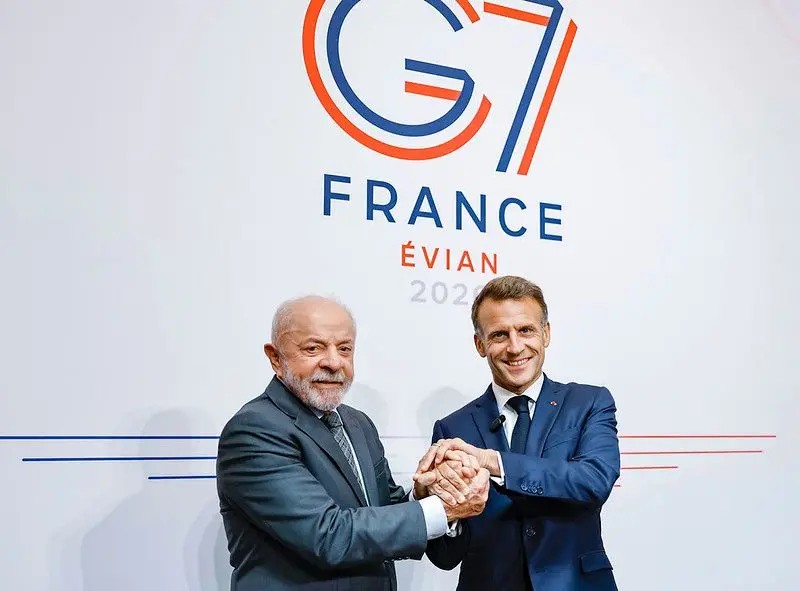
Lula held his first bilateral meeting on the margins of the G7 with Emmanuel Macron, president of France and host of the event
Ricardo Stuckert / PR
President Luiz Inácio Lula da Silva (PT) begins this Tuesday (16/06) his official participation in the G7 - the forum that brings together seven of the largest industrialized economies on the planet.
Lula was invited to the event, which takes place in Évian-les-Bains, France, by the French president, Emmanuel Macron. It is customary for the host of the forum to choose some countries that are not members of the G7 to follow the expanded discussions, starting from the second day of meetings.
Who is also in the small French town on the border with Switzerland for the meeting is the president of the United States, Donald Trump.
The presence of the two leaders in the same place increased expectations for possible interactions, at a time of new tension in the relationship due to the possibility of applying an extra 25% tax on part of Brazilian imports.
Until the At the moment, there has been no confirmation about a possible bilateral meeting between Lula and Trump - and interlocutors claim that the Brazilian government did not ask the White House for a private meeting.
The two leaders, however, may cross paths during the expanded meetings of the summit or in the event's corridors.
According to experts interviewed by BBC News Brasil, winning the attention of the American president must be a great challenge for the Brazilian government, which is competing with other diverse world leaders in the midst of major global crises, such as the wars in Iran and Ukraine and the instability in transatlantic relations caused by Trump's isolationist policy.
This will also be the first contact between Lula and Trump after the American government began to formally designate the Brazilian criminal factions Comando Vermelho (CV) and Primeiro Comando da Capital (PCC) as terrorist organizations.
Brazil's participation in the G7 forum also opens the doors to closer dialogue with the European Union (EU). A week ago, the bloc made official its decision to ban the import of meat, tripe, fish and honey produced in the country, in a veto that should come into force on September 3rd.
Lula and Trump last met at the White House in May
Ricardo Stuckert / PR
A meeting with Ursula von der Leyen, president of the European Commission, and António Costa, president of the European Council, is scheduled for this Tuesday.
According to interlocutors, the bilateral meeting was a request from the Europeans themselves.
The Brazilian president already met with Macron on Monday afternoon.
The two discussed cooperation in defense, technology and expectations for the summit.
After the meeting, Lula shared images of the two on social media and stated that the forum is an opportunity for Brazil to represent the Global South and reaffirm "its commitment to peace, the defense of multilateralism, sustainable development and the construction of a fairer world".
G7 leaders meet in France
The G7's priorities
According to experts interviewed by BBC News Brazil, Lula may find it difficult to navigate among the G7 leaders at a time when the world's attention is focused on issues other than those prioritized by the Brazilian government.
On the one hand, the focus of the international community is the two major current conflicts: in Iran and Ukraine.
The USA and the Islamic Republic announced on Sunday night (14/06) the conclusion of a peace agreement to end the conflict between the two countries, which began on February 28.
A The signing of the pact is scheduled for next Friday (19/06), when the reopening of the Strait of Hormuz, blocked since mid-April, is also expected.
So far, however, there are few details about the agreement - and many doubts about the possibility of it remaining in place, given the volatility of the region and the many years of failed negotiations between the US and Iran.
As it is a preliminary agreement, which will possibly have further developments in the coming days, the issue should still gain great prominence on the leaders' agenda. of the seven largest industrialized economies in the world in Évian, says Clarissa Forner, professor of International Relations at the State University of Rio de Janeiro (UERJ).
The expectation is that Trump will use the forum to promote his achievements with the agreement, points out the expert.
In addition, he says, the American president must demand Europe for more support for the USA in the face of clashes in the Middle East.
"North American priorities will still be very much guided by issues related to the war with Iran, mainly in the sense to press, as has been the practice, for greater European involvement in military efforts", highlights Forner.
Lula arrived in Évian-les-Bains late on Monday morning local time
Ricardo Stuckert / PR
Lauren Sukin, professor of US Foreign Policy at the University of Oxford, also points out that with the progress of negotiations, the reversal of the economic effects of the war gains more prominence.
"There are concerns not only in relation to the fuel supply chain and energy security, but also with fertilizer production and food security, as well as a wide range of other issues related to the supply chain that were affected by the war", says the analyst.
The Europeans want to take advantage of the G7 talks to pressure the United States to take a greater role in the aid provided to Ukraine in the face of the Russian invasion, experts say.
This has been a constant theme in the EU's relationship with Trump since the American president suspended military aid to President Volodymyr Zelensky's government last year past.
In addition to all this, the G7 is going through a moment of internal crisis, points out Oliver Stuenkel, researcher at Harvard University and the Carnegie Endowment for International Peace and professor at FGV.
"The G7 is going through a deep crisis, with many doubts about its relevance due to the crisis in the transatlantic relationship", he said.
According to Stuenkel, the United States today has a hostile stance towards most of the other G7 governments, especially when it comes to Canada and the United Kingdom. United.
This means there is little room "to create consensus", he says. "And Brazil's presence will not change this general fragmentation", he says.
This is the tenth time that Lula has participated in the annual G7 forum, throughout his three terms. The group's full members are: Canada, the United States, the United Kingdom, France, Italy, Germany and Japan.
The EU participates as an institutional member.
In addition to Brazil, this year's extra guests include Ukraine, India, Kenya, South Korea, Egypt, the United Arab Emirates and Qatar.
Brazil 'sidelined'?
In this context, issues of immediate interest between Brazil and the USA may take a backseat, according to sources heard by BBC News Brasil.
For Lauren Sukin, from the University of Oxford, a meeting with Lula is probably not on Trump's list of priorities in the forum.
"But the Trump administration does not always plan these summits with the same precision as previous administrations, so there may still be some space left on the agenda, depending on how the summit unfolds", he says.
On the other hand, says the American expert, the American administration has acted to reduce the dependence of other countries on China and the topic could be a way of attracting Trump's attention.
"Thus, it is possible that Brazil, by highlighting, for example, its advantages in critical minerals or new investment opportunities, becomes attractive to the Trump government, especially if the issues are presented as a way of detaching itself from China", he says.
A source at the Ministry of Foreign Affairs also states that there is no space at a G7 summit to discuss specific issues in the relationship between Brasilia and Washington, such as threats of taxation and the designation of criminal organizations as terrorists.
Also according to this interlocutor, who asked not to be identified, this was never the expectation of the Brazilian government in Évian.
Lula and the president of the European Commission, Ursula von der Leyen, after the signing of the agreement between the European Union and Mercosur in January 2026
AFP via Getty Images
A discussion about the veto of Brazilian meat by the EU could be addressed in the meeting with Brussels representatives.
The experts interviewed by the report state, however, that a breakthrough is still unlikely at this time.
"I think it is unlikely that there will be a quick reversal" of the measure, assesses Oliver Stuenkel.
The European decision to ban the import of meat, tripe, fish and honey produced in Brazil was made official last week. According to the European Commission, the country was unable to prove that its producers meet some of the European health requirements, especially that they do not use, throughout the entire production chain, antimicrobial medicines to treat and prevent infections in animals. in the G7, it will be this, with a certain concern about these latest developments and seeing what we can do to resolve the issues", said before the event Ambassador Philip Fox-Drummond Gough, Secretary of Economic and Financial Affairs at the Ministry of Foreign Affairs (MRE), who directly follows the negotiations. as a way of defending local producers.
"[The agreement] was a major defeat for European agriculture", says the Harvard University researcher. "The veto is a kind of political reaction to stifle this mobilization."
But even if Lula returns to Brazil without a face-to-face meeting with Trump or representatives of the European Union during the G7, this does not necessarily mean that the trip to the forum was a waste of time, point out the analysts interviewed by the report
"There are other possible spaces for demands and negotiation that go beyond the relationship with the USA and this could be very positive, in fact", says Clarissa Forner, from UERJ.
"Exploring these other alternatives seems to me to be an important part of the Brazilian delegation's calculation."
"In the case of the USA, it seems less likely that there will be significant advances at this moment, but a possible bilateral meeting between the presidents or contacts between delegations could open up space for other future negotiations, especially in the tariff field."
Global South, AI and critical minerals
Lula already has bilateral meetings planned with the Prime Minister of Japan, Sanae Takaichi, and the Prime Minister of Japan. Egypt, Abdul Fatah Khalil Al-Sisi. Both should take place this Tuesday afternoon, local time.
Also today, the Brazilian president will speak during a session on international solidarity with developing countries.
The expectation is that Lula will cover the expansion of Official Development Assistance (ODA). The so-called AOD, which in English is Official Development Assistance (ODA), refers to financial transfers made by the most industrialized countries in the world to promote the well-being and economic development of countries in more vulnerable situations.
On Wednesday (17/06), in another session of leaders, Lula participates in a session on balanced economic growth, in which he must defend the need for reform of global governance, especially in institutions such as the World Trade Organization (WTO) and the United Nations itself. (UN).
The issue is considered important for Brazilian diplomacy and is frequently discussed by Lula in international forums.
US President Donald Trump (on the right), arriving at the hotel where the G7 summit is taking place in Évian-les-Bains
Getty Images
Still on the 17th, the Brazilian delegation will participate in a lunch whose central theme will be Artificial Intelligence (AI).
Sam Altman, from OpenAI, Dario Amodei, from Anthropic, and Arthur Mensch, from Mistral, participate along with eight other representatives from the technology industry at the forum.
Brazil is interested in influencing this debate to ensure that this is not a topic dominated by countries in the Global North and China, points out Oliver Stuenkel. The Lula government has also demanded greater regulation of the activities of companies in the technological sector.
According to sources from the Ministry of Foreign Affairs, there is a desire to present Brazil's advances in the area, with changes promoted in the Marco Civil da Internet, as an example for the rest of the world.
The French Presidency also hopes to sign, at the end of the forum in Évian, an understanding on the diversification of critical mineral chains.
Lula and his delegation are interested in exploring the topic, according to the government itself. Brazilian.
Brazil has already been discussing with foreign leaders the issue of industrialization of the sector, as a way of guaranteeing more investments so that the country is not just an exporter and the raw material sold gains more added value.
But a source at Itamaraty stated that the drafts of the document presented so far may not fully align with the Brazilian vision on the format of international cooperation in the area.
There is not yet, however, a final decision by the Lula government on the possibility of endorsing the text.
Source: G1