Joyce Moreno takes sides with MPB and the Brazilian people in the high musical and poetic flight of the show 'Passarinhourbano'
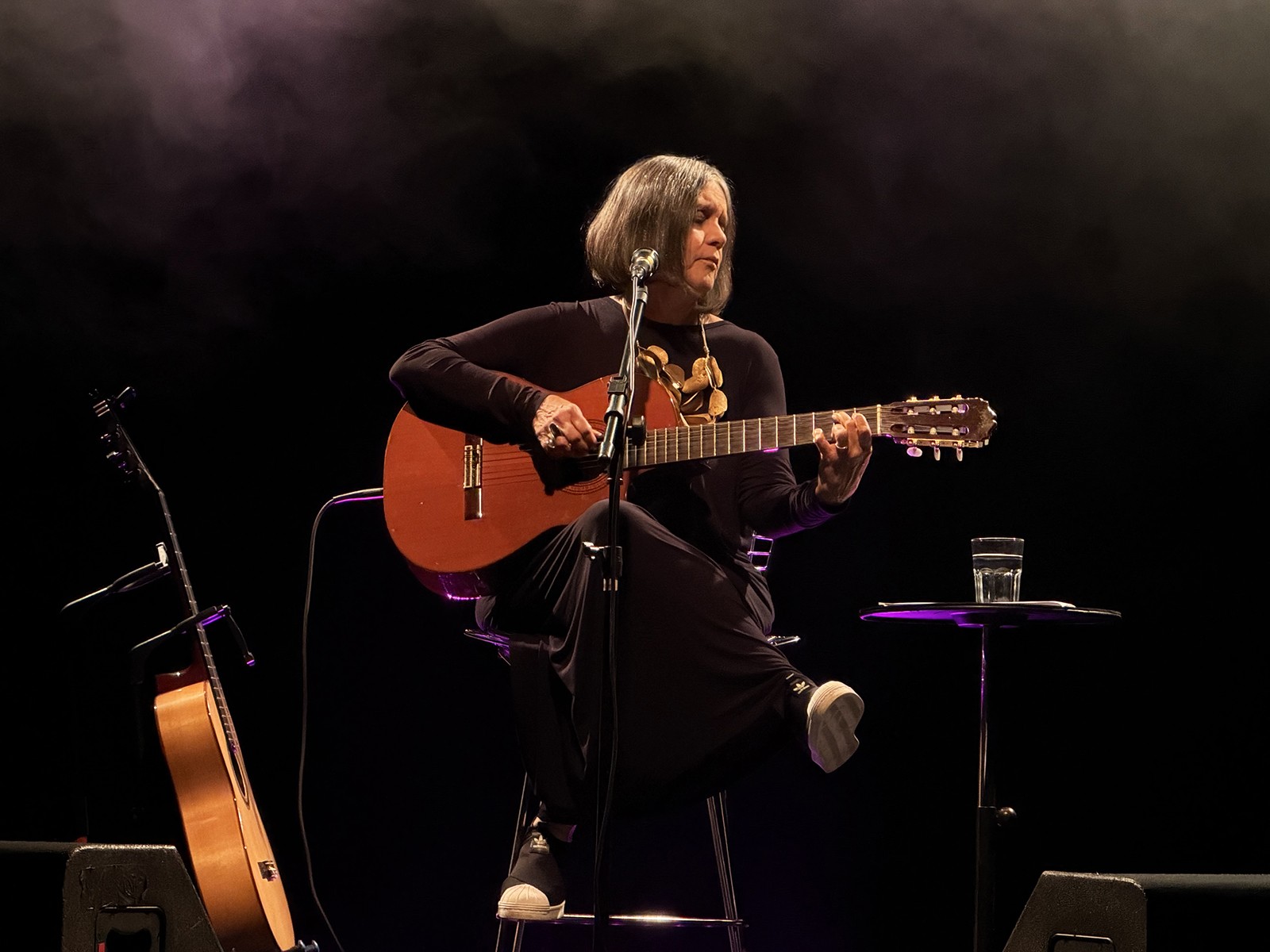
Joyce Moreno presents the show 'Passarinho urban' at Teatro Ipanema, in Rio de Janeiro (RJ), last night, Tuesday, June 3rd
Rodrigo Goffredo
♫ SHOW REVIEW
Title: Passarinho urban
Artist: Joyce Moreno
Date and place: June 3, 2026 at Teatro Ipanema (Rio de Janeiro, RJ)
Rating: ★ ★ ★ ★ ★
♬ Joyce Moreno took part in the high flight of "Passarinho urban", a show that landed at Teatro Ipanema last night, Tuesday, June 3, almost seven years after having premiered in October 2019 in the same city of Rio de Janeiro (RJ), birthplace of the singer, composer and guitarist carioca.
The decision was the same one taken by the artist in 1975 when, at the invitation of the Italian composer and producer Sergio Bardotti (1939 - 2007), Joyce recorded an album in Rome as a performer, covering songs by Brazilian composers censored for raising their voices against the dictatorship that had suffocated the country since 1964.
Entitled "Urban Passarinho", Joyce Moreno's Italian album was released in 1976 in a discreet, as the singer told the audience when she returned for the encore, in which she covered "We Want to Know" (Gilberto Gil, 1976) and sang the samba "Juízo Final" (Nelson Cavaquinho and Élcio Soares, 1973) a cappella, in the style of a prayer, accompanied by the choir of the public hoping for better days.
But the album "Passarinhourbano" became a cult over the last 50 years, was reissued on LP and generated the show performed by Joyce occasionally since 2019.
"Passarinhourbano" is a show of voice and guitar, and that is enough in the case of Joyce Moreno, an exceptional guitarist and singer with extreme tuning and musicality. Opened with the a capella singing of "Joia" (Caetano Veloso, 1975), yesterday's performance stood out as a moment of pure love for music, to quote a line from Caetano's song. Everything came together, from the insightful script - built with some thematic medleys - to the beautiful light of the show.
Joyce Moreno sings the samba 'Juízo final' in the form of a prayer at the end of the show 'Passarinhourban'
Rodrigo Goffredo
In an atmosphere of enchantment, Joyce Moreno showed that she mastered the rhythm naturally since, armed with the guitar whose touch was admired even by the sovereign Antonio Carlos Jobim (1927 - 1994), she fell into the samba "Defronta pro crime" (João Bosco and Aldir Blanc, 1974), triggering an urban flash of violence in the jungle of cities.
Then, the singer linked together three songs - "Pesadelo" (Maurício Tapajós and Paulo César Pinheiro, 1972), "Bodas" (Milton Nascimento and Ruy Guerra, 1973) and "Clube da Esquina" (Milton Nascimento, Lô Borges and Marcio Borges, 1970) - which sounded like songs of resistance in Brazil in the 1970s as they portrayed dark times of cannons and helpless sadness throughout the country.
If the samba-plot "Love for Nature" (Paulinho da Viola, 1975) - a pioneer in environmental activism - symbolized a breather, the sagacious medley that linked "Chora Doutor" (J. Campos, J. Piedade and Orlando Gazzaneo, 1958) - samba released by the singer Blecaute (1919 - 1983) - at "14 years old" (Paulinho da Viola, 1966) highlighted the inequality that opposes doctors and samba singers on the social scale.
Following on, "A História do samba" (Geraldo Figueiredo, 1976) - a song released by Joyce on the album "Passarinho Urban", a script theme that went beyond the LP's repertoire - had an onomatopoeic effect with the singing of the lines "Eu te cutuco, eu te poke, não poke / Eu te poke, não" simulating a soft drumming in Joyce's voice and in the chorus made by the audience at the artist's request.
If Carnival eases the pain of the people who come together and sing with desire, as highlighted by verses from the samba "Pede passa" (Sidney Miller, 1966), the "Ash Wednesday March" (Carlos Lyra and Vinicius de Moraes, 1962) restores the harsh reality in the day-to-day parade, as Joyce sang.
Joyce Moreno sings sambas by Chico Buarque, Paulinho da Viola and Nelson Cavaquinho in the show 'Passarinho urban'
Rodrigo Goffredo
In addition to the refined musicality of Joyce Moreno, what enhanced the presentation of the show "Passarinho urban" in the project "Terças no Ipanema" - orchestrated by curator Flávia Souza Lima to occupy the legendary Rio theater with shows - was the social and political script constructed with cunning and precision by the artist.
Whether in the feminine exaltation of the original samba "Mulheres do Brasil" (Joyce Moreno, 1988), or in the singing of "Querelas do Brasil" (Maurício Tapajós and Aldir Blanc, 1978), the artist wove a web in which, through samba, she touched on national wounds and ills without creating a pamphlet. The lyrics of the songs spoke by Joyce Moreno.
If the baião "Minha História" (João do Vale and Raimundo Evangelista, 1965) pointed out the lack of study as an obstacle to the social mobility of the poor classes, the samba "Favela" (Padeirinho da Mangueira and Jorginho Pessanha, 1966) highlighted the creation of communities in the face of urban housing imbalances, the subject of the following samba, "Saudosa maloca" (Adoniran Barbosa, 1955) in yet another example of the script's ingenious architecture.
With the right to jab at candidates for federal scoundrels, the samba "Homagem ao malandro" (Chico Buarque, 1978) followed a trail that led the singer and guitarist to another samba that speaks in Central do Brasil, "O trem delayu" (Arthur Vilarinho, Estanislau Silva and Francisco da Silva Fárrea Júnior, o Paquito, 1941), released by singer Roberto Paiva (1921 - 2014) and revived in 1965 in the tuned voice of Nara Leão (1942 - 1989).
And here it is worth highlighting that some songs collected by Joyce Moreno for the (flexible) script of the show "Passarinhourbano" in yesterday's performance - "Opinião" (Zé Kétti, 1964), "Pede passage", "Minha História", "Marcha da Wednesday de Ashes" and "Favela", in addition to the aforementioned samba "O trem delayu" - were part of Nara Leão's activist repertoire between 1964 and 1966, years of resistance in which Nara took the same side as Joyce Moreno in the fight for democracy and social justice.
As Brazil is still a land of injustice, far from fulfilling the ideal envisioned by Chico Buarque and Ruy Guerra in the verse of "Fado tropical" (1973), a song from the 50th anniversary album of 1976 that echoed in yesterday's performance, Joyce Moreno once again took this side in the high musical and poetic flight of the show "Passarinho urban" in a moment of pure love for MPB and the Brazilian people.
Joyce Moreno follows the script ingenious in which the chain of songs underlines the political tone of the show 'Passarinhourbano'
Rodrigo Goffredo
Source: G1