Italian hospital tests robot that talks to patients and helps healthcare teams
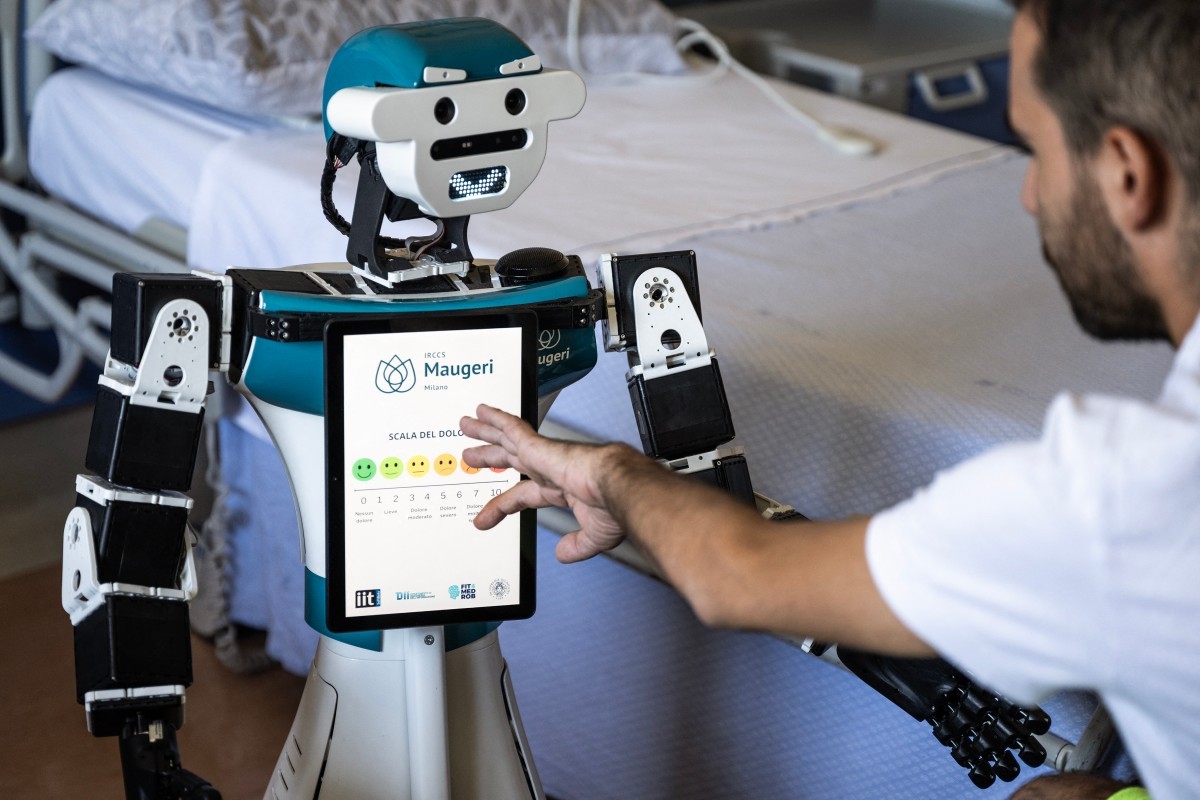
Patient can indicate their level of pain using a scale with the help of the Alter-Ego robot
MARCO BERTORELLO / AFP
A robot with expressive eyebrows and capable of interacting with patients is being tested in a hospital in Milan.
The expectation is that it will help reduce the workload of healthcare staff by performing basic but essential tasks.
Do you have any suggestions for a report? Send it to g1
Named "Alter-Ego", the 1.2 meter robot can perform functions ranging from representing a doctor in remote care to bringing a bottle of water to a patient or accompanying him to a treatment room.
At Maugeri hospital, in Milan, Daniel Senna, 31, records his level of pain on a screen installed on the robot's chest.
Robot uses AI and wins table tennis match against athletes professionals
"Hello, Dani. How are you? Do you need anything?", Ego asks Senna, who uses a wheelchair. At the same time, the collected data is immediately sent to the sector's nursing team.
The robot has been tested since April in a department specializing in the care of people with amyotrophic lateral sclerosis (ALS), a neurodegenerative disease.
"In the beginning, we were afraid that patients would react negatively," Christian Lunetta, director of the institution's neuromotor rehabilitation department, explained to AFP.
But they were soon "very satisfied, because the robot was designed to arouse curiosity, and its movements - or at least its functions - indicate a wide variety of possible uses."
Lighten the load
The Alter-Ego humanoid robot, designed by the Italian Institute of Technology
MARCO BERTORELLO / AFP
The project is the result of a partnership between the Italian Institute of Technology and the University of Pisa, in the north of the country.
For now, the robot is controlled remotely by an operator. From July, however, it will begin to operate autonomously.
The advancement of artificial intelligence has accelerated the development of robotics, but these machines still need to go through a long training phase before operating without supervision.
According to Manuel Catalano, from the Italian Institute of Technology, the objective of the experiment in Milan is to work together with patients and caregivers to better understand the limits of what a robot can or should do within a hospital.
Catalano added that, in the future, the "Alter-Ego" will also be able to help patients and caregivers in their own homes.
Regarding hospitals, Lunetta noted that these institutions "have a lot of repetitive tasks" that "could be delegated to a good robot."
"This would also allow us to value human work more, dedicating more time to relationships with patients," she added.
"Although 'Alter-Ego' seems very capable, no one considered directly delegating medication administration to it," noted the neurologist Rachele Piras.
Still, it can be useful. Patients may feel more comfortable placing orders directly with the robot, which would also help reduce caregivers' workload.
The Alter-Ego humanoid robot, designed by the Italian Institute of Technology, greets a patient at the IRCSS Maugeri hospital in Milan
MARCO BERTORELLO / AFP
Source: G1