Israeli army attacks Beirut suburbs amid expectations of peace agreement between US and Iran
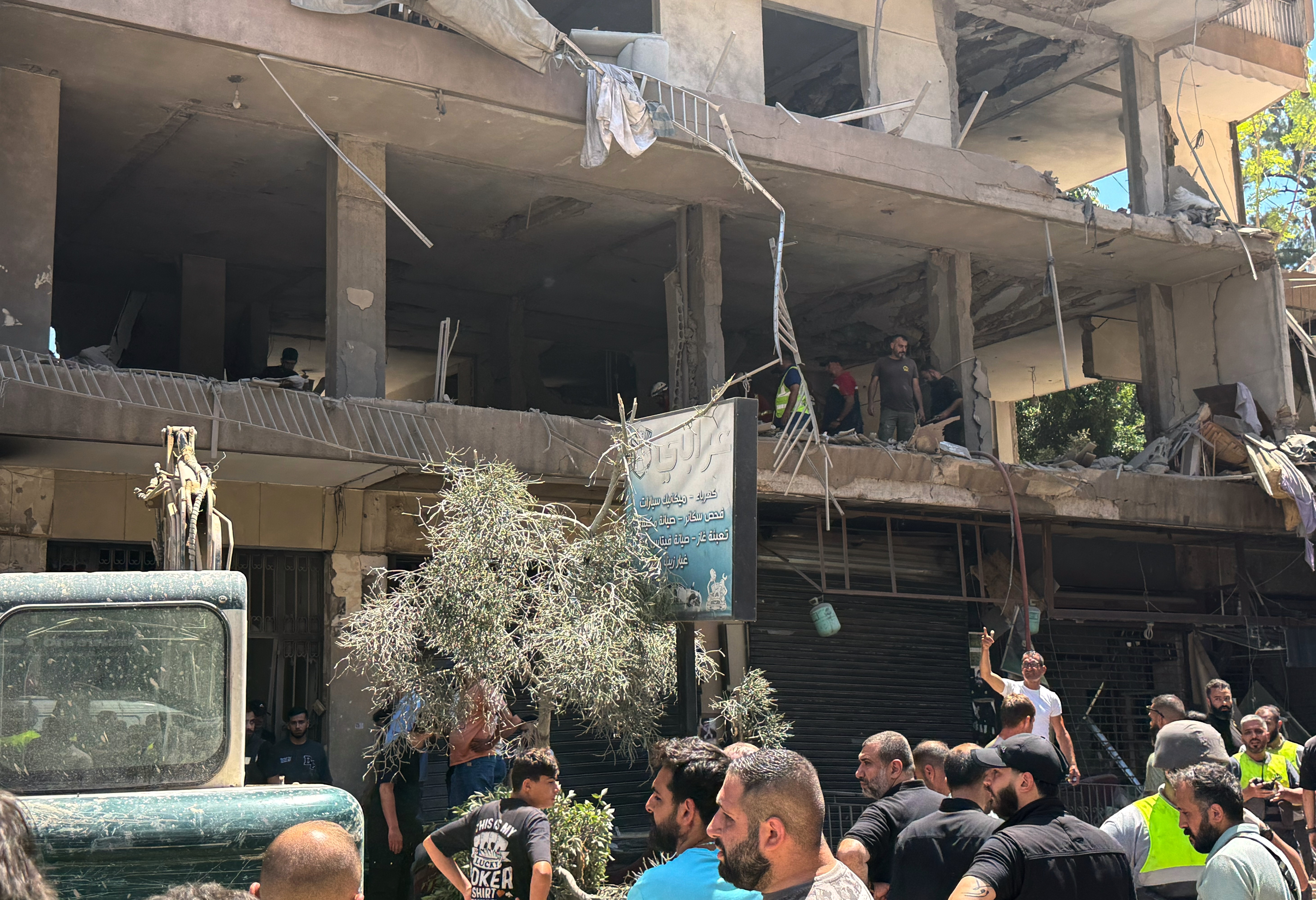
People gather at the site of an Israeli airstrike that hit an apartment in Dahiyeh, in the southern suburbs of Beirut, Lebanon, Sunday, June 14, 2026.
AP Photo/Bilal Hussein
The Israeli army said it had launched attacks on Beirut this Sunday (14), targeting Hezbollah infrastructure, despite continued efforts to negotiate an end to the war between the US and Iran. It was possible to see smoke rising over the Lebanese capital.
Favorite g1 on Google and follow the main news of the day
The office of Israeli Prime Minister Benjamin Netanyahu said that the attacks were a response to Hezbollah's attacks on northern Israel. Earlier, the Israeli military had declared that the group launched three projectiles into the region, releasing images in which an explosion was heard followed by a column of smoke.
Israel's last attack on the suburbs of Beirut had taken place a week ago, triggering the most serious escalation of fighting since the beginning of the fragile ceasefire on April 7. Iran retaliated by attacking Israel, and the Israeli government responded with new attacks on Iranian territory the following day.
Since this exchange of aggression, the US and Iran have moved towards an agreement. In its current form, the text represents a deep disappointment for the Israeli government, which was marginalized in negotiations led by Pakistan and other countries. Iran demands that the ceasefire pact include fighting in Lebanon, in addition to seeking the release of billions of dollars in frozen funds.
Hezbollah fired missiles at Israel on March 2, two days after the US and Israel attacked Iran, starting the war in the Middle East. Israeli troops have deepened their invasion of Lebanon to a level not seen in more than a quarter of a century.
Now on g1
Mediators bring Iran and US closer to a deal
Qatar mediators traveled to Tehran on Sunday to finalize the deal, according to two regional officials.
The sources, who spoke on condition of anonymity because they were not authorized to speak to the press, expressed cautious optimism that the US and Iran are finally close to an understanding that could halt hostilities - which have already left thousands dead - and reopen the Strait of Hormuz, whose closure has destabilized world markets.
US President Donald Trump and Pakistani Prime Minister Shehbaz Sharif said on Saturday that the agreement would be signed on Sunday, while Iranian Foreign Ministry spokesman Esmail Baghaei stated that this could happen in the coming days. Trump stated that the Strait of Hormuz will be opened immediately after signing.
The document is expected to be signed electronically, without an in-person presidential ceremony, although it is not yet clear when or how the formal act will take place.
Donald Trump says that agreement with Iran will be signed on Sunday (14)
Reproduction/Social media
Nuclear issues and other pending points
The agreement does not resolve the most complex issues between the US and Iran, including Iran's nuclear program or the frozen assets, but offers a 60-day framework for technical discussions on these topics.
The information comes from Pakistani and regional officials familiar with the ongoing negotiations, who spoke on condition of anonymity due to lack of public authorization. The representatives described Pakistan's months-long effort to lead the negotiations, fighting to prevent both sides from abandoning the meetings and the dialogue from collapsing entirely on several occasions.
Under the current terms under discussion, the US and Israel appear to have failed to achieve their original goals of destroying Iran's nuclear and missile programs, as well as ending Tehran's support for allied groups (proxies). It is unclear how the agreement will address these points or whether they will be part of the final text.
Critics within Trump's own Republican Party, which is facing the strain of an unpopular war ahead of the midterm elections, have criticized the pact.
A
Some have said the proposal does not improve the terms of the 2015 Iran nuclear deal, which Trump withdrew the US from during his first term and which he still describes as "bad."
Meanwhile, Trump is expected to discuss demining the Strait of Hormuz during the G7 summit, which begins this Monday. The sea route is crucial for the global flow of oil, natural gas and derivative products such as fertilizers, and its practical closure has shaken the world economy.
Iran's nuclear program and highly enriched uranium have long been at the center of tensions with the US and Israel, posing an international concern.
On social media, Trump stated that "when everything is calm", the US would act to "dilute and destroy" the enriched uranium, whether in Iran or the US.
From According to the International Atomic Energy Agency (IAEA), Iran possesses 440.9 kilograms of uranium enriched to 60% purity, a technical step short of the 90% level needed for nuclear weapons.
Iran has maintained for years that its nuclear program is for strictly peaceful purposes and has not publicly committed to giving up the enriched uranium, which is believed to be stored beneath three underground nuclear facilities severely damaged by American strikes last year.
Source: G1