Iranians opposed to the regime protest outside the stadium in Los Angeles before the debut of Iran's national team
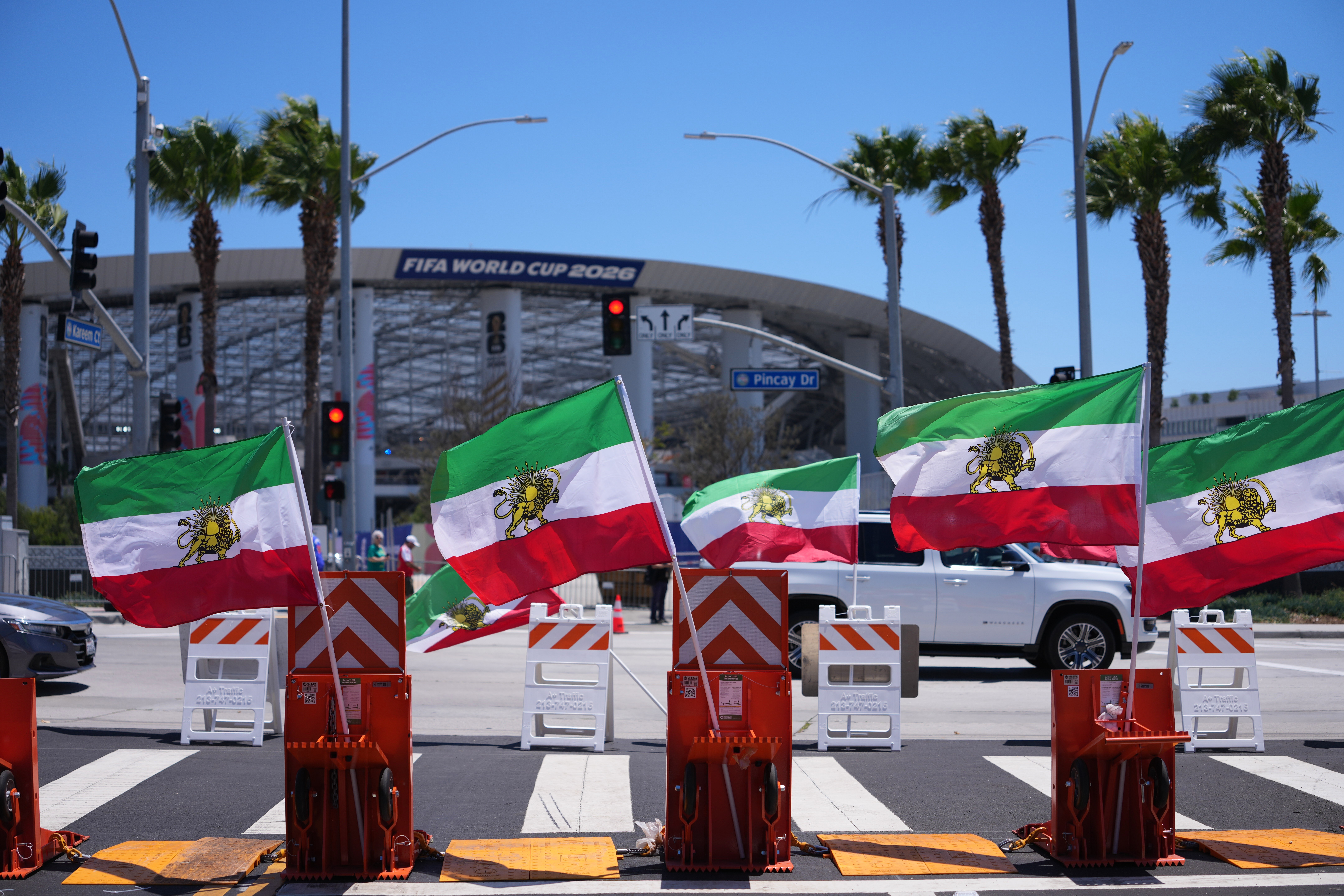
Flags of the Iranian monarchy are placed in front of the Los Angeles stadium shortly before the Iran team's debut at the 2026 World Cup, on June 15
Jae C. Hong/AP
Members of the Iranian-American community hold a protest this Monday (15) in front of the stadium where the Iran team makes its World Cup debut.
✅ Follow the g1 international news channel on WhatsApp
The protest was organized in front of the stadium near Los Angeles, home to the largest Iranian community outside of Iran. Many of Southern California's Iranian-Americans arrived in the region after the 1979 Islamic Revolution, and a hub of restaurants, shops and markets about 10 miles from the stadium is known as "Tehrangeles."
Drapped in red and green flags with a golden lion and sun, protesters gathered in front of the stadium where Iran will face New Zealand. A few hours before the start of the match, a Los Angeles judge confirmed FIFA's ban on the use of the pre-revolutionary flag in games, according to the newspaper "The Athletic".
Ella Bah, 42 years old, nevertheless wore the flag tied to her body like a dress before the match. She and other protesters took extra clothing to cover themselves before entering the stadium and planned to reveal themselves after entering, she said.
Amid peace deal announcement, Iran arrives in US under tight security
"We are not here to cheer for them," she told the Associated Press. "We are here to be the voice of the people inside Iran."
When football and geopolitics meet
Like Bah, some protesters said they had tickets to watch the game, while others did not. Rameileh Jaffrey, 46, of Los Angeles, said she wants a change in the government in Tehran to bring freedom to people living in the country she left a dozen years ago.
"They are not my team. They are a government team," she said. Still, she said she hopes Iran wins and plans to watch the team play later in the tournament.
Iran's participation in the tournament has been marked by conflict due to the country's war with American and Israeli forces.
Late on Sunday (14), President Donald Trump announced that the US had reached an agreement with Iran to end the war and open the Strait of Hormuz. The war started by the US and Israel on February 28 shook the region and practically paralyzed the supply of oil and natural gas to the Persian Gulf.
After the start of the war, the team transferred its training base from Tucson, Arizona, to Mexico, and some Iranian football officials were not granted visas to enter the United States. Many in the diaspora have mixed feelings about how to show their support for the Iranian people, rather than the government, through their passion for football.
"We play for all Iranians, whether they are in the diaspora or in Iran. People have different opinions, but we are here to unite people and we will try to bring joy to all Iranians, wherever they live," team captain Mehdi Taremi said at a press conference on Sunday. "We are here to bring joy to the Iranian people. We don't get involved in politics. We are here to play football."
Divided opinions
Reza Garajedaghi, 57, said he will watch the game with his 96-year-old father in San Diego. He said he did not buy tickets for the match, in part because of the exorbitant prices. But he supports the team, leaving politics aside, while respecting the wide range of opinions in the diaspora.
"I'm a football fanatic, and the boys represent all Persians, Iranians around the world," said Garajedaghi, who left Iran at age 10. "To me, this has nothing to do with the government they have in Iran."
Game parties are being planned to support the team, and when Iran was assigned to play in Los Angeles last year, many bought tickets.
But in recent months, some have said they sold their tickets in protest after January's brutal crackdown.
Some Iranian-American football fans have also said the team is involved in politics.
In the past, Iranian athletes have faced serious consequences for speaking out. In 2022, a former key national team player was arrested for allegedly protesting the country's leadership, and striker Sardar Azmoun was not called up for this year's World Cup, reportedly because of a social media post that angered authorities.
Iran coach Amir Ghalenoei called Azmoun an "excellent player" and said he would like to have him in the team.
"I am happy that they will come and watch us and I hope they will pray for us and encourage us," Ghalenoei said on Sunday when asked about the large Iranian diaspora. He added that he hoped the team would repay that loyalty with a good match.
The flag issue
Some Iranian-Americans are also unhappy with FIFA's rule banning the flying of political flags. They want to fly the lion and sun flag, used before the revolution, which is not the official flag of Iran.
The Iranian American Institute for Voices of Freedom filed a lawsuit last week to challenge FIFA's rule on the flag, but a Los Angeles Superior Court judge ruled on Monday that the ban could stand.
"There could be harm to about 2,500 employees who have to deal with security protocols," judge Curtis Kin said, according to The Athletic. "It's a huge burden to change a long-standing protocol for a major event in a matter of hours. It's difficult."
"To see how FIFA could make a change in one stadium and not the others."
Parsa Ezati, 21, and her mother took the official Iranian government flag to the protest so people could trample it. Many passersby took the opportunity to step over her, some scratching her further or spitting on her for a minute.
"She represents the ayatollahs who killed so many Iranians and massacred people of my generation," Ezati said. "FIFA only accepts this flag on the ground."
Source: G1