Iran says it attacked US targets as tensions in Hormuz test deal
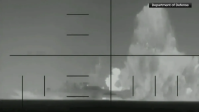
Iran says it has attacked US military targets in the Middle East region in response to US strikes in the Strait of Hormuz area, as tensions around the important waterway put a peace agreement between the two countries to the test.
Iran's Revolutionary Guard reported this Saturday (27) that it attacked US military positions, according to a report by Iranian state media Press TV, with the Ministry of Foreign Affairs accusing the US of violating the agreement.
The US military has not confirmed any attacks, but these exchanges are the first since the memorandum of understanding was signed last week.
CNN has reached out to the White House and CENTCOM for comment.
Bahrain, which hosts a US military base, reported Iranian drone strikes on its territory in the early hours of Saturday. The country's Foreign Ministry condemned the attacks as "a flagrant violation of Bahrain's sovereignty." The target was unclear and there was no initial comment from Tehran.
Meanwhile, an oil tanker in the Strait of Hormuz was hit on Saturday by an "unidentified projectile", according to the UKMTO (United Kingdom Maritime Trade Operations Organisation).
The vessel suffered damage, but all crew members were unharmed, said the UKMTO, which recommended that ships transit the area with caution.
These developments mark the latest episode in a series of reciprocal attacks concentrated in the strait, casting uncertainty over the agreement between the US and Iran signed earlier this month, which provides for the gradual restoration of normal maritime traffic.
The JMIC (Joint Maritime Information Center), overseen by the US Navy, raised the threat level in the strait to "substantial" on Saturday, a measure it said was taken following attacks on merchant ships.
Meanwhile, a route through the Strait of Hormuz near Oman has been widened to allow greater simultaneous passage of maritime traffic in both directions, JMIC reported, suggesting the US is resisting Iran's control over the waterway.
Iran's attacks on Saturday came after the US military carried out strikes on Friday against Iranian military targets around the Strait of Hormuz. "US aircraft attacked Iranian missile and drone storage sites, as well as coastal radar stations," CENTCOM reported. "The unjustified aggression against commercial shipping by Iranian forces clearly violated the ceasefire."
The escalation began with an Iranian attack on Thursday on a commercial ship near the Strait of Hormuz, which US President Donald Trump described as a "senseless violation" of the agreement to end the war with Iran.
USA x Iran: United States attacks Iranian targets in the Strait of Hormuz | H TIME
A US official downplayed the possibility of an escalation following the attacks, telling CNN that they do not reflect a return to full-scale combat operations, at least for now.
Vice President JD Vance - who played a leading role in negotiating the Iran deal announced last week - said Friday night that "violence will be met with violence."
The recent attacks have once again destabilized the Strait of Hormuz, one of the most important choke points for global shipping, amid a fragile memorandum of understanding signed by the US and Iran.
The memorandum stipulates that Iran will take "measures, using its best efforts", to ensure the safe passage of commercial vessels through the Strait of Hormuz, and that traffic in the strait returns to the same volume as before the start of the war. However, he did not establish detailed conditions for compliance with these terms.
The two sides presented divergent interpretations on whether Iran could charge fees to vessels passing through the strait. Trump insisted that the strait would remain toll-free, but Tehran maintained that it would have the right to charge vessels that pass through it.
Understand what the United States wants in Iran
Source: CNN