'I knelt down and asked God to give me water': how irrigation transformed 'the corridor of misery' in Goiás into a fruit hub
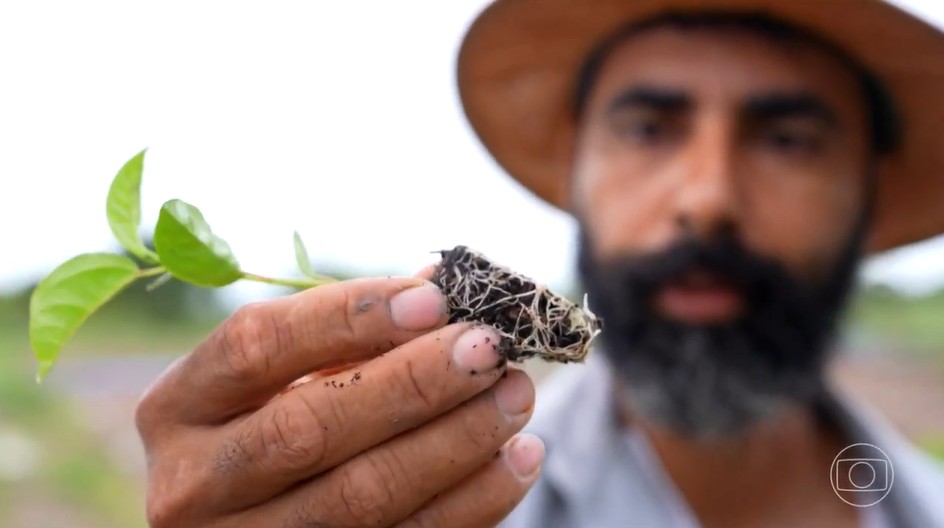
How water is transforming the old "corridor of misery" in Goiás
"I knelt down and asked God a lot to give me water."
The phrase from farmer Júlia Pereira de Andrade summarizes the reality that, for years, marked the lives of thousands of families in Vão do Paranã, in the northeast of GO. In an agrarian reform settlement in Flores de Goiás, she spent two years without water on her own property.
Do you have any suggestions for a report? Send it to g1
"We had to go out to get water to bathe and do domestic use. It was like that for two years. The moment I managed to drill this well, when I saw water inside my farm, for me it was the greatest good that God gave me", he says.
The water that was once lacking for the most basic needs today irrigates passion fruit and mango trees that guarantee income for the family. Júlia's story symbolizes the ongoing transformation in a region historically known as the "Corredor da Miséria", a nickname associated with high levels of poverty and frequent droughts.
With investments in irrigation, technical assistance and fruit growing, family farmers in Vão do Paranã are managing to produce throughout the year and change the economic reality of their properties.
Vão do Paranã, in the northeast of Goiás, previously known by many as the "corridor of misery", begins to reap the fruits of an investment which brings water and technology to small agrarian reform settlements.
Globo Rural
The project, developed by Embrapa and financed by the Companhia de Desenvolvimento dos Vales do São Francisco e do Parnaíba (Codevasf), already benefits 80 rural producers. The initiative received R$23 million in investments and aims to serve 250 families and irrigate 500 hectares in the region.
The change was possible thanks to a geographical characteristic of Vão do Paranã. Surrounded by Chapada dos Veadeiros and Serra Geral de Goiás, the region favors the accumulation of underground water, facilitating the drilling of artesian wells for irrigation.
"The producer now has a source of income throughout the year", explains Embrapa researcher José Carlos Sousa.
From the field to the refrigerator: why there is so much food waste, while millions go hungry in Brazil
'I didn't know arugula, parsley, kale': how agriculture changed lives in a Brazil's food desert
Living off the land
Before the arrival of irrigated fruit growing, Júlia's family's production was limited to small plots dedicated to their own consumption. Her husband, João, needed to seek income outside the property.
"I worked with a bulldozer on the people's farm", she remembers.
Today, the reality is different. The couple participates in the irrigated fruit growing project and grows passion fruit and mango on two hectares.
The model envisages one hectare of passion fruit, a crop that starts producing in around six months, guaranteeing a faster financial return. The other hectare is dedicated to mangoes, which take approximately four years to come into production, but can remain productive for decades.
On some properties, passion fruit productivity already reaches 30 tons per harvest, double the national average.
Money in your pocket and young people in the field
The financial results began to appear quickly. Júlia claims that she earned around R$15,000 in just two months by selling passion fruit and pumpkin grown on the property. The money helped cover household expenses and the financing used to establish the orchard.
In other properties, the income allowed investments in solar energy, household appliances and improvements in rural infrastructure.
The project has also helped to contain the rural exodus.
At the age of 19, Daniel Rodrigues, a graduate in agriculture, decided to remain on the family property after the implementation of the irrigated system.
"Now my focus is being able to plant more fruit trees for myself when I am older, not work so much and have an even better income", says.
The challenge of selling production
Despite advances, producers still face difficulties in selling the fruits.
Without fixed buyers, many depend on middlemen and live with price fluctuations and uncertainty in the sale of production.
To try to solve the problem, farmers in the region have created a cooperative and await the completion of an agro-industry financed by the state government.
The expectation is that, in the future, passion fruit and mango will be processed locally and transformed into pulp, adding value to production.
Expansion to other states
So far, the project has benefited 80 farmers, of which around 30 are already in the harvesting phase.
The expectation is to expand service to 250 producers and reach 500 irrigated hectares.
The model has already aroused interest in other regions of the country and should be replicated in rural communities in Bahia, Mato Grosso and Minas Gerais.
For farmers like Edgar Rodrigues, who today defines himself as a small rural entrepreneur, the future looks promising.
"I dream big", he says. "I'm still going to see these mangoes being sold to the United States and wherever else is needed."
A region historically marked by drought and low levels of human development is undergoing a profound transformation through irrigated fruit growing.
Vão do Paranã, in the northeast of Goiás, previously known by many as the "corridor of misery", begins to reap the fruits of an investment that brings water and technology to small agrarian reform settlements.
Water: the watershed
For producers like Dona Júlia, the arrival of water was a blessing. Ten years ago, she lived in a wooden shack and needed to get water outside to meet her basic needs.
"Water is everything, water is life", she says, and today she sees her farm produce tons of fruit after the drilling of an artesian well.
The region favors the accumulation of underground water due to the relief formed by the Chapada dos Veadeiros and the Serra Geral de Goiás, which facilitates the opening of wells for irrigation. This resource allows producers to have income throughout the year, overcoming the rigorous dry season in the Cerrado.
The production model
The project counts on an investment of R$ 23 million from Codevasf and a technical model developed by Embrapa.
Each selected farmer receives an irrigation kit and technical assistance to cultivate two hectares:
One hectare of passion fruit: a short-cycle crop that starts producing in six months, guaranteeing faster income.
One hectare of mango: long-term project, which should start producing in four years, functioning as a kind of "retirement" for the producer.
Productivity has been impressive. On some properties, the passion fruit harvest reaches 30 tons per harvest, double the national average.
Economic and social impact
The financial success is already visible. Dona Júlia reports having earned around R$15,000 in just two months from the sale of passion fruit and pumpkins.
The money has been used to pay for the project's financing and improve the family's quality of life, with the purchase of household appliances and solar energy panels.
In addition to the financial aspect, the project has helped to combat rural exodus.
Daniel, 19 years old and with a degree in agriculture, decided to stay on his family's land to apply the knowledge he acquired and new technologies.
For others, like Seu João, fruit growing allowed him to abandon temporary work on distant farms and start working on his own property.
Logistic challenges and cooperativism
Despite the optimism, producers still face bottlenecks, especially in marketing. Without a fixed buyer, many depend on middlemen, which reduces profitability and creates uncertainty about the final price.
To face this challenge, the creation of a cooperative and the construction of an agroindustry by the state government is underway.
The expectation is that passion fruit and mangoes will be processed on site, transformed into pulp and sold with greater added value.
Expansion
Currently, the project benefits 80 producers, but the target is is to reach 250 families and 500 irrigated hectares.
Due to the success of the initiative in Goiás, the model already has agreements to be replicated in rural communities in Bahia, Mato Grosso and Minas Gerais.
For farmers like Seu Edgar, who today feels like a "small businessman", the future is promising.
"We dream big", he says, hoping to see his mangoes conquering the international market in the coming years.
From the corridor of poverty to fruit growing hub: irrigation transforms lives of farmers in Vão do Paranã, in Goiás
Reproduction Globo Rural
Source: G1