How to deal with professional frustration: what athletes outside the World Cup teach about disappointment
How to deal with professional frustration: what athletes outside the World Cup teach about the topic
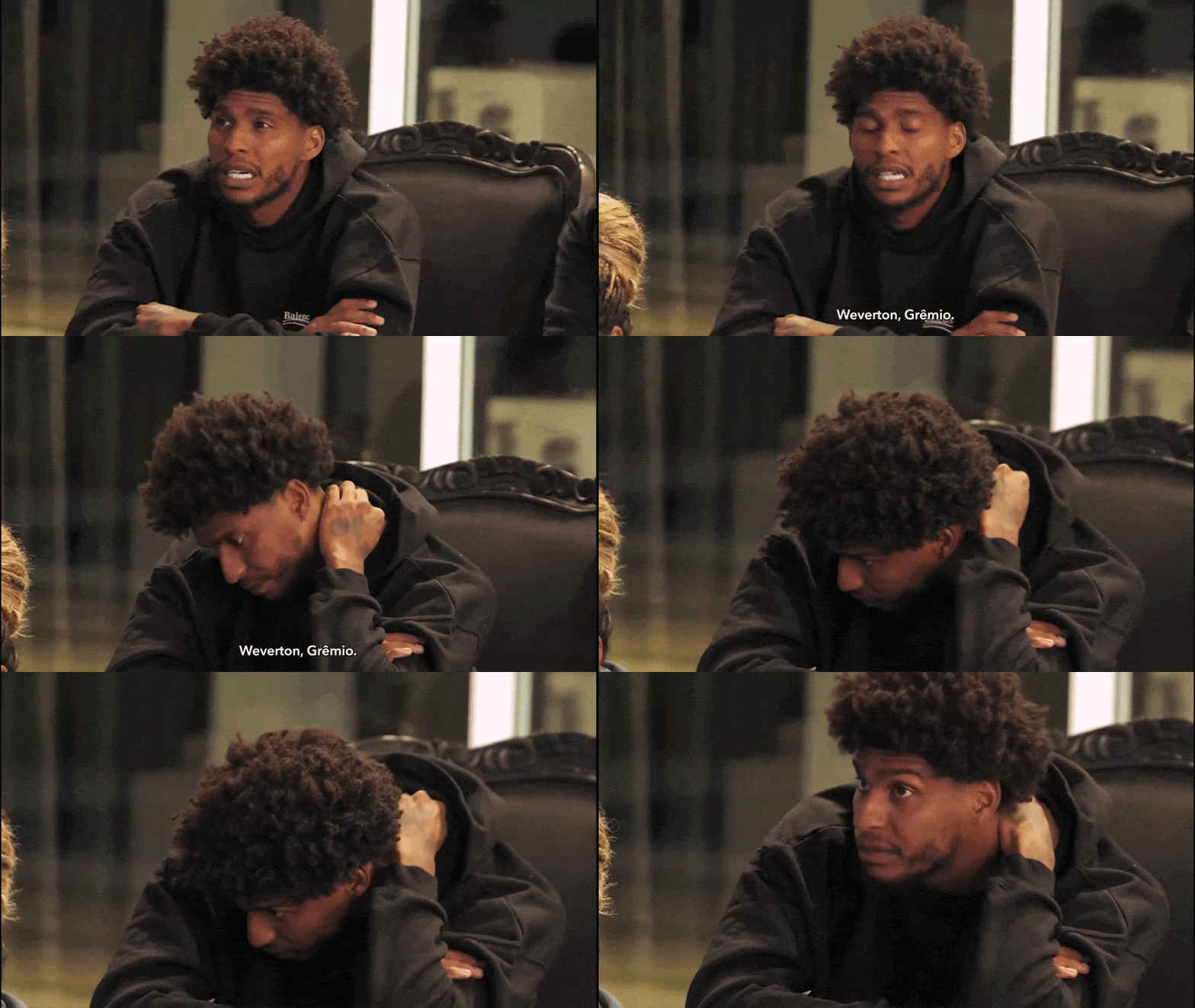
Hours before the official call-up of the Brazilian team for the 2026 World Cup, goalkeeper Hugo Souza appeared in front of the camera on his own YouTube channel trying to control his anxiety. Surrounded by friends and family, he followed the list announced by Carlo Ancelotti live.
In recent months, Hugo had been frequently called up by the Italian coach and was going through one of the most consistent phases of his career.
Then, the names began to be announced: Alisson, Ederson and Weverton. And not his.
Do you have any suggestions for a story? Send it to g1
The repercussion was immediate. What was seen there was the reaction of someone realizing that one of the biggest goals of their career would not come true.
This feeling was also experienced recently by right-back Wesley, who saw his dream of the first World Cup end before it even started. Called up for the tournament, he suffered an injury in the Seleção's last friendly, against Egypt, and ended up being cut from the competition
On social media, he stated that he faced the moment "with his head held high" and that he would come back even stronger.
The two cases illustrate different forms of the same experience: dealing with frustration when a long-awaited professional goal gets in the way. It's no wonder that stories like these arouse so much identification.
Goalkeeper Hugo Souza was left out of the squad for the 2026 World Cup
GIF/ Hugo Souza
According to experts interviewed by g1, this happens because the situations experienced by Hugo and Wesley are in dialogue with experiences that happen daily off the pitch.
They are repeated when a professional waits for a promotion that doesn't come. When someone spends months in a selection process and receives a rejection. When years of preparation seem insufficient in the face of a rejection that is difficult to explain rationally.
In sport, however, this type of frustration usually occurs in front of millions of people.
How to deal with professional frustration?
While the public follows those who secured a place in the Brazilian team, there is also another side to the call: that of athletes who need to emotionally reorganize their own trajectory after being left out of the most important competition of their career.
This reorganization is not simple. Mainly because, both in sport and in the corporate environment, performance and identity often end up being confused, experts explain.
USP researcher Gustavo Drago, who has worked on planning and monitoring the preparation of delegations that competed in the Olympic Games in Beijing, London and Rio de Janeiro, states that one of the issues that most caught his attention throughout his career was realizing how people subjected to the same pressures can react in completely different ways.
♀ According to him, studies show that some athletes, in away games, interpreted the adverse environment as a threat. The pressure from the fans, the provocations and the feeling of hostility were accompanied by relevant physiological changes, such as an increase in cortisol, insecurity and more hesitant behavior on the field. Others, however, saw that environment as stimulating and presented physical responses linked to competitiveness, greater intensity and more correct decisions.
This process helps to understand why professional rejections affect people so differently, explains Drago. In the researcher's assessment, suffering does not only arise from the negative itself, but also from the interpretation that each person constructs about it.
When an athlete is left out of an important call-up, or when a professional loses a long-awaited promotion, the feeling often goes beyond specific frustration. In many cases, it directly affects self-esteem, identity and the perception of personal value.
According to Drago, this happens because many people build their own identity around performance. A career is no longer just a dimension of life and starts to function as a measure of recognition, competence and belonging.
When the expected result does not materialize, there is a risk that the person will stop seeing the situation as a specific episode and start to interpret it as a permanent definition about themselves.
In the researcher's assessment, this is precisely where the difference between a healthy frustration and a destructive one lies.
The first causes pain, but still allows learning, adaptation and continuity.
The second transforms rejection into a narrative of incapacity.
"The problem begins when a person stops seeing rejection as an episode and starts seeing it as a definition of personal value", says Drago.
Athletes learn to reorganize themselves after defeats, while in the corporate world there is an unrealistic demand for continuous linear growth.
Pexels
High performance market
The discussion gains even more complexity in a job market increasingly guided by the logic of high performance. Many corporate environments have started to reproduce a dynamic similar to that of high-performance sports, marked by continuous demands, pressure for results and constant demands.
The difference, says Drago, is that sport tends to offer emotional support and recovery structures that rarely exist to the same extent within companies.
♂ While athletes rely on psychological support, load control, rest periods and mental preparation, many workers simply live with the permanent demand for productivity.
According to the researcher, the human brain tends to work better when the challenge is accompanied by a minimum of psychological security. When the fear of making mistakes becomes permanent, the mind goes into self-protection mode, which can reduce spontaneity, creativity and decision-making capacity.
"The constant fear of failing makes the brain go into self-protection mode."
In sport, according to Drago, an athlete who is excessively concerned about not failing may hesitate in decisive moments. In the corporate environment, this usually manifests itself as extreme perfectionism, procrastination, constant insecurity and difficulty in innovating.
For the Audit partner at CLA Brasil, Thiago Brehmer, the emotional intensity of these rejections is also directly linked to the investment made along the way.
According to him, both in sport and in companies there is an accumulation of expectations, dedication and effort around certain objectives. When they don't materialize, many people feel not only frustration, but also a kind of symbolic devaluation of the journey itself.
Brehmer believes that sport offers an important lesson about emotional reconstruction, as athletes learn from an early age that defeats, cuts and refusals are part of the competitive process.
Remaining paralyzed by frustration can compromise the continuity of your career, highlights the expert. Therefore, they develop the capacity for emotional reorganization, route adjustment and resumption of preparation.
"Unearned promotions, rejected projects or lost vacancies do not need to be interpreted as definitive failures, but as part of a continuous process of development and repositioning."
In the corporate environment, however, this relationship with failure tends to be more difficult. There is a silent expectation of linear growth, as if successful careers were built without interruptions, refusals or loss of space.
According to Brehmer, frustration stops being healthy when it starts to continuously affect motivation, self-esteem and daily functioning.
♀ The constant pressure for performance also highlights how discussions about emotional recovery still face resistance within companies, according to experts.
Drago states that, in high-performance sports, rest is not seen as a waste of time, but as a strategic part of performance. No athlete sustains maximum intensity without adequate physical and mental recovery.
In the corporate environment, however, a culture still persists that associates commitment with hyper-availability, excessive hours worked and continuous productivity.
For the researcher, this creates an increasingly evident paradox: companies demand creativity, emotional clarity, innovation and quick decisions from professionals subjected to constant levels of exhaustion.
The result, according to him, is increased anxiety, burnout, insomnia, emotional exhaustion and loss of quality of life.
"There is no high performance in the presence of chronic exhaustion (...) emotional sustainability should be understood as a performance strategy, and not as a secondary benefit."
Brehmer agrees and argues that organizations capable of balancing demands for results with emotional security tend to form teams that are more resilient and prepared to deal with pressure.
"Sport shows that recovery is not an unproductive pause, but a strategic part of consistency (...) organizations that understand this tend to form teams that are more resilient, innovative and less vulnerable to burnout", he concludes.
Muscular edema should keep Neymar out until the World Cup; understand what it is
Source: G1