How much does it cost to watch the World Cup? Fans count how much they are spending
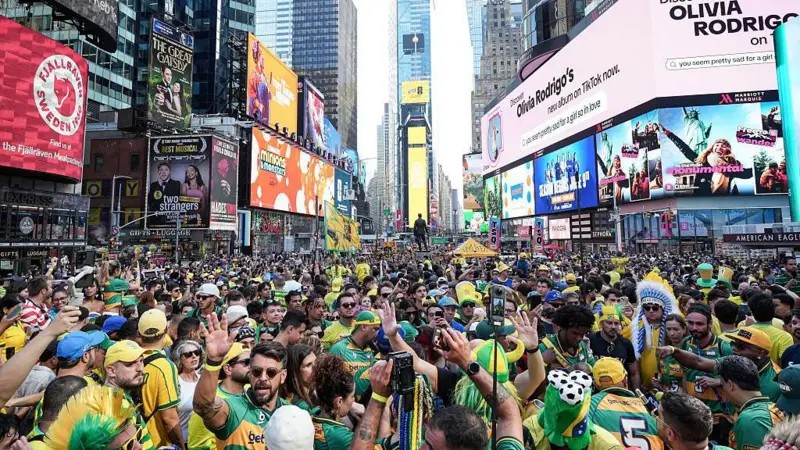
Brazilian fans gathered in Times Square, in New York, before the team's debut against Morocco (1-1), on June 13
Getty Images
For many fans, attending a World Cup is a once-in-a-lifetime opportunity, which is priceless. But, if you calculate the costs of the undertaking, it makes you cry.
Tickets for the games, flights, hotels, the journey to the stadiums, the cost of a drink during the game... the costs are adding up without stopping.
A few days after the start of the tournament, fans in Mexico, Canada and the United States told the BBC how much they have already spent during the 2026 FIFA Men's Football World Cup.
Now on g1
Norwegian in the USA spends R$20,000 for just one game
Morten Oftedal takes the expression "once in a lifetime" seriously.
Norwegian who lives in Atlanta, in the American state of Georgia, he knows that this would probably be the only chance to take his 82-year-old father to see his country's team play in the World Cup. After all, Norway qualified for the tournament for the first time since 1998, in France.
"I've been a big football fan since childhood, mainly thanks to my father", Oftedal tells the BBC. "I can't say 'no, let's go next time or somewhere else.' of fidelity. A single hotel room for two nights exceeded US$1,100 (R$5,600). And transportation to the stadium, round trip, cost US$80 (around R$407) per person.
In total, Oftedal spent around US$4,000 (R$20,300), including money and points, for him, his father and his wife to watch a match. He describes the value as "insane".
"It's really not for individuals, it seems like it's for corporate America", declared Oftedal, regarding the 2026 tournament.
Morten Oftedal spent the equivalent of around R$20,000 to take his 82-year-old father and his wife to watch the Norway 4-1 Iraq game, in Boston, in the United States
Getty Images
Several people told the BBC that the cost of watching to the tournament reached a few thousand dollars. But they say their love of football and the memories they hoped to create on the occasion helped them open their wallets.
"I paid around US$1,200 [R$6,100] per ticket, in category 2", says Briton Iain Bagwell, 58 years old. He lives in Atlanta and traveled with his son by car to see England vs. Croatia in Dallas, Texas.
"At the time of the purchase, I thought it was a broad daylight robbery. But seeing what's going on and the way FIFA is handling it, it probably wasn't such a bad deal."
Bagwell and his son camped along their trip to Dallas, for fun and to save money at the same time. And, after the game, they will drive to Kansas City to watch Tunisia vs. the Netherlands, for US$235 (about R$1,200) per ticket.
Many American fans are accustomed to the high cost of sporting events. The cheapest ticket to see the New York Knicks basketball team in the recent NBA Finals, at Madison Square Garden, cost around US$3,500 (R$17,800).
But the costs of watching the 2026 World Cup scared fans from other countries.
Iain Bagwell (right) and his son
Iain Bagwell
'Incredible' experience - but each ticket costs R$ 4.5 thousand
Alisa and Admir Maric admit that their trip to Toronto, Canada, was expensive. But it was worth it.
They went to watch the debut of their country's national team, Bosnia-Herzegovina, against Canada, a 1-1 draw on the second day of the World Cup.
"It's an incredible feeling, I never thought that one day I would go to a World Cup game," said Admir.
"I always wanted to have this experience."
They chose the tickets at the "last minute", according to Maric, paying 1,250 Canadian dollars (US$890, or around R$4,500) each, for seats in the third row. The hotel cost around US$600 (R$3,000) per night and the flights cost US$1,150 (around R$5,800) per person.
In total, the cost of the trip was around US$3,800 (R$19,300).
Aaron Vieyra and his partner, outside the Azteca Stadium
Aaron Vieyra
The sisters Aida and Emina Tucic, also fans of Bosnia and Herzegovina, didn't have to travel that far. They came from the city of Hamilton, near Toronto.
They knew they wanted to watch the match "the second" Bosnia qualified, says Aida.
"We were a little apprehensive because the ticket prices started to get, let's say, crazy," she says.
The sisters watched the prices for some time and bought their tickets three days before the game. They spent 1,200 Canadian dollars (about US$850, or R$4,300) each entry.
Emina has some tips for other visitors, such as checking local social networks for suggestions of cheaper places to eat in the region.
When asked if they thought the ticket prices were fair for the experience, Aida replied "probably not". For her, football "should be accessible to fans".
But she highlights that "for me, it's priceless".
"It's once in a lifetime", declared Emina. "The two countries you love, one where you grew up and one where you were born. Seeing them both playing on the world stage is incredible."
A ticket costs about three months' rent in Mexico
Watching an impromptu street game on the sidelines of Mexico City's Zona Rosa, among passersby and police, is perhaps the closest some Mexicans will get to sport this World Cup.
Ticket prices for the opening game (Mexico 2-0 Africa South) were far beyond the means of the majority of inhabitants of a country where around 30% of the population lives in poverty.
Outside the Azteca Stadium, last Friday (11), fans cited different amounts paid for the coveted tickets.
Few paid less than US$1,500 (around R$7,600) and some even spent US$4,000 (R$20,300) or more. Some lucky people received free tickets as a gift or in exchange for work.
"I paid 30 thousand pesos [US$ 1,750, approximately R$ 8.9 thousand] for each ticket", says Aaron Vieyra, from the organized fans of the Mexican team Fúria Azteca.
Vieyra bought the tickets for him and his girlfriend through a contact with good relations. He highlights that a single ticket was worth around three months' rent for many residents of Mexico City.
Vieyra accompanied the Mexican team in the 2014 World Cup, in Brazil, and 2018, in Russia. He claims that he spent more on one game in Mexico than on the sum of the matches he watched in other tournaments.
"The game itself was historic and we were very happy to be at Azteca for that moment", he says. "I still get goosebumps."
But was it worth the money? "It was worth it, but barely," he replies, without hesitation.
"For us, it worked because I didn't have to pay for flights or hotels. If we also needed to cover these costs, I wouldn't be able to pay all that money for a ticket."
The train ticket from Penn Station, in New York, to the NYNJ Stadium, the venue for Brazil's debut against Morocco, costs US$98 (around R$498).
Typically, the price is US$12.90 (R$66).
Adam Gray/Getty Images
R$81 for a beer at the New Jersey stadium
The price of food and drinks inside stadiums varies depending on the location, but they appear to be within the range that fans and music fans typically pay in American stadiums.
A survey by the website The Athletic found that fans are paying US$16 (about R$81) for a American beer (470 ml) at the New York-New Jersey (NYNJ) Stadium, where the World Cup final will be held, and US$5 (R$25.40) for a water (590 ml).
But, at the Mercedes-Benz Stadium in Atlanta, for example, you will pay just US$5 (about R$25.40) for a small beer (355 ml) and US$9 (R$45.80) for large (570 g). And water (590 ml) costs US$3. Normally, it costs US$12.90 (R$66).
The increase occurred so that local residents would not have to pay for transportation for fans, according to New Jersey Governor Mikie Sherrill. She also highlighted that FIFA is not contributing to transport costs, which reach US$48 million (around R$244 million).
At the same time, local authorities tried to negotiate with FIFA to reduce costs for ordinary fans.
The mayor of New York, Zohran Mamdani, negotiated with FIFA and guaranteed 1,000 tickets for local residents for US$50 (around R$254), which can be purchased by through a draw.
The Canadian province of Ontario approved the Fans First Law, to reduce resale prices. And Dallas offers free transport to and from the local stadium.
Headlines about ticket prices have dominated the tournament, but fans who spoke to the BBC remain enthusiastic about the World Cup and say the expense was worth it.
Oftedal, the Norwegian fan, said that creating memories with his father was the most important thing and that worries about money "disappear after a while".
Source: G1