How long can a person survive under the rubble after an earthquake?
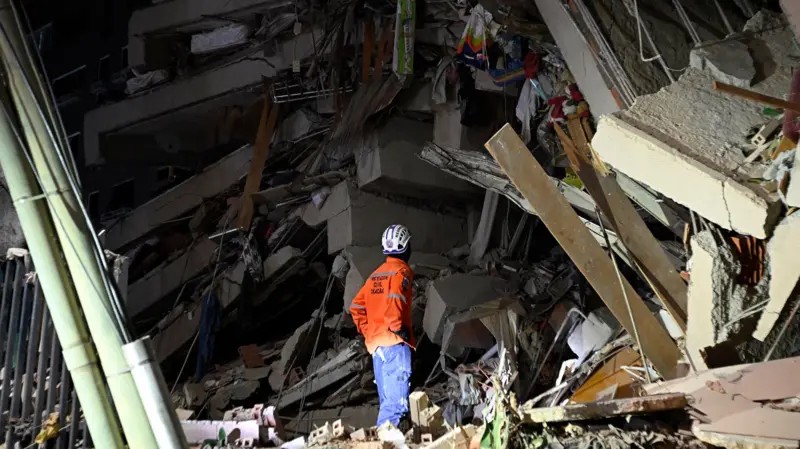
How long can a person survive under the rubble after an earthquake?
AFP/Getty Images via BBC
Eight days ago, on June 24, two earthquakes of magnitude 7.2 and 7.5 struck Venezuela just a minute apart. The second was the strongest to hit the country since 1900.
✅ Follow the g1 international news channel on WhatsApp
At least 250 buildings suffered serious damage, and many of them collapsed. International rescue teams have arrived in Venezuela to help search for survivors trapped under a huge amount of rubble.
But how long can a person survive trapped under rubble?
The answer depends on several factors, experts explained to the BBC. The position in which the victim was trapped after the collapse, access to air and water, climate, weather conditions and the person's physical state directly influence survival time.
Most rescues occur within the first 24 hours after a disaster. Still, there are cases of people pulled alive from the rubble many days later - such as a 3-year-old child rescued on Tuesday (30/6).
Now on g1
The United Nations usually ends search and rescue operations between five and seven days after a catastrophe. The decision is usually made when no person is found alive for one or two consecutive days after the disaster.
So, what are the factors that can keep victims alive until rescue arrives?
State of consciousness and preparedness
Access to air and water
Degree of injuries
Climate and weather conditions
Mental strength
Amazing stories of survival
State of consciousness and preparedness
Abdulalim Muaini was rescued of the rubble in Hatay province, Turkey, in 2023.
Reuters via BBC
Although it is not easy to predict when an earthquake or the sudden collapse of a building will occur, the position in which a person is after it happens is fundamental to increasing the chances of survival, according to experts.
Being in a more protected location can reduce the risk of injuries caused by the debris and increase the chances of access to air.
"Being able to adopt the position of 'duck, protect and hold on' can create a survival space, an air pocket", says Murat Harun Ongoren, coordinator of Akut (Turkish Search and Rescue Association), the largest civil society search and rescue organization in Turkey - a country that experiences thousands of earthquakes of different magnitudes each year.
Being prepared is key to survival.
Getty Images via BBC
Guidance from "Duck, take cover and hold on" consists of kneeling or crouching on the floor, taking shelter under a table or other sturdy furniture and staying in that position until the shaking stops. "This can determine your chances of surviving under the rubble."
Doctor Jetri Regmi, a technician with the World Health Organization (WHO) Health Emergencies Program, also highlights the importance of preparedness.
"Sheltering in a safe place, such as under a sturdy table or desk, increases the chances of survival. There are no guarantees, because each emergency is different, but the success of initial search and rescue operations depends on the preparedness of local communities," says.
Click here to return to the top.
Access to air and water
Access to air and water is essential to keeping a person alive when they are trapped under the rubble of a building.
However, the chances of survival also depend on the severity of the injuries: a large loss of blood, for example, significantly reduces the probability of surviving for more than 24 hours.
Therefore, if the victim has not suffered serious injuries and can breathe thanks to the existence of an air pocket, the next decisive factor is to stay hydrated, according to experts.
According to Professor Richard Edward Moon, a specialist in intensive care medicine at Duke University in the United States, "the lack of water and oxygen is one of the main challenges for survival."
"Every adult loses up to 1.2 liters of water per day", he explains.
"This loss occurs through urine, breathing, water vapor and sweat. When a person loses eight liters or more, their condition becomes critical."
Some estimates indicate that a human being can survive between three and seven days without water.
Air and water are essential for survival, according to experts.
Getty Images via BBC
Click here to return to the beginning.
Degree of injuries
If a person has suffered a head trauma or other serious injuries and is trapped in a place with little room to breathe, the chances of survival until the day after a disaster are reduced.
The ability to assess the severity of injuries is crucial, according to doctor Regmi.
"It is possible that people with spinal, head or chest injuries will not survive until they are transferred to trauma centers," she says.
Blood loss, fractures or lacerations to organs increase the risk of mortality.
Medical care after rescue is also equally important, according to Regmi.
"Even people who have been pulled from the rubble can die from crush syndrome. This often occurs in disasters such as earthquakes and affects people who are trapped under collapsed or moving structures."
Crush syndrome occurs when muscles are damaged by the pressure of debris and release toxins, according to the WHO technique. Once the debris is removed, these toxins spread throughout the body and can cause serious health consequences.
Click here to return to the top.
Climate and weather conditions
The climate of the region also determines how long victims can survive.
According to Professor Moon, winter conditions in Turkey, where two devastating earthquakes occurred in February 2023, significantly worsened the situation.
"An adult can generally withstand temperatures of up to 21°C without the body losing its ability to retain heat. But, when it gets colder, the situation changes", he says.
At this point, the body temperature starts to approach the ambient temperature.
"The speed at which hypothermia develops depends on how isolated the person is or the type of shelter available. However, ultimately, many of the victims in the most vulnerable situation end up developing hypothermia in these circumstances", explains the intensive care specialist.
In summer, on the other hand, if the space the victim is trapped in is too hot, they can quickly lose water, which reduces their chances of survival.
Click here to return to the top.
Mental well-being and self-control are key factors in survival.
Getty Images via BBC
Mental strength
According to experts, an often underestimated factor is mental well-being and self-control.
Maintaining mental strength and focusing thoughts on survival can also be crucial to remaining alive, they warn.
"Fear is our natural reaction, but we shouldn't panic. We need to be mentally strong to be able to survive," says rescue expert Ongoren.
This requires determination.
"It's important to try to avoid the feeling of fear and take control of yourself. 'It's okay, now I'm here, I need to find a way to stay alive' should be the motivation. This will make you scream less and move less.
It will be necessary to save energy by controlling the senses and panic."
Click here to return to the beginning.
Impressive stories of survival
In 1995, after an earthquake in South Korea, a man was rescued from the rubble after 10 days. According to reports, he survived by drinking rainwater and even eating a cardboard box. To keep his mind active, he was distracted with a children's toy.
In May 2013, a woman was removed from the rubble of a factory in Bangladesh, 17 days after the collapse.
"I heard the voices of rescuers for several days. I continued hitting the rubble with sticks and metal bars to attract attention. Nobody listened to me," she said after being rescued.
"I ate dry food for 15 days. In the last two days, I have ingested nothing but water."
In Haiti, after the January 2010 earthquake - which left more than 220,000 people dead - a man survived for 12 days under the rubble of a store that had been looted. Later, another man was found alive after remaining 27 days among the rubble of the earthquake.
In October 2005, two months after the earthquake that hit Kashmir, Pakistan, a woman from 40-year-old named Naqsha Bibi was rescued from her kitchen.
She was found with muscle stiffness and so weak that she could barely speak. In an interview with the BBC in 2005, her cousin said: "At first we thought she was dead, but she opened her eyes when we pulled her out of the rubble."
Click here to go back to the top.
Source: G1