How Leonard Cohen's Maximum Melancholy of the 1990s Reflected the Dark Mood of the Time
The beginning of the 1990s in the United States was marked by a turbulent political and social scenario, which found a unique artistic expression in the work of singer and songwriter Leonard Cohen. In 1992, as the country watched the election of Bill Clinton, a president who symbolized a new progressive hope after more than a decade of Republican rule, the reality was much more complex and bleak. The initial euphoria was deeply shaken by events such as the riots in Los Angeles, triggered by the not guilty verdict for the white police officers filmed attacking the African-American driver Rodney King, and by an economic recession that heralded difficult times.
In this context, American music reflected an identity crisis and a sense of disillusionment. The gangsta rap of Los Angeles and New York, as well as the anguished rock of Seattle, captured the spirit of a society trying to put itself back together after the excesses of the 1980s. Leonard Cohen, who had already revived his career with the album "I'm Your Man" in 1988, felt particularly inspired by this chaotic environment, especially living in Los Angeles, where he witnessed natural disasters and social conflicts up close.
Known since the 1960s as a "prince of darkness" of folk music, Cohen was often asked to "cheer up" by friends and fans, advice he always rejected, stating in 1992 that this was an inappropriate greeting for someone who already lived with a profound, realistic view of human existence. For Cohen, facing the darkness was a way of maintaining emotional balance, allowing him to observe the world from a distance that avoided both despair and naive optimism.
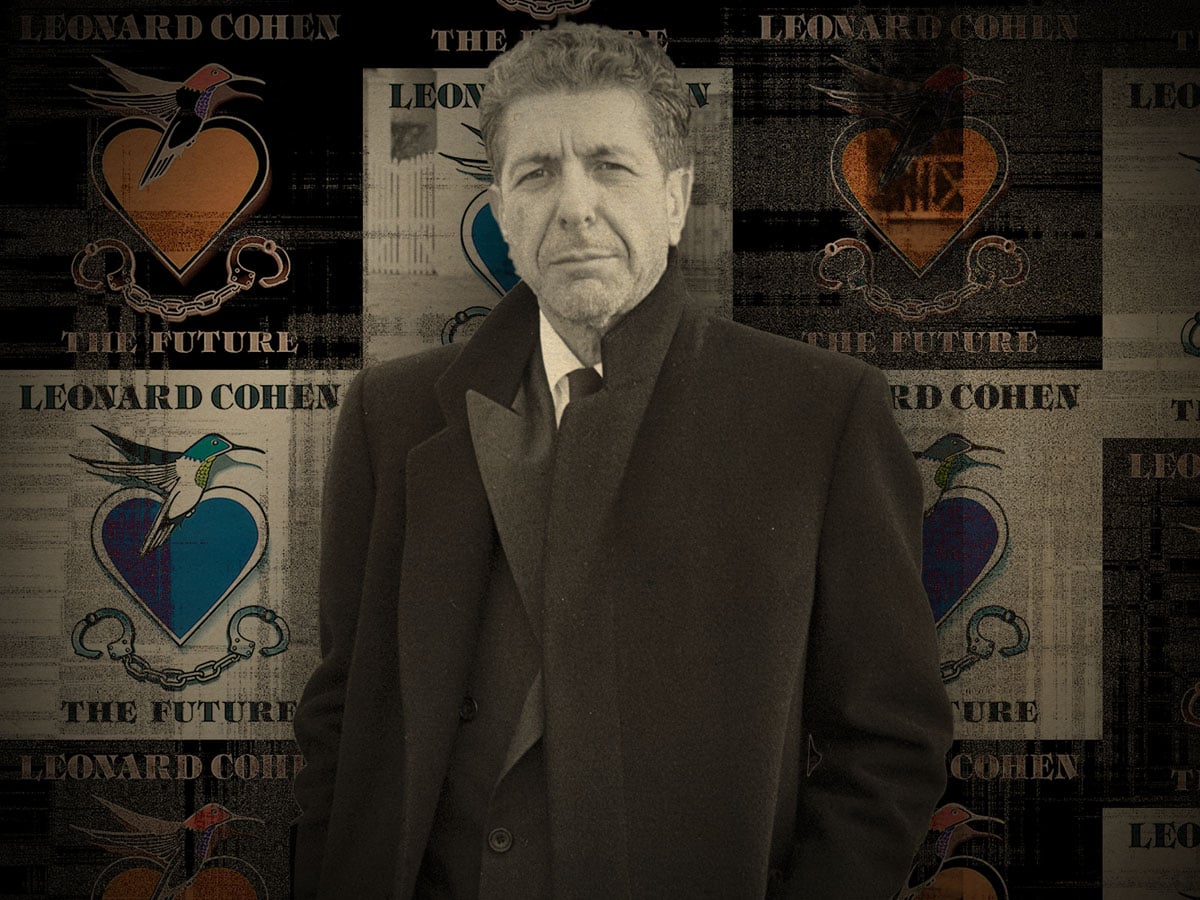
On November 24, 1992, just weeks after Clinton's election, Cohen released his ninth studio album, "The Future." This work, one of the most extensive of his career, featured a collection of songs that went through long creation and revision processes. The title track, "The Future", stood out as a centerpiece of the album, offering a satirical and devastating vision of what was to come, with a sound that combined elements of gothic soul and a serious gospel choir, contrasting sharply with the upbeat tone of Clinton's campaign theme, "Don't Stop Thinking About Tomorrow", by Fleetwood Mac.
In the song, Cohen expresses a blunt pessimism: "Give me back the Berlin Wall, give me back Stalin and Saint Paul / I've seen the future, brother / It's murder." Unlike rappers who chronicled the fragmented reality around them or grunge singers who explored personal crises, Cohen elevated criticism to a global scale, embracing the inevitability of human destruction with resignation and irony. The chorus "Things will slide in all directions / There will be nothing left that we can measure" encapsulates this feeling of chaos and loss of control.
"The Future" represented for Cohen, then 58, a kind of anarchist punk moment, replacing youthful fury with a jaded acceptance of collective destiny. The repetition of the word "repent" in the song suggests a reflection on the loss of moral values, but Cohen interpreted this more as a shared forgetting, similar to the decline of the Roman Empire, when valuable spiritual knowledge was lost. In an interview with Song Talk magazine in 1993, he explained that concepts such as redemption, repentance and resurrection have been abandoned by contemporary society.
Speaking to Entertainment Weekly shortly after the album's release, Cohen acknowledged that its somber tone seemed to resonate with the zeitgeist: "A catastrophe has happened, but now we're waiting for the flood," referring to both the Los Angeles riots and the general climate of violence and simmering destruction. He further stated that this feeling of despair was already part of the collective psyche, something he had been saying for a long time, highlighting that "the human condition has no solution" and that "we were expelled from paradise".
Despite the absence of typical summer commercial hits, "The Future" was a surprise success, selling over a million copies worldwide. This success may have been driven by Cohen's growing recognition among younger artists and audiences, especially after the release of the tribute album "I'm Your Fan" in 1991, which featured covers of his songs by the likes of Nick Cave, REM, Pixies and Ian McCulloch.
Cohen's influence also manifested itself in popular bands of the time, such as Nirvana. Kurt Cobain, the band's lead singer, even mentioned that listening to Leonard Cohen during his moments of depression only deepened his state, and the lyrics of the song "Pennyroyal Tea" (1993) make direct reference to the singer: "Give me an afterlife Leonard Cohen / So I can sigh forever". After Cobain's death, Cohen expressed regret for never having met him, commenting on the overcoming alternatives he saw in people at the Zen Center, where he attended.
Although "The Future" carries an aura of pessimism, the album as a whole is not entirely bleak. One of the most iconic tracks, "Anthem", brings a message of acceptance and forgiveness, with the famous line "There's a crack in everything / That's how the light gets in". In an interview with Reuters in 1993, Cohen explained how his fatalistic view of society coexisted with an inner peace, saying that he lives in a constant state of panic, but that he has learned to live with it, considering it his "natural landscape".
Thus, the deep melancholy that marked Leonard Cohen's darkest phase in the 1990s not only reflected the cultural and social climate of that period, but also cemented his position as an artist capable of transforming collective despair into timeless art that continues to resonate with new generations.