How football's World Cup exposes the tense relationship between its three host countries
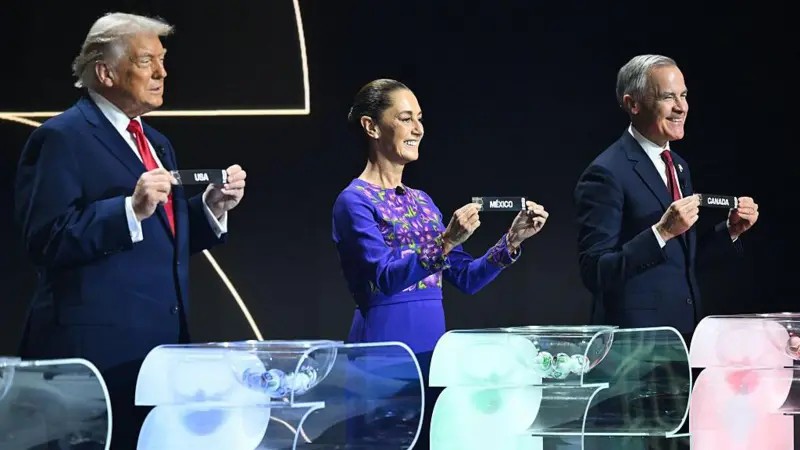
The 2026 World Cup will be held amid a turbulent period in diplomatic relations between the United States, Mexico and Canada
AFP via Getty Images/BBC
It's like arriving for dinner at the exact moment the hosts are in the middle of a heated argument.
Fans traveling to North America to watch the 2026 World Cup will find three host countries going through moments of tension.
The tournament will be played in 16 cities spread across the United States, Mexico and Canada, which are facing a turbulent period in their diplomatic relations.
The current problems seemed far away when the leaders of the three countries gathered for the World Cup group draw in the American capital, Washington DC, in December. They even posed for a selfie with the president of FIFA, Gianni Infantino.
But maintaining the same cohesion throughout a tournament that will last 39 days will probably be very different.
The president of the United States, Donald Trump, has been bluntly highlighting that his country is the dominant power on the continent.
This has brought to light the very concrete tensions that exist between the three nations, in sectors such as trade, migration and drug trafficking, which have come into conflict. boiling since Trump returned to the White House in January 2025.
On the other hand, if everything goes well, the World Cup could establish stronger ties between the three countries.
Tensions regarding trade, tourism - and Trump
Mexico and Canada are the United States' main trading partners. But they didn't forget that they were among the first countries to be hit by Donald Trump's import tariffs.
Canada had already been outraged by the American president's repeated comments about turning the country into the American "51st State" and responded with its own countermeasures.
Canadian provinces removed American drinks from the shelves and their citizens considerably reduced their travel to their southern neighbor, which also ended up angering the United States.
The problems with the United States also hurt relations between Canada and Mexico, says the director of international policy at the University of Calgary, in Canada, Carlo Dade.
Canada was accused of "betraying" the Mexicans even before Trump's second term, when American and Canadian authorities accused Mexico of serving as a gateway for Chinese investments in North America. diversify the country's trade, moving away from the United States.
Three is too many
This is the first time that the World Cup is held in three countries. And because the 2026 tournament involves an entire continent, there are a huge number of authorities involved.
With fans traveling between the three nations to watch the matches, the tightening of US immigration controls could create logistical difficulties and inflame the already frayed nerves of those involved.
And American security concerns, amplified by the ongoing war against Iran, could bring even more frustrations and create the potential for seemingly innocuous incidents to escalate. unexpected.
Wesley is cut from the national team due to an injury to his left leg; midfielder Éderson is called up
"Jointly promoting global sporting events is not necessarily a recipe for a pleasant relationship between host countries", says Lindsay Sarah Krasnoff, writer and professor of global sport at New York University, in the United States.
Krasnoff recalls that the 2023 Women's World Cup, held in Australia and New Zealand, had positive results.
But the 2002 men's tournament, in Japan and South Korea, was considered a "bag of cats" between two nations with a long and uneven history.
"The event did not harm bilateral relations, but it is historically considered as a kind of draw", explains the professor.
Fifa itself expressed high hopes for this model.
"It is a moment in which three countries and an entire continent jointly affirm: 'We are united to welcome the world and offer the biggest, best and The most inclusive FIFA World Cup ever held," said world football's governing body. Mexican capital, its saturated public transport system and the Azteca Stadium itself, in Mexico City, now renovated.
Not to mention the presence of cartel members on the streets a few months ago, in a brief but widespread display of violence.
Now, the main teachers' union is promoting a national strike, demanding better working conditions and increased pensions. Mass protests threaten to close the main roads leading to the games.
Their slogan is "without a solution [for their demands], the ball doesn't move."
Mexico and South Africa open the 2026 World Cup at the Azteca Stadium, in Mexico City, on June 11
AFP via Getty Images/BBC
But, despite all the difficulties, Mexico's president, Claudia Sheinbaum, remains resolute and confident.
"This is the moment to witness the best football in the world and show everyone who we are", she declared last year, "not only a country with immense cultural heritage, but one of empowered people."
It would be wrong to cover the sun with a sieve, covering up the problems faced by Mexico during the preparation for the World Cup, argues Mexican sports journalist Rafael Puente.
"I really hope that the fans show patience and good behavior, in the face of some of these problems that we cannot hide", he highlights.
"All we can hope for is the excitement, illusion and expectation that the Mexican people have shown in the past, particularly regarding the participation of the national team."
The trio's objectives beyond the tournament
Analysts indicate that the three North American neighbors could achieve other achievements, if they achieve success in sport in the coming weeks.
The trio is in the midst of a difficult review of the historic North American free trade agreement, known as USMCA, for its acronym in English. This review has brought uncertainty about the continent's trade partnership, maintained in some form since 1994.
Mexico has already begun formal negotiations with the United States, which is expected to be followed by Canada.
Canadians seek to strengthen their trade ties with China, while Mexico has increased its import tariffs on the Asian country.
Both are moving in different directions in relation to the "increased importance of China as a primary concern" in the Trump administration, according to Dade.
Trump, Sheinbaum and Carney posed for a selfie with FIFA president Gianni Infantino during the World Cup group draw in December
Getty Images via BBC
The World Cup provides an opportunity for diplomacy, as we saw when Trump, Carney and Sheinbaum gathered, smiling, during the group draw in December. attractive" in the world.
He certainly sees the World Cup as an opportunity to put the United States in the global spotlight.
His desire to dominate events, whether by attending events or posting on the Truth Social network, could fuel resentment between the two neighboring countries - and harm diplomatic relations on the continent in the long run.
On the other hand, he has invested heavily in the success of the tournament and may try even harder to avoid diplomatic incidents that could derail the events.
Football is a little box of surprises, says the old saying. And as unpredictable as the sport itself are the possible results of this new experiment, of bringing together three countries to promote a World Cup.
"It was known from the beginning that it would be very complicated, right from the definition of the host countries", concludes Krarsnoff.
The World Cup will be decided on these pitches - as scientists have perfected it for decades
The revolt of fans over World Cup ticket prices: 'Monumental betrayal'
American portal names favorite for the World Cup and puts it Brazil in the top 5; see the ranking
The concern of hotel owners in the USA regarding the low level of reservations before the World Cup
What the 'guru' of the World Cup predicts for Brazil - and which team will be champion
Source: G1