How Ahmadinejad, former president of Iran, became one of the greatest mysteries of the war?
American officials say the US and Iran will extend ceasefire for 60 days
"You need to understand that this hated regime [Israel] is heading towards collapse and, by the grace of God, it will fall. Nothing will be able to save it. This regime has come to an end and will soon disappear from the map."
For years, statements like this made former Iranian president Mahmoud Ahmadinejad (2005-2013) one of the main symbols of anti-Israel discourse in the world.
He questioned the Holocaust, called Israel a "manufactured regime" and defended the advancement of Iran's nuclear program despite sanctions, positions often used by Israeli authorities to support the idea that Iran represented a real threat.
Still, the American newspaper The New York Times reported that, in the "post-war plans", the United States and Israel even considered the possibility of Ahmadinejad breaking with the Iranian security apparatus and presenting himself as a possible future leader of the country.
But, according to the newspaper, the initiative would have failed because an attack intended to free Ahmadinejad from house arrest at the beginning of the war ended up leaving the former president injured.
Ahmadinejad and his allies have not commented on the allegations, and his whereabouts remain unknown.
The report was received with skepticism by many American and Israeli analysts, who question why the two countries would consider approaching someone associated for so many years with an extremist anti-Israel discourse.
The apparent contradiction also reignited doubts about whether Ahmadinejad's public figure always hid more complexity than he appeared.
A useful enemy for Israel?
To understand the sensitivity of this issue, it is necessary to go back to the years when Ahmadinejad began to rise in Iranian politics. In 2003, he was elected mayor of Tehran, the capital of Iran, although he was still a little-known figure on the national scene. Two years later, in 2005, he assumed the presidency with the apparent support of Iran's then supreme leader, Ali Khamenei.
In the presidential campaign, Ahmadinejad relied on speeches about social justice, simplicity and the fight against corruption. But he gained international prominence not because of his internal policies, but because of his statements about Israel, the USA and the Holocaust.
In October 2005, during the conference entitled "The world without Zionism", held in Tehran, Ahmadinejad declared that "a world without America and Zionism is possible".
About a year later, the Iranian capital hosted the controversial International Holocaust Global View Review Conference, a meeting that brought together well-known Holocaust deniers and provoked a strong international reaction.
Years later, Israeli authorities and analysts began to say publicly that Ahmadinejad, with his aggressive rhetoric and denialist statements about the Holocaust, ended up benefiting Israel politically.
In 2008, Efraim Halevy, former head of Mossad, the Israeli intelligence agency, called Ahmadinejad "Iran's greatest gift to Israel" and stated that his statements helped reinforce, before the world, the perception that Iran represented a threat real.
Ahmadinejad's supporters reject this reading and claim that he merely adopted an aggressive and ideological policy of confronting Israel and the West.
Change of image after leaving power
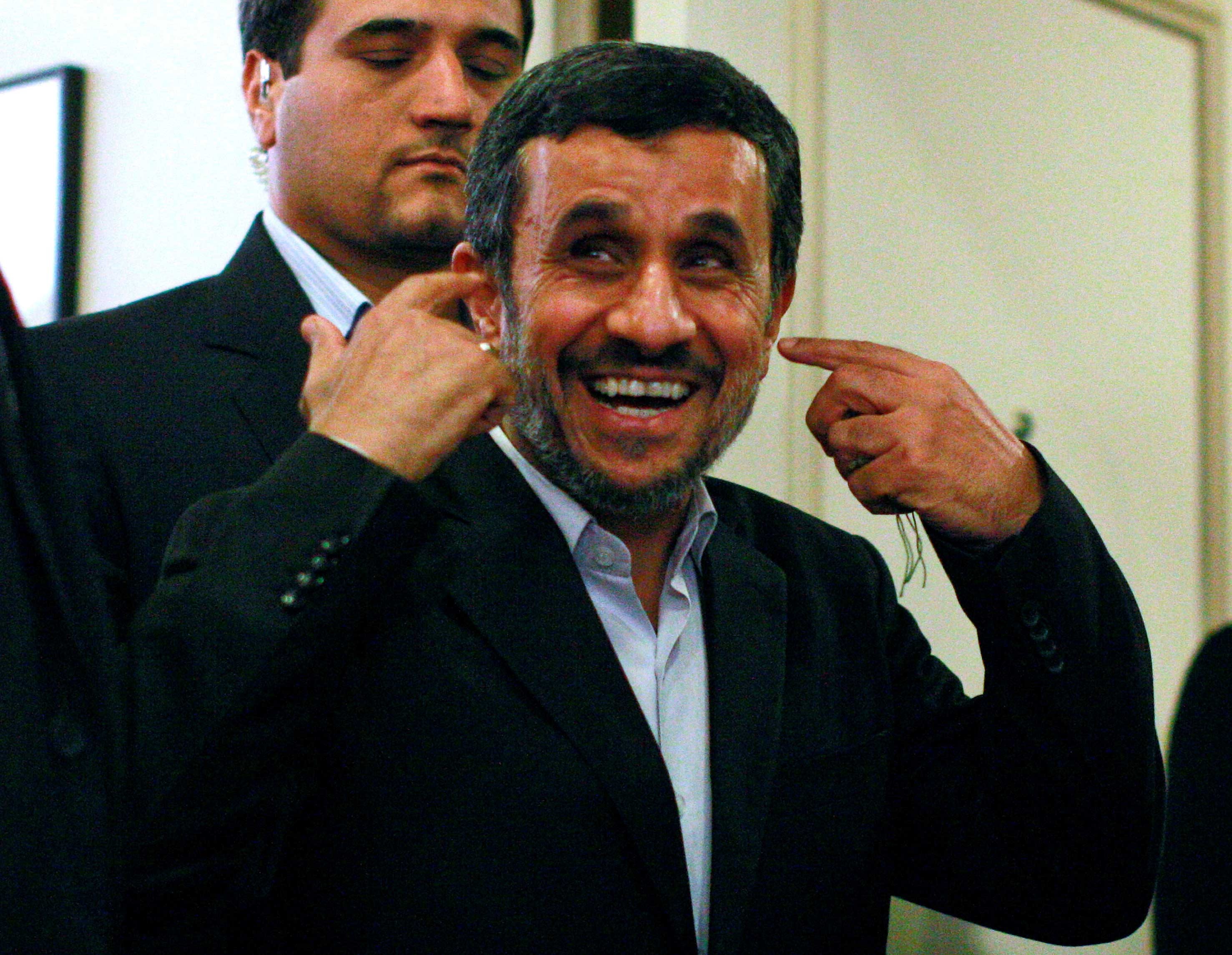
Iranian President, Mahmoud Ahmadinejad, in file image from September 2012
Brendan McDermid/Reuters
After leaving the presidency in 2013, Ahmadinejad began to clash with the supreme leader Ali Khamenei and with sectors of the Iranian security apparatus, including the Islamic Revolutionary Guard Corps.
Later, Iran's Guardian Council blocked several attempts by him to run for president again.
In a post on the social network Zimmt.
In recent years, Ahmadinejad has also rebuilt his international image on social media. He started publishing messages in English, congratulated the football team at the University of Michigan, in the USA, and even mentioned the American rapper Tupac Shakur. At another point, he praised American President Donald Trump for "fighting political corruption in the USA".
Although he recognizes this effort to build a more moderate image, both within Iran and in front of the Western public, Zimmt states that Ahmadinejad never had enough support to return to power in a country with more than 90 million inhabitants.
READ ALSO
USA and Iran reach agreement, but final approval from Trump is lacking
What happens if Trump declares PCC and CV terrorists, how does Flávio Bolsonaro want it?
Trump government is pushing for the creation of a US$250 bill with the president's face, says newspaper
Globopop: click to see videos from the g1 stage
Skepticism among American experts
The former president of Iran, Mahmud Ahmadinejad, during an interview in New York
AFP
Three American experts interviewed by BBC Persian also cast doubt on the existence of an "operational plan serious" to put Ahmadinejad back in power.
Max Abrahms, professor of political science at Northeastern University, in the USA, and counterterrorism researcher, says that this story should be treated with "great skepticism", given the volume of disinformation surrounding the war.
According to Abrahms, it is unlikely that Israel would accept Ahmadinejad's return, considering his history of Holocaust denial and his role in advancing Iran's nuclear program. In Abrahms' view, Ahmadinejad would also not fit, for Donald Trump, into the narrative of a successful regime change.
Ilan Berman, from the American Foreign Policy Council, also considers it unlikely that the US and Israel have developed a consistent plan in this regard. According to Berman, even if Ahmadinejad's name had emerged among possible leaders, it would hardly be the main option.
Michael Rubin, from the American Enterprise Institute, considered the report "fanciful" and stated that The New York Times relies too much on anonymous sources. Still, he argues that many in the West still do not understand why Ahmadinejad has won support in part of Iranian society.
However, The New York Times stated on the social network September, in works by Greek photographer Platon Antoniou, in Cologne, Germany
AFP
Some Israeli security experts focused their criticism on what this scenario would reveal about Israel's view of Iran.
Danny Citrinowicz, from the Institute for National Security Studies, wrote on the social network X that any attempt to "coronate" Ahmadinejad would demonstrate a profound misunderstanding of the Iranian political system.
According to Citrinowicz, Ahmadinejad does not have a real power base and would never count on the support of the Islamic Revolutionary Guard Corps, the country's main elite military force.
Thus, he would only be able to take command if the entire current Iranian power structure collapsed, something that, according to Citrinowicz, the American and Israeli attacks were unable to provoke.
Yossi Melman, a veteran Israeli security analyst, also wrote in X: "This story is absurd on several levels." For Melman, the idea that it would be possible to overthrow the regime through minority uprisings and air strikes would show that those responsible for planning in Israel and the USA "lived in a fantasy world".
Why did Ahmadinejad's name appear?
In the face of so many doubts, the question remains: why Ahmadinejad?
The answer may lie in the unusual combination of three characteristics: fame, experience from within the system and distance from the supreme leader.
Ahmadinejad is a A well-known figure in Iran, he has experience leading the government, knows how to dialogue with part of the popular classes and knows the power mechanisms of the Islamic Republic. At the same time, his conflicts with Khamenei mean that he is not only seen as someone aligned with the regime.
For some foreign policy experts, this set of characteristics could transform him into a useful figure in a scenario of instability, not as an ally, but as someone capable of widening divisions within the Iranian power elite.
Who is Ahmadinejad anyway?
Former Iranian president Mahmoud Ahmadinejad participates in summit 12 of the Islamic Cooperation Organization
AFP PHOTO / GIANLUIGI GUERCIA
Some Iranian critics and commentators say that Ahmadinejad's behavior over the years, from his presidency to his controversial international trips, to his silence during the recent war, has raised new doubts about his political stance.
According to these critics, his policies contributed to Iran's international isolation, worsened the nuclear crisis and ended up offering Israel some of its most effective arguments against Iran. The New York Times report rekindled this debate.
And this would not be the first time.
During his government, Ahmadinejad consolidated part of his legitimacy by accusing important reformist figures and former members of the Iranian high echelon of sedition, a reference to the mass protests that followed the contested 2009 election.
After leaving power, however, the Iranian press reported that he tried to reconcile with these same figures, even seeking a meeting with one of his predecessors, although the initiative never came to fruition.
This apparent ease in changing positions and redefining alliances, instead of following rigid ideological lines, may simply reflect an attempt to move in internal power disputes, and not necessarily indicate hidden links with foreign powers. There is, in fact, no concrete evidence linking Ahmadinejad to Israel or the US.
Still, the contradiction remains: a politician for years identified by his fiercely anti-Israel rhetoric now appears, in some reports, as a possible alternative for Iran's future, reigniting one of the most persistent doubts in Iranian politics about who Ahmadinejad really is.
VIDEOS: Now on g1
Now on g1
Source: G1