Historic heatwave hits US ahead of 4th of July holiday
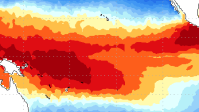
Record temperatures spread from the Midwest to the Eastern United States on Wednesday, placing tens of millions of people under heat warnings that are expected to extend into the July 4th long weekend, when Americans are expected to celebrate the country's 250th birthday.
The extreme heat is expected to raise wind chills to 37.8 to 46.1 degrees Celsius across much of the region, according to forecasts, increasing the risk of heat-related illnesses for vulnerable populations and threatening to overwhelm power grids, already strained by increased consumption from data centers and electric vehicles.
In Hill City, Kansas, a small town in the High Plains, clerk Sabrina Hooper struggled with temperatures exceeding 90 degrees Fahrenheit just a week after starting her job.
"It's completely debilitating," Hooper, 34, said of the heat's effect on his job, which involves walking up to 15 kilometers a day to deliver packages.
She said she gets some relief from garden sprinklers: "It's so nice. You can take your hat off, wet it and put it back on your head."
Hill City was the hottest place in the country for five consecutive days in 2012 when another record heat wave swept through the region, raising the city's heat index to 41.7 degrees Celsius. The heat index measures the thermal sensation when humidity is taken into account in the air temperature.
Dana Robles, who lives in Brownsville, Texas - a city near the Gulf Coast on the US-Mexico border - is concerned about the rising costs of cooling her home as the heat index rises to 41 degrees. During peak temperatures, your family's monthly electricity bill can exceed $300, which is almost a third of what they pay in rent.
Robles also fears blackouts due to overload on the electrical grid.
"I'm afraid the power will be off all day and our food will spoil," she said.
In Chicago, high school science teacher Michelle Klein, 57, began preparing for the heat over the weekend. She filled up her car, did her weekly shopping early, stocked the fridge with extra cold drinks, and watered her plants well.
"The basil needed some more water this morning," Klein said Tuesday night, after taking his usual evening walk despite the 100-degree heat index.
In the city's suburbs, real estate investor Amy Kaspar received an urgent call Monday night from a tenant whose air conditioner was only blowing hot air.
Kaspar discovered that the device was working well, but simply could not cool the apartment due to the intense heat and humidity.
"Combined with the wind, it feels like we're behind a bus exhaust here in Chicago right now," said Kaspar, 50.
Cooling Centers
The Chicago Office of Emergency Management and Communications has asked residents to periodically contact family members, neighbors, seniors and other vulnerable populations.
If contact cannot be established, the office said, Chicago residents can request a wellness check from the city by calling 311.
Scorching temperatures in the US mirrored those in Western Europe, which was recently hit by its own record heat wave, an event that scientists say would have been "virtually impossible" without human-caused climate change.
Scientists have confirmed, through years of studies, that greenhouse gas emissions are making heat waves around the world more likely and intense.
The extreme heat only began to spread across New York City on Wednesday morning.
By then, the city had already opened hundreds of cooling centers and mobilized more than a dozen "cooling vans" equipped with water, electrolytes, sunscreen and meals for New Yorkers in need of relief, Mayor Zohran Mamdani said at a news conference.
The air conditioning was blasting at a Harlem senior center on Wednesday, where a sign in 13 languages advertised the facility as a "cooling center" for the public.
Senior center director Richard Allman said the facility would remain open beyond its usual hours during the Fourth of July weekend.
"We try to make this a comfortable place for people on an extremely hot day," he said.
Before the heat wave, city officials had asked operators of billboards in the iconic Times Square to reduce the brightness of their billboards to reduce energy consumption and asked businesses not to set thermostats below 25.5 degrees Celsius. The city's power utility, Con Edison, asked customers to limit energy use from 2 p.m. to 10 p.m.
The city also extended the opening hours of public swimming pools, opened additional cooling centers in libraries and municipal buildings, and expanded street assistance actions.
Source: CNN