Have you ever thought about skiing in Morocco? See surprises from Brazil's 1st rival, which has snow, a king and a passionate liver
Visitors at the Oukaimeden ski resort in Morocco
Fadel Senna/AFP
When people think of Morocco, many think of sand dunes and cities surrounded by the desert. But Brazil's first opponent in the World Cup holds surprises such as ski resorts, monarchy as a form of government and even a historical heritage that associates the liver, not the heart, with love.
➡ This Saturday (13), the Brazilian team faces Morocco in its first game in the 2026 World Cup. The match will be at 7pm, Brasília time (6pm local time), at the MetLife Stadium, in New Jersey-New York, in the United States.
See below interesting facts about Brazil's first opponent in the World Cup:
Favorite g1 on Google and follow the main news of the day
From the desert to the snowy mountains
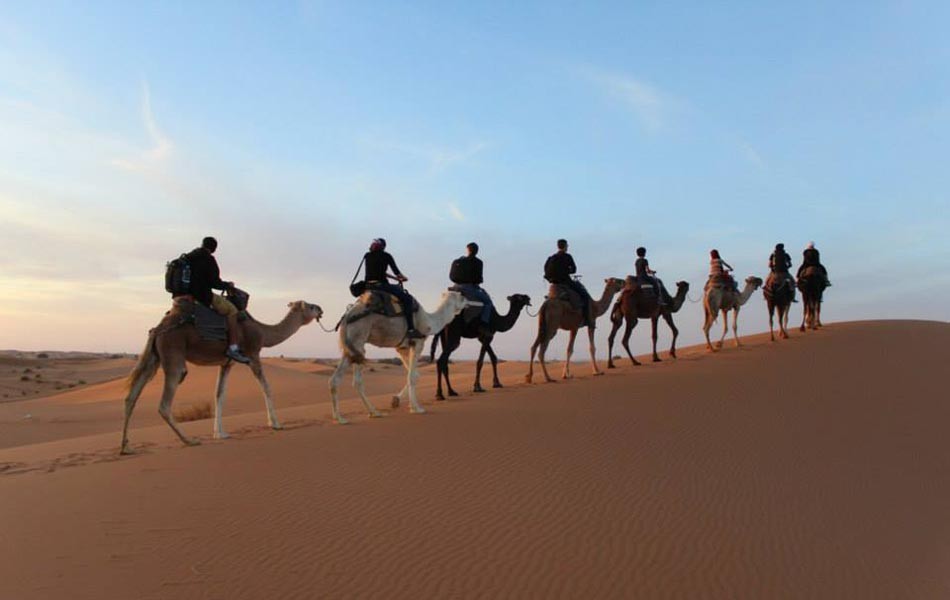
Sahara, in Morocco
Personal archive
Morocco goes far beyond the classic image of the desert. In a single territory, the country brings together very different landscapes: snowy mountains, beaches bathed by the Atlantic, dry valleys, oases and Sahara dunes.
Close to Marrakesh, for example, there are ski resorts. As history professor Wilher de Freitas Guimarães explains, the altitude of the region - which is home to the High Atlas, the country's main mountain range - causes snowfall.
After the mountains, in the interior and southeast of the country, arid regions near the Sahara desert predominate.
On the Atlantic coast, the climate is milder due to the influence of the ocean, contrasting with the desert areas in the interior.
"There is enormous diversity there. Desert, mountainous regions with snow", says the professor. "It's extraordinary to think about this whole perspective of diversity to break with this thought of homogeneity in both Africa and Morocco."
Kasbah dos Oudayas, in Rabat, located on top of a cliff over the Atlantic
Giovanna Dell'Orto/AP
READ MORE:
World Cup 2026: understand the new format and how new rules work, from 'Vini Jr law' to turbocharged VAR
Brazil in the World Cup: see the days and times of the national team's games
Monarchy
The country, unlike Brazil, which has the Republic as a form of government, is a Constitutional Monarchy, that is, its State is governed by a king. The country has an Executive, Legislative and Judiciary, but the monarch maintains broad constitutional powers and exercises strong influence over the Moroccan political structure.
The king who currently governs Morocco is Mohammed VI, who took power in 1999, with the death of his father Hassan II. Mohammed's family, the Alaouite Dynasty, came to power in 1631.
Pope Francis was received at the airport by the Moroccan king, Mohammed VI.
Fadel Senna/Pool Photo via AP
As Wilher explains, the monarch is not only seen as the central power of the government, but part of the population that believes in Islam also sees him as a religious leader.
"Sectors of the Moroccan population don't just see Mohammed as a political leader, but also a religious leader. And you have a bit of a mix of religion and political issues," he says.
In 2011, with the Arab Spring, the country's institutional structure underwent reforms. To meet the demands of the population, which asked for less concentration of power, the government promoted a new Constitution approved by popular referendum.
Among the main changes, the king was now obliged to appoint the head of government of the party that won the elections, Parliament gained more powers and guarantees of rights and political participation were expanded. Despite this, Mohammed VI maintained broad powers as head of state, commander of the Armed Forces and the country's main religious authority.
"[In Morocco] there are elections, women vote, you have political parties, but everything is under a certain control of the king", explains Wilher.
A multilingual country
Morocco aims to double tourist arrivals by 2030, with a target of 26 million annual visitors
Getty Images via BBC
Morocco has two official languages, Arabic and Amazigh (Berber), but is marked by multilingualism. In addition to Moroccan Arabic, known as Darija, it is common to find people who speak French, Spanish and, increasingly, English.
Arabic: it is one of the country's two official languages. In addition to being widely used in everyday communication, the language is also linked to Moroccan history, culture and Islamic tradition.
Amazigue (Berber): spoken by the Amazigh people, present in North Africa for millennia, it is one of the official languages of Morocco and has different regional variants.
Darija (Moroccan Arabic): it is the language most used in everyday life by Moroccans. Although it originates from Arabic, it presents vocabulary and expressions influenced by Amazigh, French, Spanish and other languages that have marked the country's history.
French: the presence of French is a result of the colonial period. During the 20th century, a large part of Moroccan territory was under French protectorate. Even after independence, the language continues to be spoken in the country.
Spanish: Spanish is spoken in the north of the country, a region that was also under Spanish influence during the colonial period. The geographical proximity to Spain, separated by only about 14 kilometers in the Strait of Gibraltar, contributes to the maintenance of the language in some areas, in addition to favoring cultural and economic exchanges.
English: the English language has gained space in recent decades driven by tourism, globalization, the internet and international relations.
Liver in place of the heart
Among the most unusual curiosities associated with Morocco is the idea that the liver, and not the heart, would be the organ linked to love. According to Professor Wilher, however, the origin of this association is much older than Moroccan culture itself and dates back to ancient beliefs.
At that time, people such as the Greeks and Romans still did not understand the role of the brain in emotions and attributed symbolic meanings to different organs of the body. The liver was seen as a vital center for physical and emotional well-being, which led to it appearing in myths, literary works and expressions related to feelings.
With the expansion of cultural influences across the Mediterranean and the Arab world, this symbolism combined with local traditions from North Africa integrated the culture of the population.
For this reason, it is possible to find references to the liver in poems, metaphors and expressions from the Arabic tradition present in Morocco. However, the theorized and reflected idea is not part of the daily lives of Moroccans nor does it replace the heart as a modern symbol of love.
Today, the association is seen mainly as a curious historical and cultural heritage that survives in some literary and popular manifestations of the region.
"You can find it in jokes, you can find it in circles of friends, but it is not an idea that you can say in Morocco when declaring yourself. You will not hear it said: "Love, you are my liver."
Relationship with football
Fans celebrate the Moroccan team in the streets of Rabat
FADEL SENNA / AFP
In 2022, the Moroccan team had a historic trajectory in the World Cup. Fourth place in Qatar, the Moroccan team achieved the best result for an African country in the tournament.
The team reached the semifinals, but ended up being defeated by France 2-0. Afterwards, they lost the third place match to Croatia, 2-1. Even so, when they arrived home, the players were received with celebration.
Historically, according to Wilher, the population. is a fan of the sport.
"They like football, maybe not as much as Brazilians, but football there is not something secondary", he says "It's part of the culture."
Source: G1