Guerrillas deliver weapons in agreement with Petro in Colombia
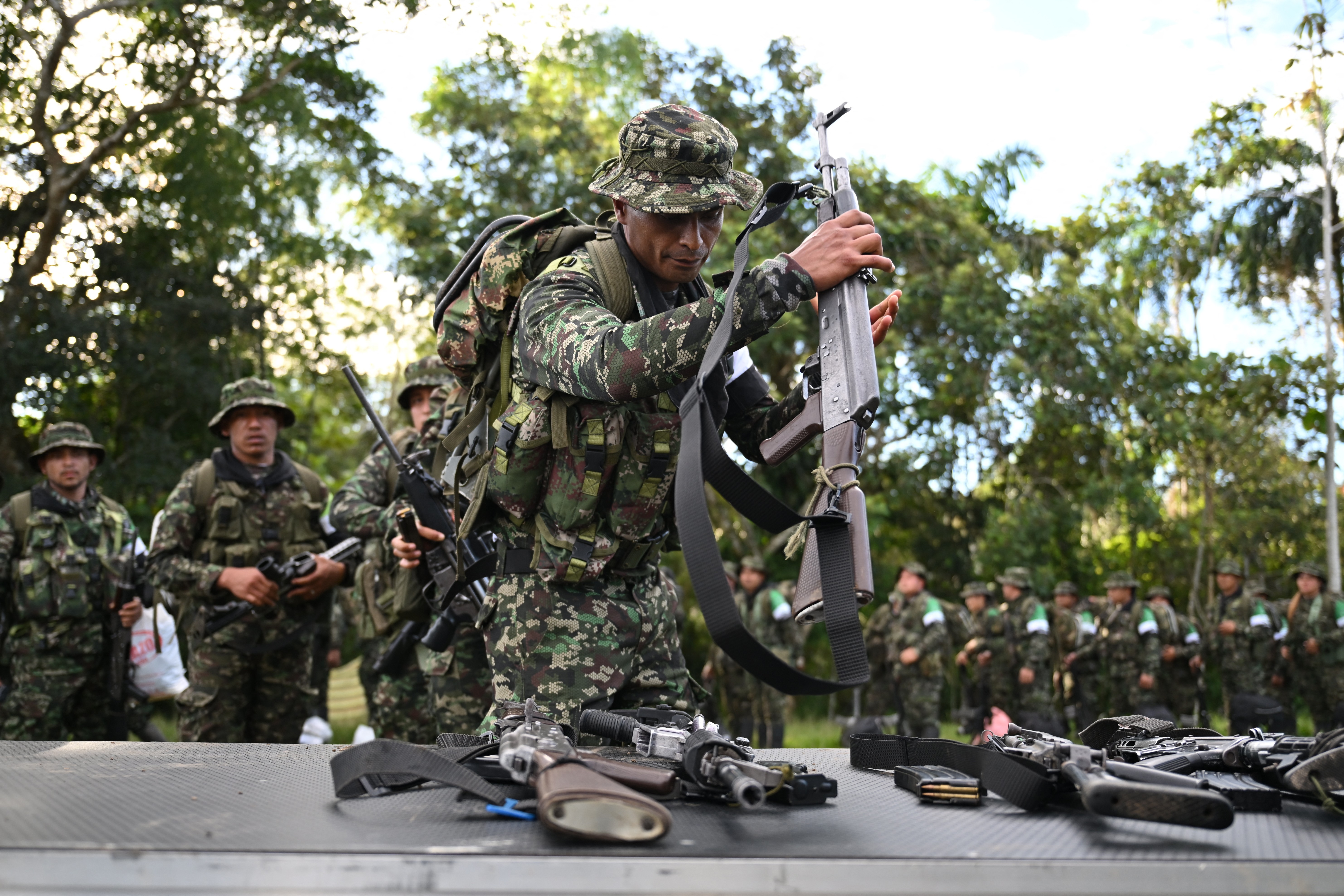
Members of the guerrilla group Coordinadora Nacional Ejército Bolivariano (CNEB) lay down their weapons at a disarmament ceremony in the municipality of Valle del Guamuez, in Putumayo, Colombia, on June 18, 2026.
Raul Arboleda/AFP
About a hundred guerrillas handed over their weapons this Thursday (18) in a region jungle in southern Colombia, as part of a negotiation with President Gustavo Petro, who is making his last efforts to save his questioned peace policy, AFP found.
✅ Follow the g1 international news channel on WhatsApp
A few days before the second round that will define the next president of Colombia, which will take place next Sunday (21), the delivery of weapons is the first step so that the rebels can settle in a special zone where they hope to consolidate agreements with the government.
The act also represents the greatest advance in the "total peace" policy of Petro, Colombia's first left-wing ruler, who unsuccessfully tried to negotiate with all the country's armed groups.
Dressed in camouflage uniforms, 99 rebels from the Bolivarian Army National Coordinator (CNEB) left their rifles in a large container with the inscription "Bet on life, I fulfill peace", in the middle of the jungle in the department of Putumayo, in the south of the country.
Now on g1
"I'm very happy, I can barely contain the joy of knowing that we will no longer be away from our family," a rebel told AFP on condition of anonymity.
On Sunday, Colombians will elect the president between Senator Iván Cepeda, an ally of Petro who promises to continue the peace initiative, and the ultra-rightist Abelardo de la Espriella, defender of the end of any kind of rapprochement with illegal organizations.
Petro will hand over power on 7th August.
The members of the CNEB, dissidents of the 2016 agreement that disarmed the FARC, are the only guerrilla group that is advancing without setbacks in the peace negotiations with Petro.
It is "a very strong and very powerful message for Colombian society at this time when there is a lot of noise of war", said Armando Novoa, head of the government peace delegation to this guerrilla.
Unpublished
Members of the group guerrilla Coordinadora Nacional Ejército Bolivariano (CNEB) lay down their weapons in a disarmament ceremony in the municipality of Valle del Guamuez, in Putumayo, Colombia, on June 18, 2026.
Raul Arboleda/AFP
The rebels will remain for ten months in this area, where there were previously coca plantations, awaiting progress on their definitive disarmament and their situation legal.
The delivery of weapons is unusual in this type of negotiation in Colombia, a country marked by six decades of armed conflict.
The FARC did this just a year after the signing of the peace agreement.
In Putumayo, the guerrillas received hygiene kits and books before entering the area where they will remain in houses equipped with solar panels, under the protection of the state escort unit.
Military forces transported them by helicopter from remote territories to a region of the Guamuez Valley, a location where they will remain from this Thursday.
The next president may decide to close the negotiating table, which would cause them to lose benefits such as the suspension of arrest warrants.
Heavy weapons handed over by the guerrilla group Coordinadora Nacional Ejercito Boliviano (CNEB) at a ceremony in Putumayo, Colombia, on June 19, 2026.
Raul Arboleda/AFP
'Contributing to peace'
The rebels gathered in Putumayo obey the orders of Walter Mendoza, a former member of the FARC who signed the peace agreement, but took up arms again in 2019 and did not participate in the event.
"I feel proud to contribute to peace", said the guerrilla known as Ferney, carrying his backpack on his back.
"My desire is to prepare myself in some profession so that I will never practice anything illegal again in this life", he added.
Gustavo Petro
REUTERS/Luisa Gonzalez
Petro has refused to extradite guerrilla commanders committed to the peace processes in Colombia, which has generated discontent in Washington.
The president of the United States, Donald Trump, openly supports De la Espriella in the elections, amid the worst wave of violence in the last decade.
The government estimates that the CNEB has between 2,000 and 2,500 members.
De la Espriella proposes an "iron fist" policy to confront rebels and drug traffickers in the country that produces the most cocaine in the world.
Although the CNEB dominates strategic territories for drug production on the border with Ecuador, it is small when compared to the National Liberation Army (ELN) or other dissidences of the FARC, such as the one led by Iván Mordisco, the most wanted rebel in the country.
Source: G1