Google Maps now talks to users in Brazil to indicate places and even buses; see how it works
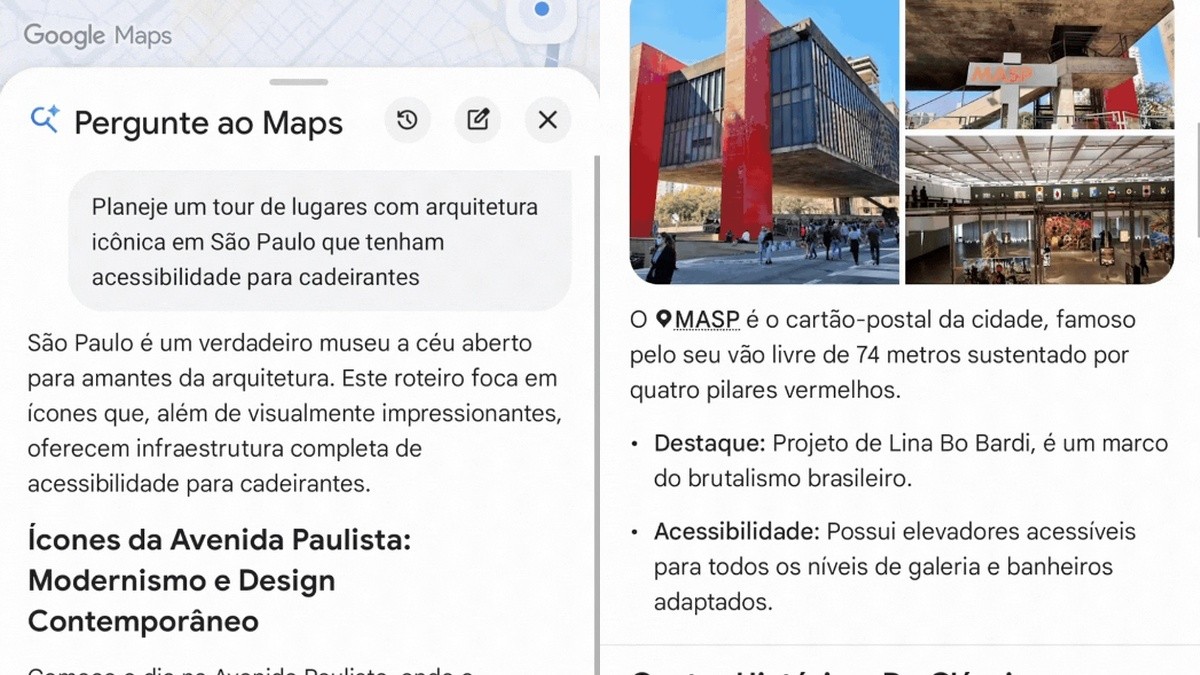
Google Maps starts chatting with users to recommend places and buses in Brazil
Google Maps users in Brazil can now chat with the app to find places and even ask questions about public transport. According to Google, it is possible to ask questions about "practically any topic", from simple requests to more specific searches.
The feature turns Maps into a kind of recommendation assistant with artificial intelligence based on Gemini. Announced in March 2026, the new feature was already available in the United States and India.
Do you have any suggestions for a report? Send it to g1
Named "Ask Maps", the feature displays answers in a conversational format, similar to what already happens in tools like ChatGPT and Gemini.
In addition to the text, it shows a personalized map, images of suggested locations and additional information, such as accessibility data and, in the case of museums, details about the works on display.
The new feature was announced during the Google for Brazil event this Wednesday (10) and works both via text and voice. The function begins to be released this Wednesday for a "select group" of users most engaged with Maps in Brazil.
According to Google, the feature will reach all users in the country "in the coming weeks".
How it works and examples of questions
Google Maps starts talking to users to recommend places and buses in Brazil
Google/Disclosure
The option to access Maps AI is at the top of the application, in the top left corner, next to shortcuts such as "Restaurants", "Shopping" and "Supermarkets".
At first, the feature will only be available on the cell phone application. The functionality will also come to the browser in the future.
According to Google, recommendations are generated by crossing information from more than 300 million places with reviews published by more than 500 million users in the Maps community.
"You can ask where to find a vegan burger near work or ask for an itinerary of places with iconic architecture in your city. It uses the most recent information to show you everything you need to know before leaving home", explains André Kowaltowski, manager from Google Maps for Latin America.
See some examples below:
"Find burger restaurants with outdoor seating near me."
"It's raining and I wanted to take my son to a fun place that isn't a mall. Can you recommend some options in the Tatuapé neighborhood?"
"Show me some ice cream shops near my work."
"Does the bus [line number] pass through the exclusive corridor?"
"What films are showing at the cinema [name]?"
"Which restaurants near my house accept meal vouchers?"
In the example of the ice cream shop, the request mentions a place "close to my work". This is possible because the user has saved the work address in their Google Maps account.
With this, the AI can use this information to understand references such as "near my work", "near my house" or "near my mother-in-law's house" and offer more personalized suggestions.
Google also states that the Maps AI can take into account the user's history to personalize the suggestions.
For example, if the person usually searches for vegetarian restaurants, the tool can consider this preference in future searches, even if the term "vegetarian" is not mentioned.
In the case of public transport, Google claims to use information provided in real time by companies responsible for operating systems in cities, such as SPTrans, in São Paulo.
Therefore, some data displayed by Maps may present discrepancies, as it is not collected by the company.
Bus lane on Avenida Bezerra de Menezes receives speed bumps
JL Rosa/SVM
Social networks have changed the way we discover places
It is unclear whether Google intends to use the feature to attract users who started looking for recommendations for places on platforms such as TikTok and Instagram.
In recent years, social networks have gained ground as a research tool for discovering restaurants, tourist attractions and other recommendations. In 2023, g1 showed this trend in a report on the topic.
On the occasion, literature professor Lu Cunha explained that traditional search does not always offer direct answers for those looking for more specific suggestions.
"Google is very good as a source of information, but, depending on what you are looking for, it presents many pages on that subject and it can be difficult for you to select exactly the one that will suit you", he said in an interview with g1 in 2023.
READ ALSO
Chip, AI and battery make the 2026 World Cup ball work like a 'computer'
Instagram now allows you to reorganize profile posts; see how to do it
OpenAI, owner of ChatGPT, files for IPO; company could be worth US$ 1 trillion
Siri AI: Apple launches application focused on artificial intelligence
Instagram Plus is released in Brazil; see price and benefits
Source: G1