Galípolo admits a failure in Copom's communication, but says that the BC's role is not to generate consensus in the market
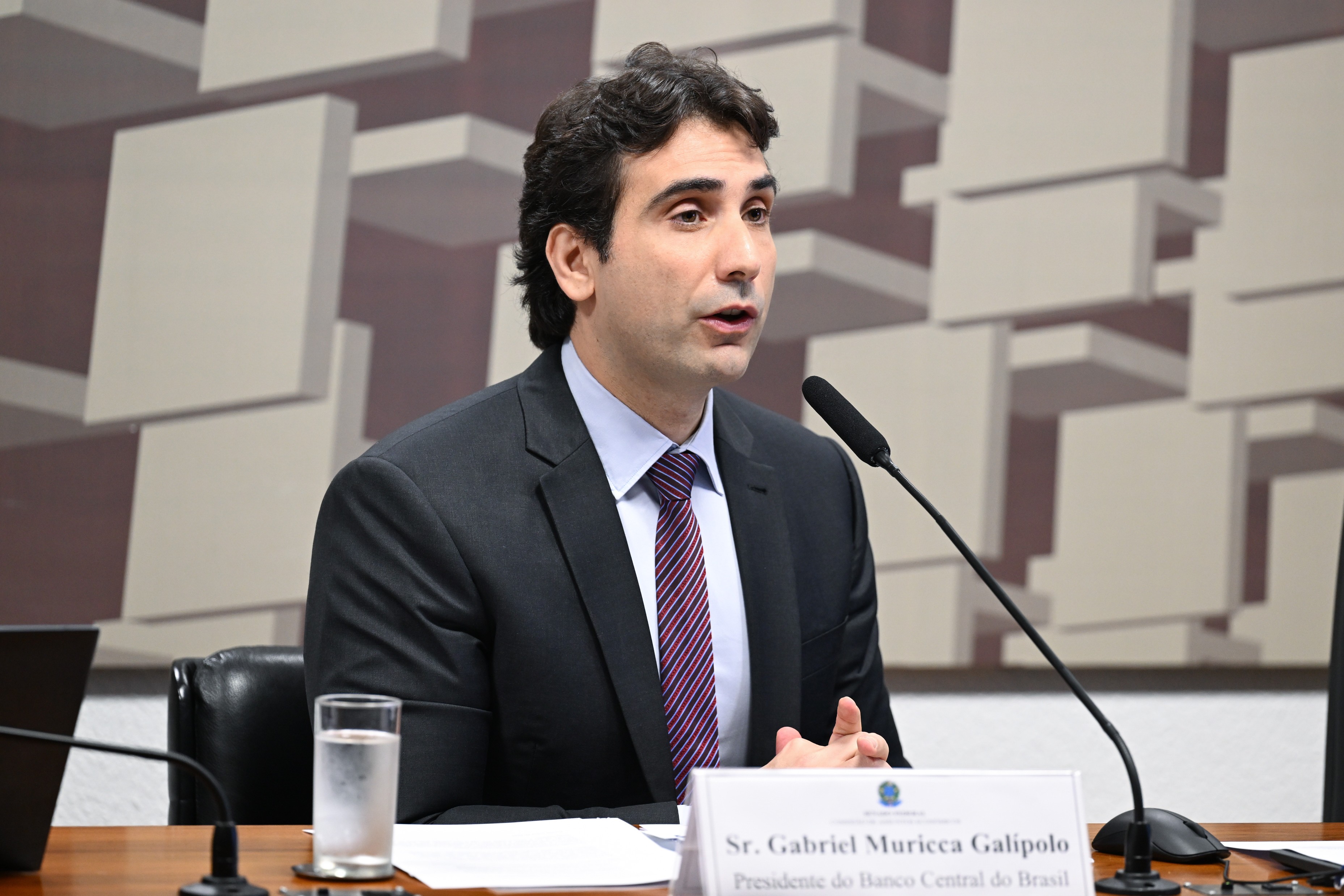
The president of the Central Bank, Gabriel Galípolo, speaks at the Economic Affairs Committee (CAE) of the Federal Senate, on May 19, 2026
Edilson Rodrigues/Agência Senado
The president of the Central Bank, Gabriel Galípolo, assumed, this Thursday (25), responsibility for communicating the latest decision of the Monetary Policy Committee (Copom), which generated doubts in the market.
The BC reported that, even in the face of worsening prospects for inflation in the coming years - one of the main parameters for decisions on interest rates -, opted to maintain the Selic's downward cycle last week.
Do you have any suggestions for a report? Send to g1
This week, the market reacted badly to the Copom minutes, which indicated that the BC would keep interest rates unchanged even in the face of worsening inflation prospects in the coming years. The interpretation was that the Central Bank would adopt a less rigorous stance in combating inflation.
Galípolo stated that the Copom preferred not to react to uncertain events, such as the war in the Middle East. "The responsibility, if the paragraph failed to convey what we wanted in a concise space, is absolutely mine."
The BC justified the decision by stating that "best practices" recommend not reacting fully to price variations caused by supply shocks.
Copom cuts 0.25 pp and brings Selic to 14.25% per year
For Felipe Salles, chief economist at C6 Bank, the main point of the minutes, released last Tuesday (23), was the fact that the Committee "stated that the balance of risks now presents asymmetry bullish, something that had not been mentioned in the decision statement."
According to the economist, this change signals an attempt to adopt a tougher tone. However, the minutes also contain elements that point in the opposite direction.
"Although the Central Bank's projections remain above the target, the Committee deemed it more appropriate to consider interest rates trajectories that avoided greater volatility", explains the expert.
In other words, the BC assessed that interrupting the cycle of Selic cuts at this time could represent an excessive increase in interest rates, slowing down the economy beyond what is necessary to control inflation in the long term.
"It is a particular case of a misunderstanding, a noise that was generated from that paragraph [...] that arises from the attempt to explain a series of things in a very tight and concise space of the statement itself", stated Galípolo.
The president also highlighted that "the role of the Central Bank is not to produce consensus among market opinions."
The two sides of the coin
During an interview about the Monetary Policy Report (RPM) for the second quarter, Galípolo stated that the Central Bank is currently facing two types of pressure: the wear caused by the high level of interest and the demand for signals about the next steps of monetary policy.
"There is a first order of criticism that comes from sectors of the economy, society and of policy, inherent to the fact that we have lived for so long with an interest rate a few hundred basis points above the neutral rate", he explained.
According to him, Selic has remained at a significantly high level since he took charge of the institution. "It is protocol that we have criticism from sectors that oppose this rate", he reiterated.
After commenting on this "exhaustion" in relation to high interest rates, Galípolo addressed the second source of pressure: the market's demand for greater predictability.
"In moments of greater uncertainty, this desire for guidance [signaling] is normal, for indications of what the Central Bank will do in the future.
This type of request is normal, but no other central bank is doing this, nor does the literature recommend this practice precisely because of the uncertain environment", he stated.
According to the BC president, anticipating the monetary authority's next steps could reduce the effectiveness of interest policy.
For this reason, he argued that clearer communication should not be confused with the anticipation of future decisions. "One thing cannot be confused with the other", he pointed out.
"The Central Bank will preserve its right to Do not give this information when you think it is not worth disclosing it in advance. Not because we are hiding what we are going to do, but because this decision will be made in 40 days, at the next meeting", concluded Galípolo.
Source: G1