Frustration grows with the delay in rescues in Venezuela: 'There are buildings where not even a single stone has been removed'
President of Venezuela releases video of rescue of boy from rubble
Mothers, fathers, children, cousins, uncles, grandchildren, neighbors.
They are the ones waiting for help in the vicinity of buildings that collapsed in the areas most affected by the two strong earthquakes that hit Venezuela this week and which have already left 1,450 dead and 3,150 injured.
LIVE: See the latest updates on the earthquake
✅ Follow g1 international news channel on WhatsApp
They wait for specialized rescue teams and heavy machinery to help remove the dangerous rubble under which they hope to find their loved ones.
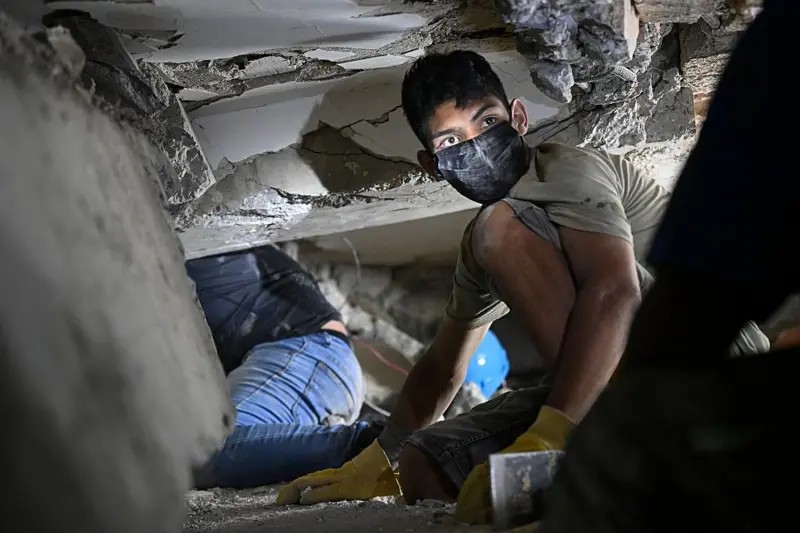
One of the volunteers who throws himself into the rubble in search of survivors
Getty Images via BBC
Many risk making their way between the concrete slabs, without any protective equipment, and remove with their own hands the bodies that are already beginning to enter decomposition.
The scene is repeated in places like La Guaira and Caracas, and the appeal seems to be the same: they ask for greater State presence.
After the fatal earthquakes on Wednesday (26), hundreds of buildings collapsed and thousands of people were trapped under the rubble.
Many Venezuelans denounced an insufficient response from the authorities and, among them, a growing feeling of frustration and indignation, as the special envoys of the BBC.
"We are all very frustrated because the government is not offering what it should: serious help," said Caracas resident Zaira Castro to BBC correspondent Will Grant.
The acting president of Venezuela, Delcy Rodríguez, stated that efforts are being made "without rest" and assured: "Rescuing people who are alive is our priority."
In La Guaira, the case of Carlos Eduardo, 31, portrays the despair faced by thousands of people. people. His family knows where he is and heard him under the rubble, but they have no way of rescuing him.
"That's it. We're here waiting for help, waiting to see if we can get him out alive," his cousin told BBC News Mundo.
Residents search the rubble after the earthquake in Venezuela in June 2026
Getty Images via BBC
In the coastal town of Caraballeda, Mileidy Romero, who was taking part in the rescue operations, told the AP news agency: "There are a lot of bodies there since last night. Newborn babies."
"At 8pm [on Saturday] there were people alive down there, and no one bothered to rescue them. We located several bodies, and they didn't help us get them out either. What are you waiting for?", he added.
A firefighter who works in the region and asked not to be identified told the envoy BBC News Mundo special to La Guaira, Norberto Paredes: "There are buildings where not even a single stone has been removed."
"There are not enough hands", he added.
"And it is very, very likely that there will still be people trapped."
Many Venezuelans expressed their discontent by booing President Rodríguez during visits to the affected areas.
"They are campaigning in the midst of a tragedy! The government does nothing for the people," shouted a woman in Chacao.
Residents of La Guaira organize to carry out search and rescue operations without the necessary security equipment
Getty Images via BBC
Despite the scale of the tragedy represents a challenge for any country, many residents complain about what they consider to be a hesitant and slow reaction from the Venezuelan government.
The president of the National Assembly and brother of the president, Jorge Rodríguez, said this Sunday that the country is now going through "critical hours" to save lives.
In total, 12,721 people were affected and 774 buildings were damaged or collapsed, Rodríguez reported.
He classified the two earthquakes as "the most brutal natural catastrophe that our country has suffered in its history."
On Saturday, he had stated that 21 international delegations were mobilized to support the rescue operations, totaling 2,242 rescuers and 96 teams with sniffer dogs.
He also said that more than 30 thousand people - including military and police, rescuers, doctors and paramedics, support teams, psychologists and other specialists - are providing assistance.
Residents are carrying out searches in the rubble after an earthquake in Venezuela, in June 2026
Getty Images via BBC
Meanwhile, the number of deaths and injuries continues to rise as the hours pass, and the UN estimates that around 50,000 people are missing.
The Venezuelan government declared a state of emergency following the earthquakes, which should facilitate the mobilization of personnel and resources to the area hit by the disaster.
In addition, it announced the deployment of 14,000 military.
"We are carrying out coordinated work between national and international rescue teams, without rest, in these first 72 hours, which are vital to save lives", said Delcy Rodríguez on Saturday.
She also confirmed, after meeting with international brigade members, that 33 people were rescued alive that day.
The crucial moment
More than 72 hours after the earthquakes, hopes of finding survivors are diminishing, according to disaster experts humanitarian aid.
The first three days after a cataclysm like the one that hit the country are crucial for rescue operations, they explain. People who were trapped under the rubble with minor injuries may survive during this period, facing dehydration and compression caused by the debris.
At least 20 international search and rescue teams were sent to Venezuela, according to the UN Global Disaster Warning and Coordination System
Getty Images via BBC
But once this limit is exceeded, completed this Saturday, experts warn that the chances of finding survivors decrease considerably.
The main factor is access to water and lack of medical care.
People can die simply from dehydration or from complications resulting from injuries or trauma suffered during the collapse.
Still, for some, hope remains.
This is the case of a paramedic with extensive experience who spoke to BBC correspondent Orla Guerin during a humanitarian flight.
Steven Salazar Vásquez explained that, after 72 hours, the chances of finding people alive under the rubble decrease rapidly, but stated that he "still has hope" because there are many tall buildings that have only partially collapsed.
Salazar Vásquez added that there may be buildings in which the collapsed walls have created a viable space, which rescue teams call it the "triangle of life".
The political crisis that has affected Venezuela in recent years, experts warn, partly explains the vulnerability of its infrastructure and also its capacity to respond to the tragedy.
The injured are being treated in improvised medical facilities, and the health centers that continue to operate are overwhelmed. Professionals in the field told the BBC that, even before the disaster, it was already difficult to care for patients.
The Minister of the Interior, Diosdado Cabello, asked Venezuelans to leave damaged homes given the possibility that the structures could collapse and the risk of gas leaks.
However, several media outlets reported a lack of supervision in this regard.
Source: G1