From the World Cup to the office: why pressure and anxiety affect professional performance so much
How to deal with professional frustration: what athletes outside the World Cup teach about the topic
After the 1-1 draw with Morocco in Brazil's debut at the 2026 World Cup, players and coach Carlo Ancelotti pointed to anxiety as one of the main factors for the Seleção's below-expected performance.
"A little anxiety, I think so. In the first half, they were under pressure and made dangerous transitions. We could have had more control," said Ancelotti.
Do you have any suggestions for reporting? Send it to g1
In addition to the coach, full-backs Danilo and Ibañez also cited anxiety as complicating the team's performance in their debut. In high-level competitions, emotional factors can influence decision-making, concentration and performance.
In the World Cup, the pressure doesn't just appear when the matches start. She starts before the debut, goes through training, competitions for selection and accompanies the athletes even when no one is looking.
But this logic no longer belongs only to sport.
The constant feeling of evaluation, the need to deliver results quickly, the fear of failure, permanent comparison and the difficulty of "disconnecting" from performance is also part of the routine of millions of professionals outside the stadiums.
But, although the challenges have become increasingly similar, the way of dealing with them follows different paths.
According to experts interviewed by g1, in elite sport, psychological preparation is no longer a complement and has become part of the athletes' training routine, being treated as a strategic part of performance.
In companies, emotional health still tends to appear as a late response, generally when burnout has already become a problem.
The update of Regulatory Standard No. 1 (NR-1), which came into force on May 26, reflects an attempt to change this logic by requiring companies to identify, prevent and manage psychosocial risks related to work, such as overload, harassment and excessive pressure.
This mismatch helps to explain why the pressure contemporary culture has produced increasingly concrete effects.
A global Work Relationship Index survey, by HP, shows that only 29% of professionals are in the so-called "Healthy Zone" at work, while 34% are already in the "Critical Zone", a range associated with significant emotional exhaustion.
The study also classifies professionals in the "Attention Zone", which represents an intermediate stage, marked by initial signs of alertness and exhaustion.
The study interviewed 18,200 professionals from 14 countries, including Brazil, where 71% say that work demands have increased in the last year.
The scenario also appears in official statistics. In 2025, Brazil recorded more than 546 thousand grants of temporary disability benefits linked to mental disorders, according to the Ministry of Social Security. Anxiety, depression and reactions to severe stress lead the absences.
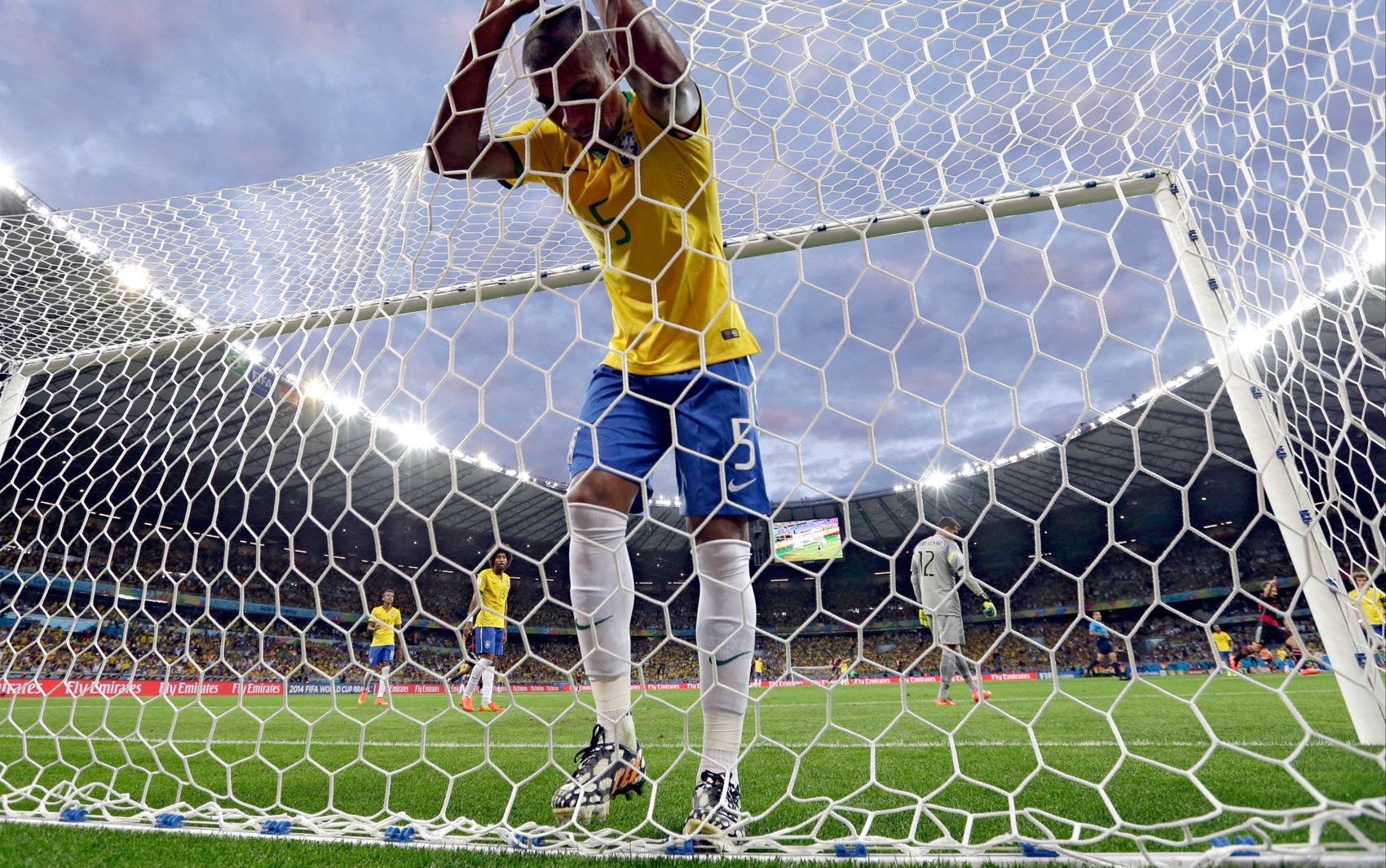
Brazilian player Fernandinho laments after Germany's third goal, scored by Toni Kroosduring, during the World Cup semi-final in Belo Horizonte. The Germans won 7-1 and qualified for the final
Natacha Pisarenko/AP/File
How the brain interprets pressure
For USP researcher Gustavo Drago, who participated in the preparation of Olympic athletes in Beijing, London and Rio, the point of intersection between sport and work is precisely in the nature of pressure and the way it is perceived.
When following athletes from 16 sports, he observed that people subjected to exactly the same conditions reacted in completely different ways, from a physiological, emotional and behavioral point of view.
⚽ One of the clearest examples appears in the comparison between competing "at home" and "away from home".
For some athletes, the adverse environment was interpreted as a threat.
This perception generated a measurable biological response, with an increase in cortisol, changes in the immune system and more hesitant behaviors, such as less physical intensity and less assertive decisions.
Others reacted in the opposite way. Faced with the same pressure, they viewed the context as a stimulus, which was associated with an increase in free testosterone, greater intensity and more competitive responses.
This principle is directly linked to the concept of "predictive brain", according to which the brain does not just react to the environment, but to the predictions it makes about it. Logic, according to Drago, helps to understand why similar corporate environments can generate such different experiences between professionals.
Two people can work towards the same goal, in the same team and with the same manager, but, while one maintains emotional stability, the other enters a continuous state of alert, explains the researcher.
And this state has a cognitive cost.
When the brain interprets the environment as a constant threat, it shifts mental resources towards self-protection, explains the researcher. Attention is no longer fully focused on the task and starts to be divided with thoughts of error, judgment, rejection or fear of loss of space.
⚠ In practice, this reduces creativity, impairs decision making, increases anxiety and favors defensive behaviors, such as procrastination, excessive perfectionism and difficulty in innovating.
In sport, this mechanism can make an athlete hesitate at a decisive moment. At work, this can translate into technically capable professionals who are unable to perform under pressure.
For Drago, this is one of the most critical points in the current corporate environment: the prolonged stay in a state of alert.
"The human brain interprets constant insecurity as a threat, and this directly compromises performance", he states.
Permanent evaluation
CLA Brasil's Audit lead partner, Thiago Brehmer, observes that this dynamic is reinforced by organizational structures that intensify continuous evaluation and short-term goals term.
"Both in sport and in the corporate environment there is a combination of pressure to perform and a constant feeling of evaluation", he says.
According to him, the problem is aggravated in cultures in which mistakes are treated as a character flaw, and not as part of the learning process, which amplifies fear, self-demand and insecurity.
This pressure has gained new layers with hyperconnectivity, according to Brehmer. If before there was a clearer separation between moments of charging and rest, today the evaluation seems permanent.
Athletes live with judgment in real time on social media. Professionals deal with constant metrics, digital exposure and continuous comparison on professional platforms.
The result is a feeling that it is necessary to perform all the time.
And it is exactly at this point that the sport distances itself, not due to the absence of pressure, but due to the existence of preparation.
➡ In high performance, the athlete is not expected to just "handle" the pressure. He is trained to deal with it before it even occurs.
There is structured preparation that includes visualization techniques, emotional control, attentional focus and recovery after an error. The objective is to reduce unpredictability and make critical situations more familiar from a mental point of view.
➡ In the corporate environment, these strategies are beginning to gain ground, but in a less systematic way, says Brehmer.
Visualization, for example, allows the brain to anticipate scenarios and reduce the feeling of threat. By mentally rehearsing a presentation or negotiation, the professional increases predictability and reduces reactivity.
Another central strategy is directing attention to controllable variables.
In sport, a swimmer can focus on the number of strokes, rhythm and breathing.
At work, this means focusing on preparation, clarity of reasoning, technical quality and execution, and not on external judgment or the fear of failure.
According to experts interviewed by g1, this shift has a direct effect on the brain: it reduces the state of threat and increases the capacity for concentration and mental efficiency.
Goalkeeper Hugo Souza was left out of the squad for the 2026 World Cup
GIF/ Hugo Souza
Frustrations
Another similarity between high-performance sport and the corporate world is in the way people deal with frustrations and unmet expectations.
In sport, being left out of a squad can lead to emotional disruption after years of preparation. At work, situations such as not getting a promotion or losing a strategic opportunity have a similar impact.
"Many people build part of their identity around performance", says Drago.
The risk arises when frustration stops being interpreted as an episode and starts to be incorporated as a personal definition.
It is the transition from "I couldn't" to "I'm not capable".
For experts, this change marks the transition from healthy frustration to destructive frustration, one that affects self-esteem, increases anxiety and can favor mental illness.
In sport, living with defeat is a structuring part of training. Athletes learn from an early age that losing is part of the process and develop mechanisms to transform frustration into adaptation.
In the corporate environment, this culture is even less consolidated.
"Many organizations are still focused on the idea of immediate success, and not continuous evolution", says Brehmer.
This difference extends to another fundamental point: recovery.
Recovery x productivity
In high-performance sports, rest is not seen as an unproductive break. It is part of the performance strategy itself. Physiological monitoring, load control, psychological monitoring and recovery techniques are used precisely to avoid a drop in performance and burnout.
The logic is simple: pressure without recovery reduces performance.
In the corporate environment, however, the association between productivity and constant availability still predominates.
Hyperconnectivity, long working hours and difficulty disconnecting create a scenario in which the state of alert stops being an exception and becomes standard.
Brehmer also argues that 'the human brain was not designed to operate continuously under threat.'
The effects appear progressively: anxiety, insomnia, decreased concentration, reduced creativity, emotional exhaustion and increased risk of burnout.
In addition, environments marked by psychological insecurity tend to reduce innovation and the quality of decisions, because professionals start to act to avoid errors, and not to generate results.
According to Drago, one of the main discussions in the coming years will precisely be understanding that sustainable performance is not just born from demand. It depends on factors such as trust, autonomy, psychological safety and a sense of belonging.
In other words, it depends on what the sport has learned before.
Source: G1