From Pelé to the 'Hand of God': the story of Azteca, the only stadium to host three World Cups
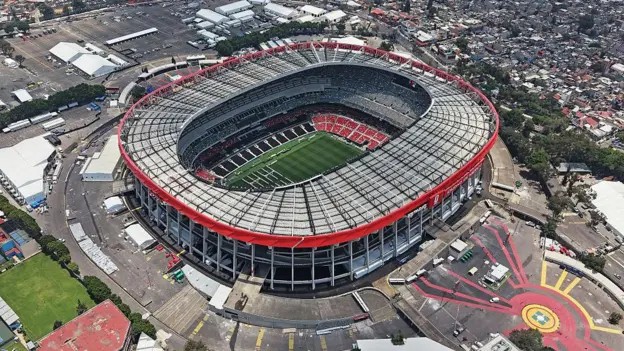
From Pelé to the 'Hand of God': the story of Azteca, the only stadium to host three World Cups
Getty Images
On June 11, 2026, when Mexico and South Africa take to the field in the opening match of the World Cup, a stadium almost 60 years old will achieve a feat that no other has achieved: hosting three World Cups.
The Azteca Stadium, in Mexico City, had already hosted the World Cups in 1970 and 1986 - and now it becomes the only one on the planet to have hosted the competition in three different editions.
But the Azteca's relevance to the history of football is not limited to the number of World Cups.
It was there that Pelé won his last world title and where Diego Maradona scored, in just a few minutes, the most controversial and one of the most celebrated goals of all time.
READ ALSO: Brazil has already won the World Cup in Mexico; see how the city of Pelé's tri is preparing to host another World Cup
A colossus built for the 1970 World Cup
Construction of the stadium began in 1962, under the design of Mexican architects Pedro Ramírez Vázquez and Rafael Mijares Alcérreca, and took around four years to complete.
The Azteca was opened on May 29, 1966, in a friendly between Club América and Torino, from Italy, which ended in a 2-2 draw. It was up to a Brazilian, Arlindo dos Santos, to score the first goal in the stadium's history.
Dos Santos is celebrated by Mexican América as one of the greatest players in the club's history.
Designed for more than 100 thousand spectators, the Azteca was born as one of the largest stadiums in the world and, from the beginning, was thought of as a showcase for major events.
Even before hosting a World Cup, it hosted football matches at the 1968 Olympic Games - and there was one of the largest audiences in its history, with almost 120 thousand people at the game between Mexico and Brazil.
Azteca Stadium in October 1968, during the Olympic Games
Getty Images
1970: a Pelé's triumphant farewell to the World Cups
Four years after its inauguration, the stadium hosted its first World Cup, in 1970.
Considered one of the best teams of all time, the Brazilian team reached the competition led by Edson Arantes do Nascimento, known as Pelé.
The Brazilian team had won world titles in 1958 and 1962 and was one of the favorites for the championship, with players like Gérson, Carlos Alberto, Tostão, Rivellino and Jairzinho in the squad.
Pelé opened the scoring in the 18th minute with a header after receiving a pass from Rivellino. Roberto Boninsegna equalized for Italy in the 37th minute.
But the Brazilian hurricane prevailed again with goals from Gérson (21 minutes into the 2nd half), Jairzinho (25 minutes) and Carlos Alberto (41 minutes).
It was in this match that Brazil won its third world championship, in a game that also marked Pelé's farewell to the World Cups.
Azteca Stadium was the stage for Pelé's Brazil's historic conquest
Getty Images
Before the decision, the stadium had already been the stage for one of the most remembered matches in the history of World Cups.
In the semi-final between Italy and West Germany, the Germans tied the match 1-1 after 90 minutes and took the win. clash for extra time. The extra time turned into a frantic sequence of comebacks: five of the match's seven goals were scored in just 30 minutes, in a duel that ended 4-3 for the Italians.
FIFA describes that extra time as "one of the most magnificent half-hours that a mass audience has ever seen in football". The confrontation became known as the "Game of the Century" and was so remarkable that the Azteca Stadium later installed a plaque to immortalize the match played on June 17, 1970.
The 'Game of the Century', between Italy and West Germany, in the semi-final of the 1970 World Cup
Getty Images
1986: the 'Hand of God' and the 'Goal of the Century'
A 'hand of God', one of the most famous moments in the history of sport, also occurred at Azteca
Getty Images
Sixteen years later, with Mexico once again as host, Azteca once again occupied the center of the World Cup.
On June 22, 1986, in the quarter-final between Argentina and England, Maradona scored two goals in the space of a few minutes - and each of them went down in history for opposite reasons.
The first came from the left hand of the number 10, in an infraction ignored by the referee. Years later, Maradona himself would summarize the episode as a goal scored "with the head of Maradona and the hand of God".
The second, however, was indisputable: a sprint that dribbled past half of the English defense and that FIFA would elect, in a vote, as the best goal in the history of the World Cup.
Argentina won 2-1, in a match marked by the political tension left by the Falklands War, which occurred four years earlier.
In the 1986 final, Argentina beat West Germany 3-2. With this, the Azteca consolidated a unique brand: it is the only stadium in the world to see both Pelé and Maradona become world champions.
It was also in the 1986 World Cup that the "ola" - the wave made by the fans in the stands - gained global recognition. Sports historians often associate the worldwide popularization of the gesture precisely with the Mexican audience at that World Cup.
For Mexicans, however, the Azteca is also associated with one of the greatest moments in the country's sporting history: the victory of the 1999 Confederations Cup, when the local team defeated Brazil 4-3 in front of more than 110 thousand fans. To this day, it is the main title for the Mexican men's main team in competitions organized by FIFA.
The stadium was also the scene of one of the most traumatic episodes for Mexican football. In 2001, Costa Rica beat Mexico 2-1 in the 2002 World Cup qualifiers, handing the hosts their first home defeat in World Cup qualifying matches. The result became known as "Aztecazo".
Renovation, new name and the third World Cup
For the 2026 World Cup - contested by 48 teams, the largest in history, in venues in Mexico, the United States and Canada -, the Azteca underwent an extensive renovation, starting in 2024 at the request of FIFA.
The works included comfort improvements, new seats, connectivity for fans and a hybrid pitch, with the capacity adjusted to around 90,000 seats.
The recent reforms were not the first to generate controversy. Over the last few decades, the stadium has undergone interventions that gradually reduced its capacity and expanded VIP areas, boxes and corporate suites, changes criticized by fans for altering the Azteca's aesthetics and traditional experience.
The pitch has also been at the center of controversy. In 2018, the NFL, an American football league in the USA, canceled a regular season match that would have been played at the Mexican stadium after complaints about the conditions of the field, affected by events held outside of football.
The renovation was accompanied by a change that generated discomfort among part of the fans: the stadium was officially renamed Banorte Stadium, due to a sponsorship agreement with the bank of the same name, valued at around 100 million dollars over 12 years.
It is not the first change of the stadium's name in six decades: between 1997 and 1998, it was called Guillermo Cañedo Stadium, in honor of the FIFA and América director who died in 1997, before changing its name to Azteca. prevent the use of the commercial name, and the arena will be identified as "Mexico City Stadium". For the majority of the public, it remains simply the Azteca.
In total, the stadium will host five matches in the 2026 World Cup, including the opening game.
And, on the night of June 11th, by hosting the ceremony and the first match of the tournament, it will complete the unprecedented feat of opening three World Cups.
The World Cup that arrives amid posters of missing people
Graffiti in Spanish with the words 'Mexico champion in disappearance'
Getty Images
A few days before the opening, the surroundings of the stadium became the scene of another type of mobilization. Relatives of missing people pasted posters with photos of their relatives around the stadium.
The surroundings of the inauguration stage were filled with images of wanted faces and banners demanding the government.
The so-called "mother searchers" carried banners demanding attention for a crisis that they say was ignored - one of them stated that more than 134 thousand people are missing - and chanted slogans such as "why are we looking for them? Because we love them".
Mexico has more than 130 thousand people missing and not located, according to records cited by the family members.
Mothers of missing people in Mexico distributed leaflets and protested
Gerardo Vieyra/NurPhoto via Getty Images
Part of the criticism targets the contrast in resources. Protesters claim that the World Cup will mobilize more than 10,000 public security agents, while families searching for their relatives have fewer than 20 police officers during excavations.
The mobilization gained strength after a report by the UN Committee against Enforced Disappearances (CED), released in April 2026, which showed signs that disappearances in the country could constitute crimes against humanity.
President Claudia Sheinbaum's government rejected the assessment, alleging methodological flaws and maintaining that the State does not use disappearance as a mechanism of repression.
Thus, the same pitch that crowned Pelé and Maradona is preparing to open, on June 11, a World Cup surrounded not only by sporting expectations, but also by one of the most sensitive discussions in the host country.
Mothers of missing people in Mexico distributed leaflets and protested
Getty Images
Source: G1