From grain to experience: how Caparaó transforms coffee into a tourist product and expands the potential of Southern ES
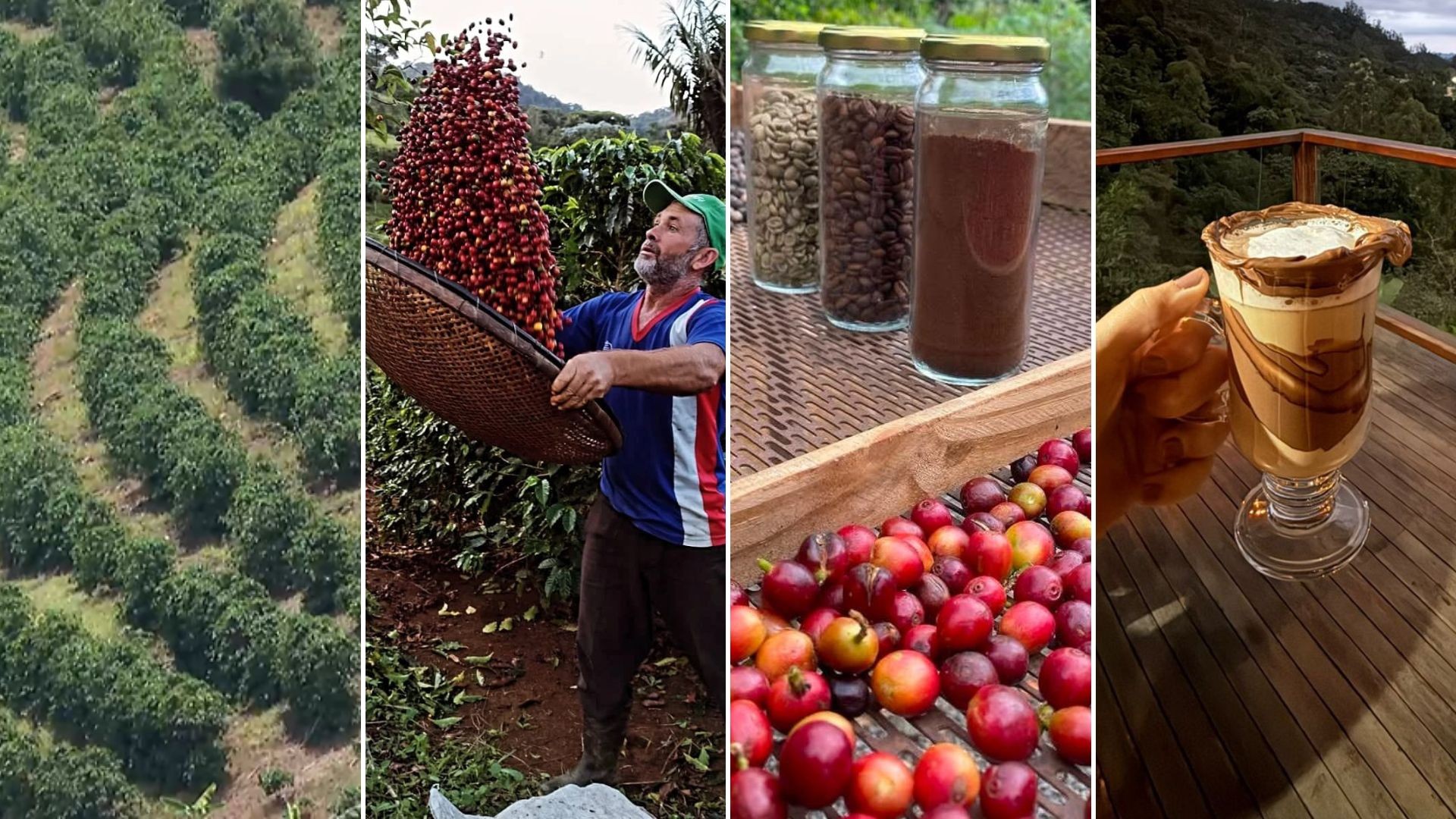
Coffee becomes a tourist product and expands the potential of Caparaó do ES
Known for its specialty coffees, waterfalls with transparent waters and Pico da Bandeira, the Caparaó region of Espírito Santo, in the south of Espírito Santo, has, since the beginning of this year, a new attraction that combines nature, gastronomy and local culture to boost the economy in the region.
Called "Experience with coffees of Caparaó origin", the project is an itinerary that aims to diversify income in the countryside and transform coffee growing into a tourist product, in all its production phases, exploring the destination beyond ecotourism.
📲 Click here to follow the g1 ES channel on WhatsApp
Passing through Divino de São Lourenço (district of Patrimônio da Penha), Dores do Rio Preto (headquarters and district of Pedra Menina), Ibitirama, Irupi and Iúna (district of São João do Príncipe), now it is possible to enjoy experiences on rural properties that were passed down from father to son and serve as a source of support for families.
In some of them, the experiences are more sensorial, with guided tasting; in others, tourists can follow the process of harvesting, drying and grinding special grains.
Café do Sol Nascente, in Iúna, Caparaó, Espírito Santo.
Disclosure
READ ALSO:
GUIDE FOR VISIT: Caparaó National Park: mountaineering, waterfalls and stunning landscapes to connect with nature
'PAU GIGANTE': discover the capital of pastel and the 2nd largest Buddha of the world
HISTORY: Discover the convent that is over 460 years old and is still in full swing in ES
There is also the option of ending the visit with a colonial coffee, as is the case with the family business responsible for Café do Sol Nascente, in Iúna. There, the producers receive, in a century-old mansion, visitors who stroll through the region and decide to take a break to eat on the balcony of the property that looks like something out of old movies.
"We have preserved the house for four generations, it is where my great-grandfather lived, a wattle and daub house located between several inns in Caparaó", explained entrepreneur Deisy Prottes, 42 years old, who manages the business.
Tourists' interest in the house, the lack of nearby cafes The city's tourist attractions and the family's experience in coffee growing were the perfect combination to bring about the idea for the business.
"We have worked with coffee all our lives, it was passed from generation to generation. Then, in 2024, we decided to open the house. The Caparaó region grew a lot, here we had several inns, restaurants, but not coffee shops."
Café do Sol Nascente, in Iúna, Caparaó, Espírito Santo.
Disclosure
Deisy's idea, which was supported by her father and brother who take care of the crops, however, only started to take off results from the structuring of the roadmap by the Espírito Santo Micro and Small Business Support Service (Sebrae/ES). She said that, before, she was losing hope that the initiative would work.
"Sebrae arrived and the team opened my eyes. I changed some things on the menu, we started guiding people along the coffee trail, showing how cultivation works. Now it's working really well."
Tourist Simone Brasileiro, 38 years old, from Campos dos Goytacazes (RJ), said that getting to know the place was an experience that goes far beyond coffee. "It's a place that truly welcomes you."
"Each room was transformed into a corner with tables, and everything there is very reminiscent of a grandma's cafe. That place where we feel safe, welcomed and want to stay.
There is a very emotional energy there", reported the photographer.
Tourist Simone Brasileiro experienced Caparaó in Espírito Santo and fell in love with the region's coffee.
Reproduction
The planning, which leveraged the Café do Sol Nascente business and nine other ventures in Caparaó, was aimed at offering a range of possibilities to increase the length of stay for tourists in the region's cities, as explained by Leonardo Ferreira, analyst at regional Caparaó do Sebrae/ES.
"We created the itinerary with the aim of having a 'menu', something comprehensive that would bring more capillarity to increase the length of stay for tourists. And, automatically, we are promoting the development of the region through these actions."
For the expert, the line between tourism and coffee growing in Caparaó is already very thin, considering that the region has great relevance in the production of national coffee.
"All this relevance, all this quality, has a very large interface with tourism. Furthermore, the climate in Caparaó is mild and there are several waterfalls."
Results for the economy and lessons for tourists
Café Cantinho da Floresta, in Divino de São Lourenço, Caparaó, Espírito Santo
Disclosure
Expanding the portfolio of attractions in Caparaó to further boost tourism in the region has become a demand due to the tax reform. Since the changes came into force, the municipalities of Espírito Santo have been looking for alternatives to resist the loss of revenue.
⁉️ With the reform, federal taxes, the state ICMS and the municipal ISS will be replaced by two new taxes: the Contribution on Goods and Services (CBS) and the Tax on Goods and Services (IBS). people consume.
According to the Sebrae analyst, tourism is one of the most effective ways to increase consumption in cities.
"Bringing tourism inside makes me bring money from other places into these municipalities, or into the State. So, what we want is to encourage consumption within the state so that this generates revenue for the municipalities and they are not so impacted by the new tax reform."
The Department of Culture and Tourism of Dores do Rio Preto, Denise Maria Silvério, states that the measure adds a lot of value to specialty coffees and to the region, and that, over time, it will promote improvements for the population itself.
"For us, it is extremely important that tourism grows more and more and the population embraces this cause to grow local consumption, generate income, generate revenue and generate improvements in the municipality as well. Because, with this, we are improving the roads, improving access, improving the visual and tourist part of the municipality."
But, in addition to generating revenue for the cities, the route has another impact. Under the slogan "from foot to cup", the project encourages the sharing of knowledge - which families who have worked with coffee for decades for decades have in abundance.
Café Cantinho da Floresta, in Divino de São Lourenço, Caparaó, Espírito Santo
Disclosure
For the rural producer Leôncio de Sousa Aguiar, 34 years old, this is, in fact, one of the main positive points of the project. "It adds value to the product and also brings learning", he argues.
Responsible for Café Cantinho da Floresta, in Divino de São Lourenço, Leôncio said that the family has been cultivating coffee on the same soil for more than a century. Having started special production in 2021, now he and his parents plan to open a café to provide a complete experience for their customers. visitors.
"We are going to take tourists to the farm, then to the yard, then there will be a tasting to show how we identify whether the coffee is special or not. This is because many people in big cities don't know about coffee.
He thinks it's an easy product that he planted there, harvested, pulled up, then planted again. But coffee requires care."
Irupi's Undersecretary of Tourism, Weuller de Souza, who is also a barista, adds. For him, the guided tastings are also responsible for providing "a lot of information about special coffee, specifically Caparaó, explaining the slogan 'naturally sweet, sensorially diverse'." They strive every day to continue producing, with great technique and quality, this product that today enhances the name of the region." Santo
Disclosure
Learning, however, is not restricted to tourists. With the development of the project, producers were invited to learn about experiential tourism and to develop, with the resources available on their properties, their own and authentic product.
Over the course of 7 months, Sebrae consultants monitored the 10 enterprises that make up the itinerary to help identify attributes that could become unique attractions and share suggestions for improvements.
The main idea was to build on what already existed. and what the owners wanted to create. Thus, explains Leonardo Ferreira, the producing family becomes the protagonist of the story, both of the coffee and the business.
"We have producers who have coffee and a garden, others who have a coffee shop, others who have two varieties of coffee. These are things that enrich the producer's story and give tourists a unique opportunity to have contact with something that is very emotional."
Sítio Bela Vista, in Ibitirama, Caparaó, Espírito Santo
Disclosure
From this movement, the producer also believes that the hard work in the field, which results in a special product, will be more valued. This is the case of Pedro Alves da Silva, 48 years old, from Sítio Bela Vista, in Ibitirama.
On the property, the tourist goes to the farm, understands all the coffee growing processes and ends the visit by visiting the producer's house to taste the coffee and taste homemade delicacies.
"The person who sees how the coffee is produced will be more interested, because arriving at the market and picking up a packet of coffee is one thing; seeing how it is made is very different", said Pedro Alves.
Capixaba Aline Oliveira, 33 years old, and her friends who left Greater Vitória towards Caparaó confirm this thought. "The coffee is produced right there. And then it's another experience, with the cold weather, the view, you know that the coffee is from there. The producer told how the process works. It's an award-winning coffee too.
It was a wonderful experience", he says.
Aline Oliveira and her friends went to Caparaó, in Espírito Santo, and tried the special coffee on a deck.
Reproduction
Check out options for coffee experiences in the Caparaó region of Espírito Santo:
Colonial cafe Rota das Garças
📍Dores do Rio Preto
☕ Colonial cafe with homemade products, fruits harvested in the backyard and country living.
Villa Januária
📍Pedra Menina, Dores do Rio Preto
☕ Guided tasting of specialty coffees in the middle of the inn's gardens, overlooking the Vale do Paraíso. Floresta
📍Divino de São Lourenço
☕ Experience the coffee cycle, from farming to tasting, with the history of family production.
Sítio Campo Azul
📍Divino de São Lourenço
☕Tasting special coffees and homemade delicacies in the middle of the mountains.
Café Relíquia
📍Divino de São Lourenço
☕Tour of the farm, artisanal roasting and tasting of award-winning coffees.
Sítio Bela Vista
📍Ibitirama
☕Experience of the coffee cycle with harmonized tastings and homemade delicacies.
Vale Encantado
📍Córrego dos Coelhos, Irupi
☕Pairing of coffees with milk candy and telling the local story.
Café Sol Nascente
📍Rio Claro, Iúna
☕Colonial cafe with traditional recipes and special coffees in a historic mansion.
Café do Príncipe
📍São João do Príncipe, Iúna
☕Experience with artisanal roasting, sustainability and tasting with local products.
Café do Sol Nascente, in Iúna, Caparaó, Espírito Santo.
Disclosure
Videos: everything about Espírito Santo
See the latest news from g1 Espírito Santo
Source: G1