Four defeats for Trump and three victories: see the main decisions of the US Supreme Court in the last two days
American justice maintains rule of automatic citizenship by birth in United States territory
The Supreme Court of the United States decided this Tuesday (30) to maintain a broad interpretation of citizenship by birth, thus rejecting an executive order signed by President Donald Trump that declared that children of illegal immigrants or tourists were not American citizens.
✅ Follow the g1 international news channel on WhatsApp
This was one of several decisions handed down in the last two days by the country's highest court. Seven of them were particularly important to the Trump administration. The result was balanced: the White House had three victories and four defeats.
The cases voted on were:
Automatic citizenship for those born in the USA (Trump's defeat)
Prohibition of the president firing the director of the American Central Bank, the Fed (Trump's defeat)
Accounting of votes sent by mail (Trump's defeat)
Maintenance of Trump's conviction for sexual abuse (defeat of Trump)
Maintenance of dismissal of a regulatory agency by the president (Trump's victory)
Ban on transgender athletes in female competitions (Trump's victory)
End of restrictions on coordinated campaign spending between parties and politicians (Trump's victory)
It is customary in the US for the Supreme Court to focus the release of several important decisions at the end of June, just before the summer recess, which ends the American judicial year.
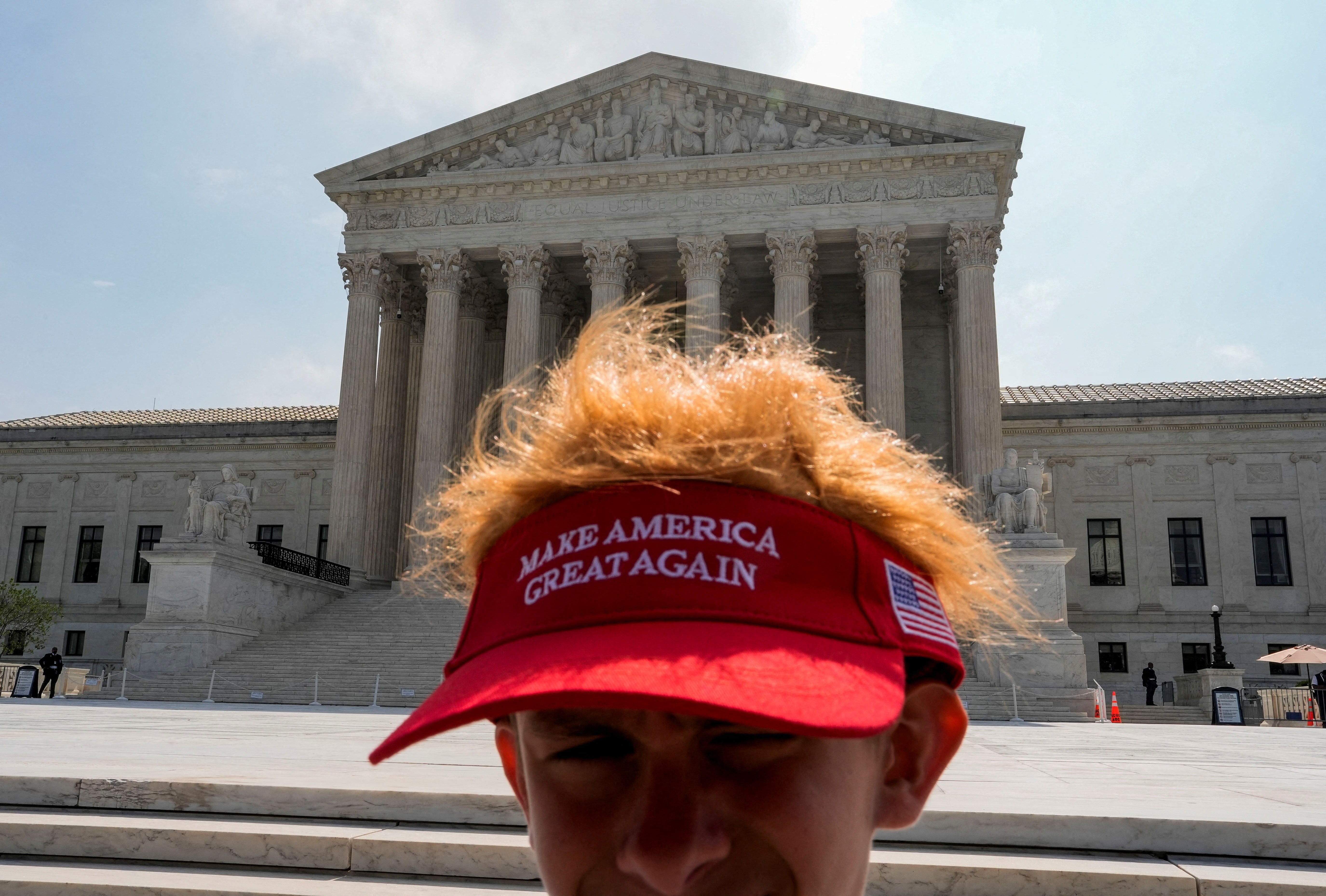
Trump supporter in front of the Supreme Court US Court in Washington, DC
Cheney Orr/Reuters
The court has taken a conservative turn, especially given Trump's appointments to the court in his first and second terms. This did not prevent his government from seeing unfavorable decisions in recent days.
Among the main victories, however, is the validation of Trump's decision to fire a head of a regulatory agency - in practice, the US Judiciary expands the president's powers to federal bodies that previously maintained relative independence.
See, below, which were the main judicial defeats and victories for Trump:
Defeats
Maintenance of the right to citizenship for all people born in the USA
By 6 votes to 3, the Court's judges confirmed a consolidated understanding of the 14th Amendment to the Constitution and concluded that anyone born in the country, with very limited exceptions, is a citizen of the United States.
➡ Historically, the United States grants citizenship on the principle of "jus soli", or right of soil: everyone born in American territory is American citizens, including children of tourists or immigrants. Exceptions are few and specific, such as for children of diplomats from other countries serving in the US.
On the first day of his second term, however, in January 2025, Trump signed an executive order limiting the granting of citizenship.
The Trump administration claimed that automatic citizenship encourages irregular immigration and the so-called "birth tourism", when foreigners travel to the country to have children and guarantee American citizenship for them.
Civil rights groups claim that the measure would serve to take away the rights of immigrants and ethnic minorities in the country. The decision was challenged in lower courts, and finally rejected by the Supreme Court.
In response, Trump asked the US Congress to create new legislation to redefine the concept of American citizenship.
Prohibition of the dismissal of the director of the Fed (equivalent to the US Central Bank) Lisa Cook
The Republican had announced the dismissal of the director last year, increasing pressure on the institution, which acts independently from the government.
The court, however, reversed its decision decision.
If he had succeeded, he would be the first president to remove a member of the Fed since its creation in 1913.
Lisa Cook, director of the Fed.
reuters
Allowing counting of mail-in votes after Election Day
Trump had promised last year to end the use of mail-in votes across the country ahead of November's midterm elections, in which his Republican colleagues are seeking to maintain control of Congress.
By 5 votes to 4, however, the Supreme Court reversed the decision of a lower court and ruled that states that so wish will be able to count votes posted in the mail until Election Day and received in the following days.
Rejection of request to overturn the decision on Trump's conviction for sexual abuse
The president wanted to overturn the decision of a jury that, in 2023, concluded that he sexually abused the writer E. Jean Carroll and later defamed her.
The Republican was ordered to pay compensation of US$5 million to the victim.
Victories
Permission for the president to fire heads of independent regulatory agencies
The court granted permission for President Donald Trump to fire a commissioner of the Federal Trade Commission (FTC), the independent federal agency that regulates competition in the country.
The decision expands presidential powers over the government and reverses the Court's own understanding of 1935, which had recognized Congress's authority to protect leaders of certain regulatory agencies from presidential dismissals. Last year, Trump removed Rebecca Slaughter from the FTC due to political differences.
Maintaining the right of states to ban transgender athletes from competing in women's college sports
The court, which has a conservative majority, found that state bans in Idaho and West Virginia do not violate the Constitution or the federal law known as Title IX, which prohibits sexual discrimination in education. As a result, decisions by lower courts that had ruled in favor of transgender students who challenged these bans fell.
Conservative judge Brett Kavanaugh, rapporteur of the court's analysis, wrote that "states can keep women's and girls' sports reserved for people of the female biological sex."
The decision was unanimous, by nine votes to zero. In other words, even the three liberal judges voted together with their conservative colleagues.
In a post on the Truth Social network, shortly after the announcement, President Donald Trump celebrated the decision. The agenda is part of the so-called "cultural war" waged by the Republican Party against measures considered liberal.
Groups defending the transgender population protest in front of the US Supreme Court, in Washington, DC
Kevin Lamarque/Reuters
End of restrictions on coordinated campaign spending between parties and politicians
The court ruled, by 6 votes to 3, that the spending limit violates the First Amendment of the US Constitution, which protects freedom of expression against restrictions imposed by the government. A lower court had considered these limits constitutional.
The decision benefits Republican candidates, who should have more money for their campaigns. This will be particularly important in the midterm elections next November, when Trumpists will try to maintain the Republican majority in the US Senate and House of Representatives.
Source: G1