Experts raise doubts about the death toll in Venezuela
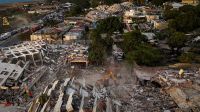
One week after two deadly earthquakes in Venezuela, the official death toll still appears surprisingly low to both Venezuelans and outside observers.
The interim leader, Delcy Rodríguez, stated this Thursday (2) that at least 2,595 people died in the earthquakes, an increase of 300 compared to the previous day's update.
A medical examiner, who asked not to be identified for fear of reprisals, told CNN she believes the government's death toll is far below reality, representing "not even a third of the real total."
The coroner reported that the makeshift morgue where she works in the port city of La Guaira - an area hit hard by the tremors - is processing around 400 bodies a day; Many of them are unrecognizable due to the trauma suffered or in an advanced state of decomposition.
There is no more space in the refrigerated trucks, which forces the team to leave the body bags outside in the sun, where they decompose quickly.
She's not the only one expressing skepticism. Opposition politicians, such as María Corina Machado, accused the government of minimizing the scale of the destruction. Venezuelans abroad have created unofficial means to report disappearances, as the government has not released official figures for days.
There are still many people under the rubble of tall buildings that collapsed, and it may take some time to get a full picture of the victims. CNN contacted the Venezuelan government to ask how the count is carried out and to request estimates on how many people are considered missing after the earthquakes.
"The situation in La Guaira is indescribable," said the coroner.
"There are so many cases, so many families. (The earthquakes) hit low-income families the hardest; they are the most affected," he added.
Many of these families bring the bodies of relatives that they themselves rescued from the rubble.
"They bring their dead themselves, because the Civil Defense, the firefighters and even the emergency services are unable to rescue all these bodies," she said. Although the death toll continues to rise and residents report that cemeteries are overwhelmed, Rodríguez insists that no one will be buried in mass graves.
Initial estimates from the US Geological Survey indicated a high probability that tens of thousands of people died in the back-to-back earthquakes of magnitudes 7.2 and 7.5.
The Venezuelan government, in addition to daily updates on the number of fatalities, did not present its own estimate for the final total of deaths.
"We are, without a doubt, facing a higher number than what has already been announced," said Gianluca Rampolla del Tindaro, United Nations coordinator for Venezuela, at a press conference on Tuesday.
"A war of information"
Critics see the official toll as evidence that the Venezuelan government is trying to purposely understate the death toll from the earthquake.
Distrust regarding death tolls is not unprecedented: after major landslides and floods in La Guaira in 1999, the government of the late Venezuelan president Hugo Chávez never released an official number of fatalities.
Machado stated, in a video posted on Instagram while in exile on Monday (29), that authorities are trying to hide information about the extent of the destruction, accusing the government of blocking communications. CNN contacted the Venezuelan government to request a position.
Machado, who left the country in December, said he tried to return this week to support response efforts, but accused the Venezuelan government of preventing his entry. Asked about her attempts to return, a US State Department spokesperson said: "Adding sensitive political issues to this scenario at this time is counterproductive to our response efforts in the wake of this tragedy."
On Sunday (28), the human rights organization Provea stated that the "official earthquake figures raise more questions than answers."
"We need full transparency in responding to this national tragedy," the NGO added.
However, David Smilde, a sociologist at Tulane University and an expert on Venezuela, is not convinced that the government would purposefully alter or downplay the numbers, given that the magnitude of the tragedy has attracted a large amount of aid.
"We will need more studies, concrete research and understanding before speculating that the government is hiding the death toll," Smilde told CNN.
"I'm not entirely sure that the government has a great motivation to reduce the number of fatalities, when it can use this data precisely to try to obtain more international aid", he added.
Smilde also pointed out some fundamental differences between the current situation and the 1999 landslides in La Guaira.
At that time, the floods were so intense that some bodies were washed into the sea and found even in Curaçao. Others "were simply buried and never rescued. So there was no real list that could be confirmed as to how many people were missing."
"In the case of Venezuela", warns Smilde, "there is a great tendency towards politicization. Basically, everything that happens in the country ends up being used by one side or the other in local power disputes. This applies to both the government and the opposition."
Sociologist Rafael Uzcátegui, director of the Laboratorio de Paz study center, stated that the Venezuelan government suffers from inefficiency and political clientelism, which makes it difficult to disseminate accurate information.
"The government is aware that this could delegitimize Delcy Rodríguez after the tragedy, raising questions about the capacity of the State and its management of resources," Uzcátegui told CNN.
Faced with a lack of information, some Venezuelans have turned to unofficial websites to obtain data on the number of missing people.
One of these channels is "Venezuela Reporta", a collaborative database that brings together posters of missing people and estimates that tens of thousands of people are missing after the earthquakes. CNN was unable to verify the numbers presented by the database.
A Venezuelan businessman based in Miami told CNN that he created the database with Claude Code just hours after the earthquake. He asked CNN not to publish his name for fear of reprisals from the Venezuelan government, which, according to him, was hiding the real number of deaths.
"This is now an information war," he told CNN. The government is unable to release the real death toll "because, at the end of the day, it will show that they were extremely inefficient."
The government reported that it is carrying out a survey of the number of people who were in the most affected areas at the time of the earthquakes. The president of the National Assembly, Jorge Rodríguez - Delcy Rodríguez's brother - said on Tuesday that there were around 30,000 people in the worst-hit areas of the state of La Guaira; Of these, approximately 20,000 managed to escape or were rescued.
No DNA tests
In an interview with CNN, directly from Caracas, the pathologist reported that she and her colleagues are overwhelmed. Although Venezuela has received significant assistance from abroad for rescue and recovery operations, it has yet to see volunteer pathologists to assist with the preparation and identification of bodies.
She explained that, as many bodies are in an advanced state of decomposition, family members are forced to identify them through tattoos, dental treatments or clothing. DNA tests are too expensive in Venezuela.
"Many children are arriving, and they are so decomposed that their families won't be able to recognize them," she said. The situation has been a huge emotional burden.
"I haven't been sleeping well. It's horrible," he said.
Karelis D'Wuentt traveled by bus for an entire day from San Félix to Caracas to identify her 22-year-old brother at a local morgue.
She told CNN that she is exhausted. The brother had been rescued from the rubble of a building that collapsed on the first night of the earthquakes, but died on Tuesday night from his injuries.
"I identified him because he has a tattoo here," she said, pointing to her neck.
"I have other family members who also died," he said.
In total, D'Wuentt has 12 family members still missing; three of them were found dead, including his brother. When the CNN team dropped her off at the morgue, she was waiting outside for her younger brother's body to be released.
She doesn't know how she will pay for the funeral.
(With information from Mauricio Torres, from CNN in Spanish)
Understand how the strength of earthquakes is measured
Source: CNN