Exoplanet four times bigger than Jupiter is being "roasted" in the heat
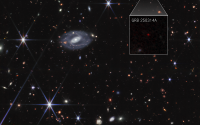
An exoplanet (planet outside the Solar System) with four times the mass of Jupiter has been spotted by NASA's James Webb Space Telescope, orbiting very close to a star similar to the Sun.
Named HD 80606 b, the planet reaches 1,100 degrees Fahrenheit (about 593 ºC) as it approaches its star. The exoplanet has been nicknamed the "roasted exoplanet."
According to the research team that presented preliminary studies on the discovery last Tuesday (16), at the 248th meeting of the American Astronomical Society, in Pasadena, California, the exoplanet's dynamic conditions make it a target for observations of changes with the Webb.
Birth of planets outside the Solar System is recorded for the first time | CNN PRIME TIME
"Observing a planet like HD 80606 b is actually very efficient, because its unusual orbit, with corresponding variations in temperature and chemical composition, allows us to collect data under changing conditions in just a few hours and apply these findings to other hot Jupiters or more conventional exoplanets," said Laura C. Mayorga, study co-investigator and exoplanet astronomer at the Johns Hopkins Applied Physics Laboratory in Laurel, Maryland.
Temperatures and chemical composition were measured using spectroscopy, a technique used to decompose light into its component colors, revealing information about the composition, temperature, movement and physical properties of objects in space.
The observation of HD 80606 b was planned for years, planning to schedule a date when the planet would be in the ideal spot, as its 111-day elliptical orbit and Webb's observation constraints were complex.
Bright Jupiter can be seen with the naked eye this Saturday (10); find out how | NOW CNN
The telescope's MIRI (Mid-Infrared Instrument) was used to observe before, during and after its closest passage to its star. During this period, the planet also passed behind the star, a phenomenon called a secondary eclipse.
Researchers claim that they have begun to unravel layers of a data set and can now clearly observe a drastic change in the exoplanet's temperature.
See the main astronomical discoveries
-
Swap imageSwap imageSwap image
1 of 33
Discoveries of 2026 - (1): Astronomers at the European Southern Observatory have identified a "shock wave" around a dead star. The phenomenon was formed from a collision between gas and dust ejected by the dead star RXJ0528+2838, and was identified with the help of the VLT (Very Large Telescope) - ESO/K. Iłkiewicz and S. Scaringi et al. Background: PanSTARRS
-
Change imageChange image
2 of 33
Discoveries of 2026 - (2): Jupiter's moon Europa is on the short list of places in our Solar System considered promising in the search for life beyond Earth, with a large underground ocean believed to be hidden beneath an outer layer of ice. However, new research is raising doubts. After modeling conditions on Europa, the researchers concluded that its rocky floor is probably too mechanically strong to allow this type of activity. - NASA/JPL-Caltech/SETI Institute
-
Swap imageSwap imageSwap image
3 of 33
2026 Discoveries - (3): The solar wind, in combination with Earth's magnetic field, has been transporting particles from our planet's atmosphere to the Moon's surface for billions of years, reveals research from the University of Rochester - Shubhonkar Paramanick/University of Rochester
-
Change imageChange image
-
Swap imageSwap imageSwap image
4 of 33
Discoveries of 2026 - (4): Astronomers may have discovered a previously unknown type of object, dubbed "Cloud-9", that could shed light on dark matter. Research published in The Astrophysical Journal Letters shows that Cloud-9 is a cloud of dark matter that may be a remnant of the formation of galaxies in the early universe - NASA/ESA/VLA/Gagandeep Anand/Alejandro Benitez-Llambay/Joseph DePasquale
-
Change imageChange image
5 of 33
Discoveries of 2026 (5) - An object from space collided with Earth around six million years ago, scattering fragments across Brazil. Only now, in 2026, has science been able to confirm the event, which gave rise to pieces of glass known as tektites. - Álvaro Cóstra/Unicamp
-
Swap imageSwap imageSwap image
6 of 33
Discoveries of 2026 (6) - Observations carried out by the James Webb Space Telescope have identified hundreds of small reddish objects in deep images of the early Universe. A study led by Rusakov et al., published in the journal Nature in January, presented a new interpretation for these objects. According to the authors, LRDs correspond to black holes in the initial growth phase - Reproduction NASA, ESA, CSA, STScI, JWST; Dale Kocevski (Colby College)
-
Change imageChange image
-
Swap imageSwap imageSwap image
7 of 33
Discoveries of 2026 (7) - Astronomers have long searched for clues that a hidden companion star lies out of sight near the red supergiant Betelgeuse. Now, they have discovered new evidence: a boat-like wake across Betelgeuse's upper atmosphere, likely formed by the invisible companion - Elizabeth Wheatley/ESA/NASA
-
Change imageChange image
8 of 33
Discoveries of 2026 (8) - An international team of astronomers revealed the discovery of an unprecedented structure of ionized iron inside the Ring Nebula. Scientists have detected the narrow "bar" that emits light specifically through iron atoms - James Webb Space Telescope
-
Swap imageSwap imageSwap image
9 of 33
Discoveries of 2026 (9) - A team of astronomers, with the help of ALMA (Atacama Large Millimeter Array), a radio observatory in Chile, managed to record 24 debris disks around stars in high resolution. The photographed rings are part of the Kuiper Belt, which is in the same Solar System as Earth, after Neptune. - Disclosure/ESO
-
Change imageChange image
-
Swap imageSwap imageSwap image
10 of 33
Discoveries of 2026 (10) - Astronomers recorded one of the most impressive examples ever seen in space after observing the presence of a black hole "reborn" after 100 million years of inactivity in a scene compared to the eruption of a "cosmic volcano". According to the study published in the scientific journal Monthly Notices of the Royal Astronomical Society, the phenomenon was observed in the center of the galaxy J1007+3540 - LOFAR/Pan-STARRS/S. Kumari et al.
-
Change imageChange image
11 of 33
Discoveries of 2026 (11) - Artist's concept of candidate exoplanet HD 137010 b, nicknamed "Cold Earth" because it is a possible rocky planet slightly larger than Earth, orbiting a Sun-like star about 146 light-years away - NASA/JPL-Caltech/Keith Miller (Caltech/IPAC)
-
Swap imageSwap imageSwap image
12 of 33
Discoveries of 2026 (13) - A 13-atom molecule containing sulfur (as seen in this illustration) was discovered in interstellar space for the first time. Researchers consider the discovery a "missing link" in understanding the cosmic origins of the chemistry of life. - Disclosure/ MPE/NASA/JPL-Caltech
-
Change imageChange image
-
Swap imageSwap imageSwap image
13 of 33
Discoveries of 2026 (14) - Jupiter is, without a doubt, the largest planet in our Solar System. However, a recent discovery has shown that it is not as big - by a very small margin - as scientists thought. According to Juno observations, Jupiter has an equatorial diameter of 142,976 km (88,841 miles), approximately 8 km (5 miles) smaller - NASA
-
Change imageChange image
14 of 33
Discoveries from 2026 (15) - Scientists are monitoring the behavior of a supermassive black hole that has specific disordered eating habits. Using mostly radio telescopes in New Mexico and South Africa, they follow the black hole, located at the center of a galaxy far beyond the Milky Way, as it continues to expel a high-speed jet of material after ripping apart and devouring a star that made the mistake of getting too close - NASA
-
Swap imageSwap imageSwap image
15 of 33
Discoveries from 2026 (16) - A new analysis of radar data from Venus, obtained by NASA's Magellan probe in the 1990s, indicated the presence of an underground cavity created by a lava flow, the first underground structure ever detected on Earth's neighboring planet - Disclosure/RSLab, University of Trento
-
Change imageChange image
-
Swap imageSwap imageSwap image
16 of 33
Discoveries of 2026 (17) - Imagine all of Earth's oceans, which cover about 70% of the planet and are composed mainly of hydrogen. Now multiply that by nine. That could be the amount of hydrogen in Earth's core, scientists reported in the journal Nature Communications. - Tumeggy/Science Photo Library RF/Getty Images
-
Change imageChange image
17 of 33
Discoveries of 2026 (18) - Researchers have tracked a large, bright star that, in its death throes, practically disappeared from view as it turned into a black hole without exploding. Now, it is only detectable due to a subtle glow caused by the heating of the remaining gas and dust, which is sucked into the newborn black hole's irresistible gravitational pull. The star, called M31-2014 - DS1, was located in the Andromeda Galaxy - Keith Miller, Caltech/IPAC - SELab
-
Swap imageSwap imageSwap image
18 of 33
Discoveries from 2026 (19) - An exoplanetary system about 116 light years from Earth could completely change the way planets form. Four planets orbit LHS 1903 - a red dwarf star, the most common type of star in the Universe - and are arranged in a peculiar sequence. - Reproduction/ESA
-
Change imageChange image
-
Swap imageSwap imageSwap image
19 of 33
Discoveries of 2026 (20) - A view of Saturn and Titan, the planet's largest moon, captured by the Cassini spacecraft. Researchers suggest that an ancient collision of Saturn's largest moon with another celestial body may have given rise to the rings - NASA/JPL-Caltech/Space Sciences Institute
-
Change imageChange image
20 of 33
Discoveries of 2026 (21) - The European Space Agency (ESA) released a stunning photograph of the interstellar comet 3I/ATLAS. It was Juice's first record of the comet's passage. - ESA/JUICE/JANUS
-
Swap imageSwap imageSwap image
21 of 33
Discoveries from 2026 (22) - Celestial bodies with a shape similar to "snowmen" are more common in the Solar System than previously imagined. The curious shape, marked by two joined blocks, is the result of the slow merger of smaller objects at the beginning of planetary formation. The best-known example is Arrokoth, visited in 2019 by the New Horizons probe - Reproduction/Google
-
Change imageChange image
-
Swap imageSwap imageSwap image
22 of 33
Discoveries of 2026 (23) - Astronomers have identified a galaxy so faint it is almost invisible - a discovery that could help shed light on one of the most elusive substances in the Universe. Researchers have found Candidate Dark Galaxy-2, or CDG-2, using the Hubble Space Telescope, and believe it is made up of at least 99.9% dark matter - Li (utoronto), Ima/ESA/NASA
-
Change imageChange image
23 of 33
Discoveries of 2026 (24) - Astronomers say the mysterious "little red dots" observed by the James Webb Space Telescope may be giant stars from the early Universe, not black holes, as initially thought - Bangzheng "Tom" Sun
-
Swap imageSwap imageSwap image
24 of 33
2026 Discoveries (25) - Scientists have obtained the most complete, high-resolution map of the cold gas at the center of the Milky Way, which contains the raw material from which stars and planets are formed. The image information could help astronomers understand the origin of our solar system. The image is the result of a four-year international effort, using one of the most powerful telescopes on Earth, the Atacama Large Millimeter/submillimeter Array, or ALMA, a set of more than 50 radio antennas spread across a plateau in the Chilean Andes - ALMA(ESO/NAOJ/NRAO)/S. Longmore/D. Minniti et al.
-
Change imageChange image
-
Swap imageSwap imageSwap image
25 of 33
Discoveries of 2026 (26) - An intense fireball crossed the sky in Europe at around 2:55 pm on Sunday (8/3), leaving a trail of smoke. The glow lasted approximately six seconds, according to the European Space Agency (ESA). The record was observed by many people in Belgium, France, Germany, Luxembourg and the Netherlands. - AllSky7/ESA
-
Change imageChange image
26 of 33
Discoveries of 2026 (27) - A superluminous supernova involving a huge star in a galaxy about a billion light-years from Earth is now helping scientists solve this mystery. Researchers determined that it became extremely bright because the explosion left behind a magnetar, an extremely compact, rapidly rotating stellar remnant with an immensely powerful magnetic field - Joseph Farah and Curtis McCully
-
Swap imageSwap imageSwap image
27 of 33
Discoveries from 2026 (28) - A study published in the scientific journal Astronomy & Astrophysics suggests that the Sun may not be exactly in its place of origin. According to the researchers, the Solar System star may have been born in a region closer to the center of the Milky Way and migrated over billions of years to its current position. - NASA
-
Change imageChange image
-
Swap imageSwap imageSwap image
28 of 33
Discoveries of 2026 (29) - Astronomers have identified a possible new type of planet outside the Solar System, with a molten interior and a sulfur-rich atmosphere. The object, called L 98-59 d, is about 35 light-years from Earth and was analyzed using data from the James Webb Space Telescope and ground-based observatories. The planet's interior may be made up of molten rock, similar to lava - Mark A. Garlick
-
Change imageChange image
29 of 33
2026 Discoveries (30) - A supernova - the explosive death of a star - is always violent, hurling material into space and usually leaving behind a compact stellar remnant, like a neutron star or black hole. But some supernovae involving the biggest stars in the cosmos can be so immensely powerful that they leave absolutely nothing behind - Monash University
-
Swap imageSwap imageSwap image
30 of 33
2026 Findings (31) - Daily satellite observations have revealed a continued increase in nighttime brightness around the world due to artificial lighting, with important regional variations, including an increase in sub-Saharan Africa and Southeast Asia, along with a deliberate reduction in Europe, driven by concerns about energy conservation and light pollution. - Reuters
-
Change imageChange image
-
Swap imageSwap imageSwap image
31 of 33
Discoveries of 2026 (32) - A new image reveals a dazzling celestial object - a star, paired with another, in the process of dying, that resembles a crystal ball. Scientists captured an image of NGC 1514, nicknamed the Crystal Ball Nebula, with the Gemini Multi-Object Spectrograph. The instrument is installed on the Gemini North telescope, located on Maunakea, a dormant volcano in Hawaii. - Gemini International Observatory/NOIRLab/NSF/AURA
-
Change imageChange image
32 of 33
2026 Discoveries (33) - By reanalyzing data involving a specific type of stellar explosion, a team of researchers claims to have confirmed the long-accepted notion that the universe is expanding at an accelerating rate - the same observation that led to the identification in the 1990s of an enigmatic cosmic force called dark energy. The study results refute research published last year that concluded this cosmic expansion is no longer accelerating - a finding that had challenged basic understanding of the universe. - Pexels - Del Woodcock
-
Swap imageSwap imageSwap image
33 of 33
2026 Discoveries (34) - An exoplanet (planet outside the Solar System) four times the mass of Jupiter has been spotted by NASA's James Webb Space Telescope, orbiting very close to a Sun-like star. Named HD 80606 b, the planet reaches 1,100 degrees Fahrenheit (about 593 ºC) as it approaches its star. The exoplanet was nicknamed "roasted exoplanet" - Reproduction | NASA, ESA, CSA, Joseph Olmsted (STScI)
-
Change imageChange image
-
-
-
-
-
-
-
-
-
-
-
-
-
-
-
-
-
-
-
-
-
-
-
-
-
-
-
-
-
-
-
-
-
default view
full view
grid view
Tiffany Kataria, the study's principal investigator at NASA's Jet Propulsion Laboratory in Southern California, reports that "Webb showed that the planet's temperature rise was even more extreme than we predicted based on the Spitzer data."
NASA's currently decommissioned Spitzer Space Telescope laid the groundwork for infrared observations of HD 80606 b, showing that more detailed spectroscopic data from Webb would be especially convincing.
Image shows gigantic Elephant Trunk Nebula in space
*Under AR supervision.
Source: CNN