Emicida compares Racionais to Pelé, criticizes conservative rappers and regrets exposure of his personal life
Emicida compares Racionais to Pelé and regrets exposure of his personal life
In December 2025, Emicida returned to the news with a new album, "Same Cores and Same Values", which pays homage to Racionais MCs and the São Paulo group's album "Cores e Valores", released in 2014.
However, in the previous months of that year, the rapper experienced "horrible" moments, as he himself defined, with the death of his mother, Dona Jacira, and the legal dispute with her brother, Evandro Fióti, on behalf of the company Laboratório Fantasma. Very reserved, Emicida saw his personal life exposed.
However, the celebration of the work of his idols was more than a refuge for the singer. It served to affirm his own quality as an artist and to place Racionais in what he considers its rightful place.
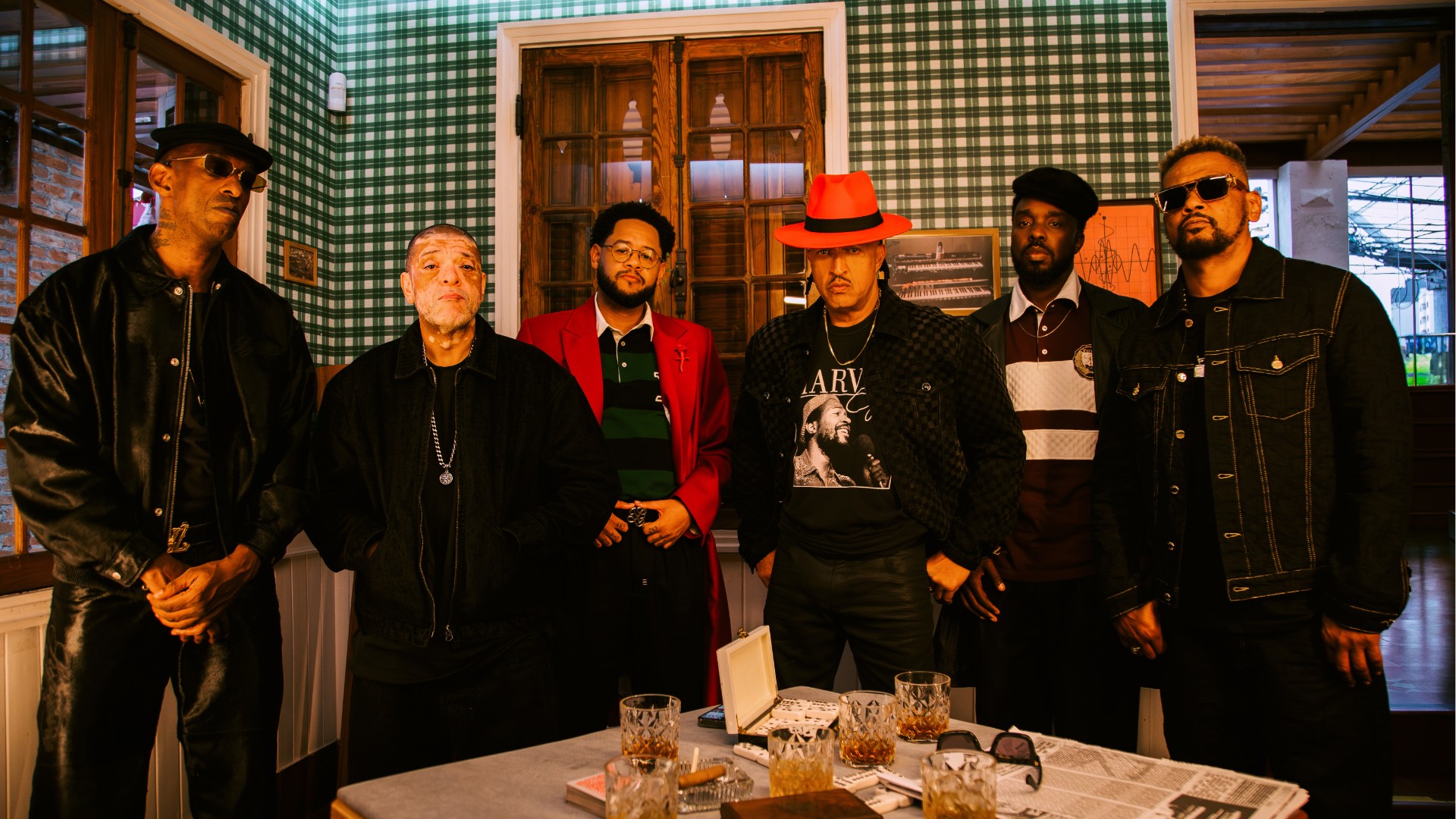
Ice Blue, KL Jay, Emicida, Mano Brown, DJ Nyack and Edi Rock
Jef Delgado/Disclosure
In an interview with Podpah, Emicida himself classified it as "controversial" to place Racionais as the biggest rap group in history.
But why, if Brazil consumes so much rap, placing the biggest group of the genre among the greats of music makes people afraid of this type of statement?
"It's not the parallel itself, but the size of the tension it causes. When you praise Racionais in this place, it's not that it's out of place. It's like looking at a belly goal and looking at a Pelé goal."
"The size of Racionais is the size of Pelé, the size of Pixinguinha, the size of Nise da Silveira. Racionais needs to be understood within this key."
To g1, the rapper explained how he assesses the reception of his album, six months after its release, with so many references included and a tour that, this weekend, will take place in Curitiba (27/06) and Porto Alegre (04/07), how he prepared his show and how he sees rap's relationship with a portion of Brazilian conservatism.
Cover of the album 'Emicida Racional VL.2: Same Colors & Same values'
Credits: Walter Firmo/Cecropia
Check out the full interview below:
g1: "Cores e Valores", by Racionais, completed a decade and to this day there is debate whether the album was understood in its entirety. Your new job is six months old, and I imagine it's still "under construction" in that regard. How do you see the public's acceptance?
Emicida: I'm very happy with the intellectual quality that the fans bring back to me. The way the record was absorbed generated a very intimate experience because it has this pain and light drawn in very sensitive ways. For some people, for example, it was and is a difficult album to listen to. That's crazy, right?
And this is not understood as a problem to be solved. But, emotionally it opens up so many things that, in order not to articulate it at any moment, people prefer to listen to it alone, in a broken way.
g1: Is there any specific message in this album that you think people haven't accessed yet and you wanted them to understand better?
Emicida: Bro, there's a lot. There is a very large universe of things there to be understood. But I think it's not necessarily what they accessed or didn't access. It is the tension that an artist manages to establish among the community that follows his work.
This is an album that will be new for the next 100 years. I tell you with absolute tranquility. When people meet Dona Edith do Prato [Brazilian percussionist] inside, they'll be like: "Oh my God", you know?
Emicida: "It's a difficult album to listen to"
g1: And this is also a very visual album. You've already released a clip, lyric video... Do you think about releasing more things? How is your image production relationship?
Emicida: We captured everything from the production. We are starting to structure a documentary now. We have very rich material at hand and, in itself, the material from the recordings is already very exciting. And we want to start having a more regular presence on social media.
I'm a guy who uses social media in a very rarefied way, man. I need to become a better content creator - that's what my friends say.
Everyone says: "Bro, you had to explain that, people aren't going to achieve that alone, man."
g1: You said you think it's controversial that "Racionais is the biggest rap group in history" and, these days, music curator Lúcio Ribeiro also stated that "Sovivendo no Inferno" is the biggest Portuguese-language album in the country. Do you think these phrases are only "controversial" because of the references to a rap group? If rap in Brazil mobilizes the masses, becomes mandatory reading in college entrance exams, etc., it shouldn't be absurd to talk about Racionais from this perspective, right?
Emicida: Right, bro, but the question is this: it's not the parallel itself, but the amount of tension it causes. So, in this sense, a compliment like this is a problem similar to the one that Brazilian archeology perhaps faces. When you go outside Brazil, there are a lot of TV programs showing excavations and saying: "look here at our history". It's a way to connect with the past and keep its cultures and traditions alive. Brazilian archeology has a paradox: in many parts of the country, what is buried does not match what is written in history books.
When you praise Racionais in this place, it's not out of place. Everything you said is true, I sign below. The point is that a victory of this size is like looking at a Pelé goal and looking at a belly goal, bro. The size of Racionais is the size of Pelé, Pixinguinha, Nise da Silveira, Santos Dumont. Racionais needs to be understood in this light. Tom Jobim, Elis Regina, Chico Buarque's pen.
Perhaps the wisdom to look at this parade is to think in terms of capoeira: it's a dance, but it's a fight. This is how I understand Brazilian culture: it is a dance, but it is a fight. The intellectual dimension is there, but the guys did it dancing and fighting at the same time. This makes the victory much tastier for us.
Racionais is "the size of Pelé", says Emicida
g1: I wanted to ask a two-sided question: the first part, in a celebratory way, is the size that rap has found in the market. You're touring the country; BK', for example, will be the first rap artist to perform in a stadium. How do you see this arrival in the market that was previously very difficult, few houses made room for rap...
Emicida: I think this, firstly, is a huge achievement. It is the dream of all of us who helped carry and build a brick of this bridge. Any of us who bring the truth as big as the truth that BK is bringing and occupy the biggest stages is an achievement for the movement as a whole. The size that the culture has reached in terms of popularity has been a wonderful parade.
But one thing is the perception and reach of rap music, another thing is its belonging to hip-hop culture. This has yet to be recognized in its full extent in a society like ours, not because of a lack of substance, but because this collective dimension sounds like a radical dimension of hip-hop culture's stance.
The industry tends to absorb the part that is closest to it. In this dimension, rap music is the easiest to synthesize on this scale. We can operate there, but the truth of all this only remains shiny and solid because of the stop I mentioned: someone like BK' makes this victory huge in both fields.
g1: But, at the same time, we see - and this was the second part of the question, the most critical part - how rap, at the same time as it invaded festivals in the last two years, has been losing this space. We hear, especially from those who work at festivals, that "there is a lack of quality in rap shows", that there are a lot of pyrotechnics and little technique. How do you see this criticism and this reduction in the space that rap had gained within major festivals?
Emicida: I believe that the market has several overlapping trends. Right now, I think there's a really cool effervescence going on with independent artists and producers remapping their scene, city by city.
It has already happened in São Paulo, in Rio, and I am sure that it is happening on a much larger scale than what the Southeast is achieving. Why? Because the cultural dimension is broader than the industry dimension. This is not a demerit to the industry, because it captures a smaller spectrum, everything is fine, it is in this dimension that it generates value. But the value of culture is a difficult value to put into numbers, because it is what oxygenates these networks.
These networks have been reorganized so that the value of rap music is not only captured or left under the judgment of people who have a contradictory conception.
For shows of other genres, this type of technical quality is not a relevant factor, you know? But when it's an artist who has the kind of discourse that legitimate rap has, it's demanded that he get there with the Paris Symphony.
Rapper Emicida in rehearsal for the album "Same Colors & Same Values"
Walter Firmo/Cecropia
g1: Did you use the term 'legitimate rap' for any specific reason? I don't know if I understand...
Emicida: Today many people talk about rap, but they have never been to a rap show. Many people listen to rap, and all of this is wonderful, but they are not necessarily close to what we can say the hip-hop movement would be. In this sense, when I use the word "legitimate", it is because I am talking about a trajectory that starts from the collective seed and will understand rap music within this spectrum. This is what I understand, within the five elements, to be a legitimate victory for the hip-hop movement.
g1: Two articles came out in recent weeks, one by [political scientist] Pedro Abramovay and another by [Rio de Janeiro councilwoman] Thaís Ferreira, which talk about the transformation of Brazilian society by the Lula governments based on the work of Racionais and yours. But, at the same time, I keep thinking about how rap, specifically in the last decade, has seen the growth of a kind of reaction from new artists who dialogue with a more reactionary, neoliberal discourse and flirting with the extreme right. How do you see this increase in artists who dialogue with a political current that is contradictory to the discourse of hip-hop culture?
Emicida: There is a statistic that says that only 10% of the population of Brazil has the full capacity to functionally interpret a text. This type of cut ends up applying to each of the subsectors of a society.
Brazil has a conservative society, however contradictory that may be. We will encounter this type of discourse within cultures that have reached the scale that rap music has reached.
Now, the contradiction that cannot be sustained there is wanting to make sense within the environment of what I called here legitimate rap and hip-hop culture. Because in this environment - and here I'm not saying that there aren't people who can have conservative positions, the cut makes sense in the small spectrum too -, the pillars that support what this culture considers most sacred are contradictory to many of the discourses of this type of artist that you mentioned.
Emicida sees contradiction between rap and conservative speech
g1: And what was it like for you to go to a freestyle battle with Jotapê who said several times that he was inspired by Emicida to be the artist he is and what was it like seeing the environment of this youth that has you as the biggest mirror?
Emicida: Bro, I don't know how big a thank you I owe to Jotapê. Not only because of the incredible artist he is, but because of the sensitivity and collective thinking he has. As I said, he is a direct and legitimate son of freestyle battles. He comes from the street. He's a black kid who has a very sensitive perception of reality and a very broad artistic desire.
When I fight in battles, I'm more relaxed so as not to generate too much frisson. What Jotapê offered me was a very beautiful perspective of a generation that appears half my age and says: "Bro, you and your generation planted wonderful seeds. Look at what these seeds have become, I'm one of them".
That's what makes me want to say a big thank you to them.
g1: Using this seed question, "Coisa Nostra" [the company that managed Racionais MCs' career] was an inspiration for Laboratório Fantasma [the company that managed Emicida's career. You are currently with Cecropia, which distributed your latest album. There's also Oofa, responsible for the products for the new tour. How is your moment as an entrepreneur, with a new company taking care of your career?
Emicida: I don't even know if I should characterize this as a company. Because I have synthesized my way of existing in this project, and this transcends how I pay my bills. It is the synthesis of a dream about the potential of Brazil's intelligence to transform reality, mainly through art. I can't give you a definition.
The comparison [with Laboratório Fantasma] is legitimate, the two structures are less similar than people think, but the metaphor is appropriate. What should happen in the coming months is a formal presentation of what is behind this project. It will be a pleasure to talk about it, but I don't like to talk about it before because it's bad luck.
Rapper Emicida in rehearsal for the album "Mesmas Cores & Same Values"
Walter Firmo/Cecropia
g1: Since you started your business with Lab Fantasma, in 2009, the economy has changed a lot and social networks dictate a way of making money that is very complex. Do you see yourself in this position of: "Wow, now I need to be a content producer" on top of everything else?
Emicida: I believe that the industry I'm part of - the little part that fits me here - has operated in a way that has driven us to occupy people's time with information about us, with a threat like: "if not, you'll be forgotten", you know?
I think this conception will work for many people, for those who think about attention as a commodity. So, the commodity will operate within this. But I believe that the person who accompanies Emicida offers him an attention that is closer to luxury, which is how I also conceive of attention at this moment.
This thing you said about the album being imagery... bro, I'll tell you honestly: for me, rap is an intellectual sport like chess. This in the United States received a name, but it is the result of the movement of the black community across the globe in diaspora. Now, the icing on the cake, my brother, there's no doubt that it's Brazil.
g1: Last question: you talked about the attention economy and you suffered from this culture last year, you were featured on the gossip page for everything that happened regarding the fight with your brother and the death of your mother. How did you feel being a person who insists on protecting your public life?
Emicida: It was horrible, but it's a page I've already turned. Some friends in the industry were very wise to contact me and say that this kind of thing happens and it is beyond our power to control the interpretation of our name. Wisdom lies in being who you believe you can be and remaining focused on what needs to be shared with the world. That's what brought me here.
There's a dimension that protects me a lot: I've never been a person known for exposing my personal life. There is no such interest in Emicida. You won't see what I had for dinner today on my Instagram. There is a danger of finding a photo of rue, three pages of a book and another photo without focus and without a right angle. This is Emicida's style of creating content.
SERVICE - "MCMV - EMICIDA" TOUR:
27/06
Emicida in Curitiba - Igloo Super Hall
Tickets via Eventim
04/07
Emicida in Porto Alegre - Auditorium Araújo Vianna
Tickets via Eventim
Source: G1