Elections in Peru: recount of votes can define result; understand
'The country of endless counting': why does the result of the election in Peru take so long?
It is not only the vote-by-vote dispute that is taking place in the counting of the presidential elections in Peru that leaves the result uncertain. The recount of votes that runs in parallel could also further mix up the election.
➡ Peru went to the polls over the weekend to choose the country's next president, in the 2nd round of the presidential elections. In the race are right-wing Keiko Fujimori, daughter of former president Alberto Fujimori, and left-wing Roberto Sánchez. This Thursday, the difference between the two was just 651 votes, with 98.216% of the ballots counted.
✅ Follow the g1 international news channel on WhatsApp
This week, the Jurado Nacional de Elecciones, the body that counts votes (similar to the Superior Electoral Court of Brazil) stated that around 1,000 minutes - documents with the vote report for each electoral table - will need to be re-counted.
The amount is small compared to the total number of votes in Peru - in total, there are 92,700 minutes in the Peruvian electoral system. However, the dispute over the count is so fierce that the revised minutes could redefine the result.
Until this Thursday morning, Keiko Fujimori and Roberto Sánchez had less than 600 votes difference. Each minute has around 300 votes, according to the Peruvian electoral system. Therefore, around 300 thousand votes will still be reviewed.
The president of the Jurado Nacional de Elecciones, Roberto Rolando Burneo Bermejo, said that the recount process is time-consuming, and, therefore, estimated that the result may only be released in mid-July, given the proximity of the number of votes for each candidate.
"We have to hold a recount hearing, and, after three days, a decision is issued that can be challenged by any of the political organizations. If this happens, the case is forwarded to the JNE plenary", explained the magistrate. "The plenary must schedule a hearing to hear the parties' legal arguments, and a final decision is issued after three days."
New turnaround
The step-by-step counting of the presidential elections in Peru at 7am on June 11th
Arte g1
Keiko Fujimori once again took the lead in the counting of votes in the second round of the presidential elections in Peru this Thursday (11).
After three days behind Roberto Sánchez, the conservative candidate has the highest number of votes: 50.002% against 49.998% of the left-wing deputy.
Candidates Roberto Sánchez, from Juntos pelo Peru, and Keiko Fujimori, from Força Popular, compete vote by vote in the presidential election in Peru. The vote took place on Sunday (7) and the result should remain undefined until the end.
Fujimori's turnaround is due to his preference among Peruvians abroad: 63.42% against Sánchez's 36.57%.
This Wednesday (10), in the morning, only 67% of ballot boxes abroad had been opened and counted. As the day went on and the counting progressed, the difference between Keiko and Sánchez became increasingly smaller. Now 94.49% have been counted abroad.
In Peru, 98.32% of the ballot boxes have already been counted.
The vote step by step
The first official data from the count were released at around 10pm on Sunday (7) by the Peruvian electoral body: Keiko Fujimori came out ahead, five percentage points ahead of Roberto Sánchez.
The difference between the two decreased as the investigation progressed. At around 7am on Monday (8), Keiko had less than a point advantage over Sánchez.
At 1:07 pm on Monday, local time, the Juntos pelo Peru candidate overtook Keiko.
The electoral authority reported that the release of the final result could take days. Voting in Peru is done with paper ballots.
The country has 27.33 million voters eligible to vote.
Now on g1
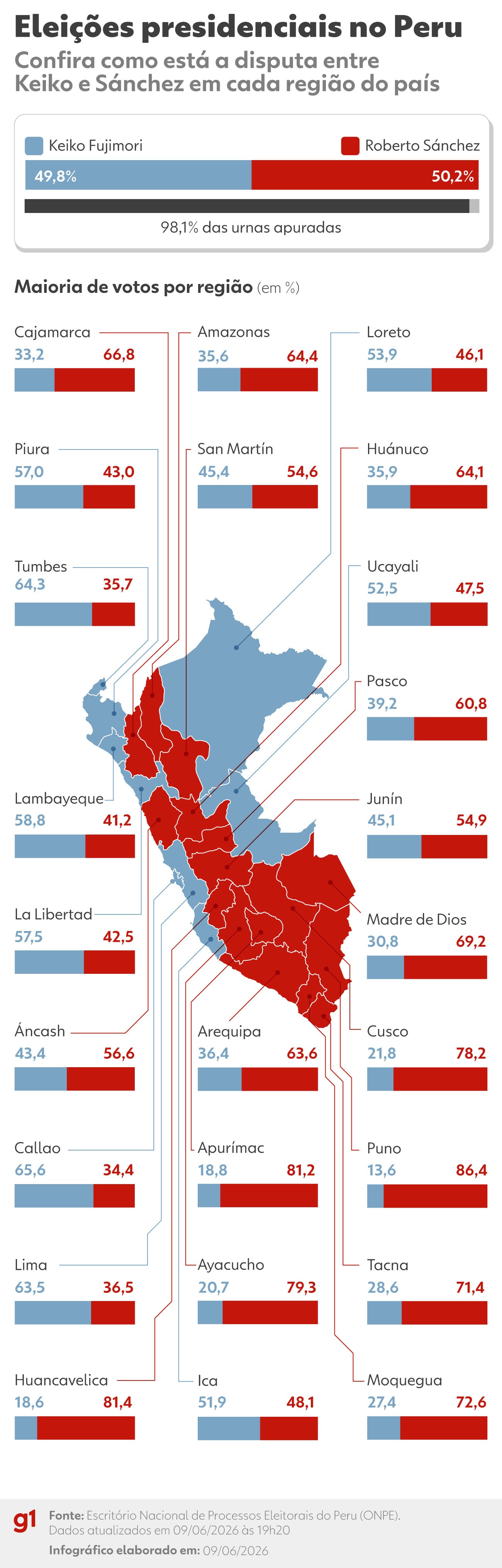
Check out the performance of the candidates in each Peruvian region on the map this Tuesday (9):
Map shows the vote of Roberto Sánchez and Keiko Fujimori in each region of Peru.
Arte/g1
Candidates' profile
Keiko Fujimori is running for the Popular Force party, a party she founded in 2008 to lead the Fujimorist current. Daughter of former president Alberto Fujimori, the candidate is running for president for the fourth time, having been defeated in the second round in the 2011, 2016 and 2021 elections.
In the first round vote in 2026, Keiko obtained 17.2% of the valid votes.
Keiko Fujimori (on the left) and Roberto Sánchez (on the right).
Stifs Paucca and Angela Ponce / Reuters
Deputy Roberto Sánchez, from Together for Peru, reached the second round after obtaining 12% of the votes in the first round.
Sánchez's support base is mainly identified in rural areas and areas far from urban regions.
History and electoral context
The elections of 2026 saw a record 35 presidential candidates in the first round. The process takes place in a scenario in which Peru has registered 9 presidents in 10 years, with constitutional mandates lasting five years.
Survey data indicates that 90% of Peruvians express little or no confidence in the government and the National Congress.
In addition, only 10% of Peruvians claim to be satisfied with democracy in the country, a situation that researchers classify as "chronic distrust".
Source: G1