Ebola treatment tent is set on fire again in Congo, and suspected patients flee health center
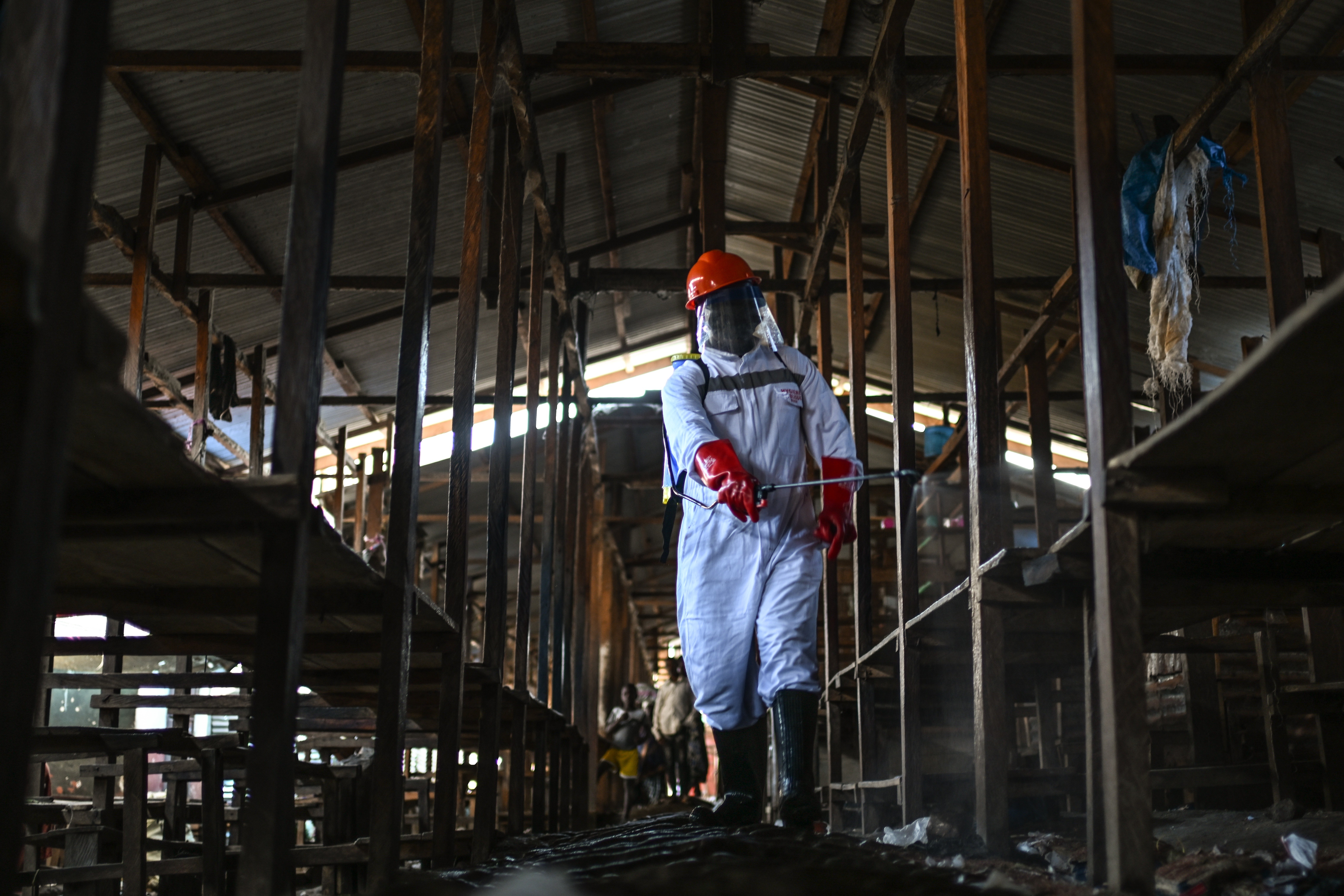
A street cleaning worker from Bunia prefecture sprays chlorine to disinfect the central market, as Ituri province continues to combat an Ebola outbreak
AP/Moses Sawasawa
A tent used to treat Ebola patients was set on fire for the second time in less than a week in eastern Democratic Republic of Congo, amid the spread of an outbreak of the Bundibugyo variant, a rare form of the virus for which there is no vaccine approved.
According to local authorities, the attack took place on Friday night (22), in the city of Mongbwalu, considered the epicenter of the outbreak. Homens não identificados atearam fogo à estrutura montada pela organização humanitária Médicos Sem Fronteiras, usada para atender casos suspeitos e confirmados da doença.
Com o incêndio, 18 pessoas com suspeita de infecção fugiram da unidade de saúde e desapareceram na comunidade, informou o diretor do Hospital Geral de Referência de Mongbwalu, Richard Lokudi.
"Condenamos veementemente este ato, porque ele provocou pânico entre os profissionais de saúde e resultou na fuga de casos suspeitos para a comunidade", afirmou o médico à agência Associated Press.
The episode occurs one day after another treatment center, in the city of Rwampara, was also set on fire. According to local reports, the attack happened after family members were prevented from recovering the body of a resident killed by the disease.
Oxford scientists develop vaccine against new Ebola outbreak
Bodies of Ebola victims can remain highly contagious after death, especially during funeral rituals and preparation for burials. Therefore, in outbreaks of the disease, health authorities usually restrict traditional wakes and carry out controlled burials, a measure that often generates tension with local communities.
This Saturday (23), burials of patients took place under tight security in Rwampara. Red Cross teams reported resistance from residents during the operations.
"When we arrived at the health structure, we faced many difficulties, including resistance from young people and the community. We had to ask for support from the authorities for safety," said David Basima, leader of the team responsible for the burials.
Sanitation workers from the Bunia city government spray disinfectant in the central market area, near a garbage truck, in Ituri province, as efforts continue to combat the Ebola outbreak in Bunia
AP/Moses Sawasawa
WHO raises risk level
On Friday (22), authorities in the province of Ituri banned wakes and meetings with more than 50 people to try to contain the spread of the virus.
The World Health Organization (WHO) also raised the risk level of the outbreak in Congo from "high" to "very high". Despite this, the body considers the risk of global spread of the disease to be low.
The director-general of the WHO, Tedros Adhanom Ghebreyesus, stated that 82 cases and seven deaths have already been confirmed in the country, but warned that the real number could be significantly higher.
This is because the Bundibugyo variant circulated for weeks without being identified.
The first patients tested negative for the most common strain of Ebola, which delayed confirmation of the outbreak.
Currently, authorities are monitoring around 750 suspected cases and 177 suspected deaths, numbers that still depend on laboratory confirmation.
Motorbike drivers and their passengers wait at the entrance to the central market while sanitation teams disinfect the area, amid the fight against the Ebola outbreak in the province of Ituri, in Bunia, Congo, in Saturday, May 23, 2026.
AP/Moses Sawasawa
Rare variant has no vaccine
The Bundibugyo strain is one of the rarest forms of Ebola and, unlike the Zaire variant -responsible for previous outbreaks and for which there is a vaccine-, it still does not have an approved immunizer.
The director general of the African Center for Disease Control and Prevention, Jean Kaseya, stated that the response to the outbreak depends not only on medical measures, but also on rebuilding trust between authorities and local communities.
The International Federation of Red Cross and Red Crescent Societies reported this Saturday that three volunteers died after contracting the virus in Mongbwalu during body removal operations carried out in March.
According to the entity, this indicates that the virus may have started circulating weeks before the first officially recognized death, registered at the end of April in the city of Bunia, capital of Ituri province.
Source: G1