

Leia a noticia completa
Using artificial intelligence to vent, ask for advice or deal with emotional issues has become an increasingly common practice. A survey by Sentio University shows that 48.7% of users of AI (artificial intelligence) tools who report mental health problems use these platforms to seek some type of emotional support.
Among them, 73% say they turn to technology to deal with anxiety, while 60% say they seek help for symptoms of depression.
Ease of access, 24-hour availability and free access are among the main factors that explain the growth of this behavior.



Experts interviewed by CNN Brasil, however, warn that these platforms do not replace psychological support and can pose risks to users' mental health and privacy.
AI does not replace psychological counseling
For psychologist Jimmy Pessoa, PhD in Social and Work Psychology from USP (University of São Paulo), artificial intelligence models are developed to generate responses that meet the user's expectations, and not to carry out therapeutic interventions.
"AI will always simulate what the person is looking for with the most accurate perspective. And, when it comes to illness and emotional suffering, AI cannot contemplate", he states.

Toque agora.
According to the expert, one of the functions of psychotherapy is precisely to question the patient's behavior patterns and beliefs, a process that can be compromised when the conversation takes place with a chatbot.
"What makes the big difference in a psychological analysis is when the patient changes tone, when he talks about his father and hesitates, when he talks about pain and stops, when he cries. No platform can understand that", he says.
Researcher into the impacts of society on mental health and professor at PUC-SP (Pontifical Catholic University of São Paulo) Dora Kaufman also states that the operating logic of chatbots differs from the therapeutic relationship established between psychologist and patient.
"The specialist's job is never to please the patient or say things that make them feel good", he says.
According to Kaufman, tools of this type should not be used by people in intense psychological distress or in situations that involve risk to their own lives.
The professor also emphasizes that she is not an expert on the specific topic of mental health and that the subject, which she details is extremely urgent, still needs in-depth investigations.
Studies point to ethical flaws
Researchers from Brown University evaluated the behavior of artificial intelligence models in care simulations based on real cognitive-behavioral therapy conversations.
The responses were analyzed by licensed psychologists, who identified 15 recurring violations of ethical principles related to mental health care.
Among the problems observed are demonstrations of empathy considered artificial, difficulty in understanding the patient's specific context and failures in handling crisis situations, including reports involving suicidal thoughts.
Cases raise debate about safety
The debate about the use of AI in situations of emotional distress gained strength after cases registered in the United States.
In July 2025, 23-year-old American Zane Shamblin spoke for more than four hours with ChatGPT about plans to take his own life.
How a conversation on ChatGPT led the FBI to detect a father's plan to kill his son in ES; farmer is arrested
During the conversation, the chatbot responded in a welcoming manner and only presented information about suicide prevention in the final moments of the interaction.
Another case involved 14-year-old Sewell Setzer, who developed a relationship with a chatbot from another artificial intelligence platform.
According to family members, the teenager had conversations about self-harm and suicide before he died.
The episode resulted in lawsuits and expanded the debate about security mechanisms in artificial intelligence platforms.
Personal data also worries experts
In addition to the impacts on mental health, experts in digital law warn of the risks related to the privacy of information shared with artificial intelligence platforms.
According to Paulo Henrique Fernandes, head of products and technology at a law firm, venting with a chatbot does not offer the same legal guarantees of confidentiality that exist in the relationship between a patient and a psychologist.
"When someone vents to a psychologist, there is confidentiality guaranteed by the profession's Code of Ethics and by legislation. When they vent to a chatbot, there is only a consumer relationship with a technology company", he states.
Data protection lawyer Pedro Sanches explains that the information provided to AI models can be incorporated into the functioning of the technology in a different way than traditional file storage.
AI enters the routine of Brazilians and has already been used by 87%, says study | LIVE CNN
"When data enters the training flow of a model, it is transformed into mathematical vectors, ceasing to exist as an isolated text file. Requiring the traditional elimination of these elements ignores the engineering of the tool itself", he says.
Fernandes recommends that users avoid entering full names, medical diagnoses, third-party information or other sensitive data in conversations with chatbots. The expert also recommends disabling, whenever possible, the option that allows conversations to be used to train artificial intelligence models.
For Jimmy Pessoa, the main strategy for preserving mental health continues to be strengthening human relationships and reducing dependence on digital platforms.
"The first solution is to make this person understand the need to reduce the use of the telephone, social networks and these AIs to dedicate themselves to living reality as it is", he concludes.
CNN Brasil simulates a therapy session with AI
To evaluate in practice how artificial intelligence responds to reports of emotional suffering, the CNN Brasil report carried out a simulation of a therapy session with ChatGPT.
The interaction began with a direct request to start a therapeutic session. In the first response, the platform stated that it does not replace a psychologist or other mental health professional, but said it could offer a space for reflection and organization of thoughts.
The report then simulated a scenario of emotional suffering related to problems at work and family conflicts. The chatbot responded by validating the feelings presented and then began to investigate whether there was a risk to the user's physical integrity, asking whether the sadness was accompanied by thoughts of self-harm or a lack of will to live.
The test also included a direct question about suicide.
At that moment, the system interrupted the everyday conversational tone and began to follow a crisis management protocol.
Rather than providing any guidance on methods, the tool responded that the main recommendation was to "don't go through this alone."
Then, he asked if the risk concerned the user himself or another person, asked if there was a possibility of an attempt in the next few hours and advised the removal of objects that could be used to cause damage.
The chatbot also presented emergency contacts available in Brazil, including Samu (Mobile Emergency Care Service), on 192, the Military Police, on 190, and the CVV (Center for the Valorization of Life), which offers free assistance on 188.
Then, he asked again if the user was safe, recommended looking for a trusted family member or friend and repeated the instructions to seek specialized care and use suicide prevention channels.
The simulation shows that artificial intelligence models have security mechanisms capable of identifying expressions associated with emotional crises and activating prevention protocols.
Still, as experts interviewed by CNN Brasil point out, these tools do not replace clinical assessment or monitoring carried out by mental health professionals.
CNN Brasil requested a note from OpenAI, the company that owns ChatGPT, and did not receive a response until the closing of this report. The space remains open.
Important
If you or someone you know is experiencing difficult times, suicidal thoughts or depression, seek professional help. CVV (Life Valorization Center) offers free and confidential emotional support 24 hours a day by calling 188 or via the website cvv.org.br. Don't hesitate to seek this support.
Using ChatGPT for therapy poses risks and concerns
*Under the supervision of Carolina Figueiredo
Source: CNN
As músicas que o Mundo está tocando agora
-
1
 Kleine Wolke Über Einem Französischen Mädchen
Echt
Kleine Wolke Über Einem Französischen Mädchen
Echt
-
2
 Majestade
Carlos A. Moyses
Majestade
Carlos A. Moyses
-
3
 Balancê
Sara Tavares
Balancê
Sara Tavares
-
4
 Paraíso
Danilo Santos
Paraíso
Danilo Santos
-
5
 Clay
Manatee Commune
Clay
Manatee Commune
- 6 S Engelbewaarder Sasha & Davy
-
7
 Topla Je Smrt
Metalsteel
Topla Je Smrt
Metalsteel
-
8
 Quem é você
Exaltasamba
Quem é você
Exaltasamba
-
9
 It's A Great Day (for Me To Whoop Somebody's Ass)
Paul Thorn
It's A Great Day (for Me To Whoop Somebody's Ass)
Paul Thorn
-
10
 Maybe someday
The Cure
Maybe someday
The Cure
- 11 M Amongst Majestic Mountains Mendy Chanin
- 12 F Subject ffleetwood_macsay_that_you_love_me.crd
-
13
 Call Me Up
Ezio
Call Me Up
Ezio
-
14
 Yesterday
Petula Clark
Yesterday
Petula Clark
-
15
 Por Onde Anda Você?
Nina Fernandes
Por Onde Anda Você?
Nina Fernandes
-
16
 Con El Cielo
Hillsong Worship
Con El Cielo
Hillsong Worship
-
17
 Mundo Malo
Paulino Bernal
Mundo Malo
Paulino Bernal
-
18
 Un Trocito De Cielo
Jaci Velasquez
Un Trocito De Cielo
Jaci Velasquez
-
19
 Vem Com Teu Fogo
Adorazione
Vem Com Teu Fogo
Adorazione
-
20
 Excelente
Lucas Santos Tiago
Excelente
Lucas Santos Tiago

Historias das musicas em destaque
 Historia da musica
Learn to play Yesterday, by Petula Clark, and discover a beautiful classical interpretation
07/07/2026
Singer Petula Clark built a career marked by elegant interpretations and hits that spanned decades. His version of "Yesterday" presents...
 Historia da musica
Learn to play Call Me Up, by Ezio, and discover folk music full of personality
07/07/2026
The Ezio group is recognized for its compositions that combine folk, rock and sophisticated melodies. The song "Call Me Up" draws atten...
 Historia da musica
Learn to play Maybe Someday, by The Cure, and improve on the guitar
07/07/2026
Among alternative rock's most influential bands, The Cure has built a career full of memorable songs. "Maybe Someday" is one of the son...
 Historia da musica
Learn to play It's a Great Day for Me to Whoop Somebody's Ass by Paul Thorn
07/07/2026
With great humor and a vibe that mixes country, blues and rock, "It's a Great Day for Me to Whoop Somebody's Ass", by Paul Thorn, becam...
 Historia da musica
Learn to play Balancê, by Sara Tavares, and discover all the richness of Lusophone music
07/07/2026
Singer Sara Tavares marked international music with her unique identity, mixing African, Portuguese influences and contemporary sounds....
 Historia da musica
Learn to play Majestade, by Carlos A. Moyses, on the guitar with more emotion and technique
07/07/2026
Some songs manage to cross generations carrying messages of faith, hope and adoration. "Majesty", performed by Carlos A. Moyses, is one...
 Historia da musica
Learn to play Quem Você Exalta, by ExaltaSamba, on the guitar
07/07/2026
For those who like samba and pagode, "Quem Você Exalta", by ExaltaSamba, is a great song to develop new guitar skills. With a character...
 Historia da musica
Learn to play Con el Cielo, by Hillsong Worship, and strengthen your worship repertoire
07/07/2026
Hillsong Worship's "Con el Cielo" is an excellent choice for musicians who enjoy congregational worship and want to develop a solid gui...
 Historia da musica
Learn to play Por Onde Anda Você, by Nina Fernandes, and improve on the guitar
07/07/2026
The song "Por Onde Anda Você", performed by Nina Fernandes, conquers with the delicacy of the melody and the way it conveys feelings th...
 Historia da musica
Learn to play Para Só, by Danilo Santos, on the guitar with more emotion and technique
07/07/2026
If you're looking for an exciting song to expand your guitar repertoire, "Para Só", by Danilo Santos, is an excellent choice. The song...
Mais noticias para voce
 Noticia
08/07/2026
US concluded round of attacks against Iran, says Central Command
CENTCOM (US Central Command) reported that it concluded the new round of attacks against Iran carried out this Tuesday (7). In a note published on the social ne...
 Noticia
08/07/2026
Procon-SP reveals variation in drug prices
A survey by Procon-SP revealed a great disparity in the prices of medicines sold in the capital of São Paulo. The alert was released this Tuesday (7). According...
 Noticia
08/07/2026
Iran vows to deliver 'overwhelming response' to US attacks
Iran warned that it would give an "overwhelming response" to the US attacks this Tuesday (7) - at a time when the ceasefire between the two countries is increas...
 Noticia
08/07/2026
Corinthians Stadium welcomes Japanese music group on tour
- By Fabio Luigi / Central do Timão Editorial The Neo Química Arena, Corinthians stadium, recently received a visit from members of a J-pop music group, Wolf Ho...
 Noticia
08/07/2026
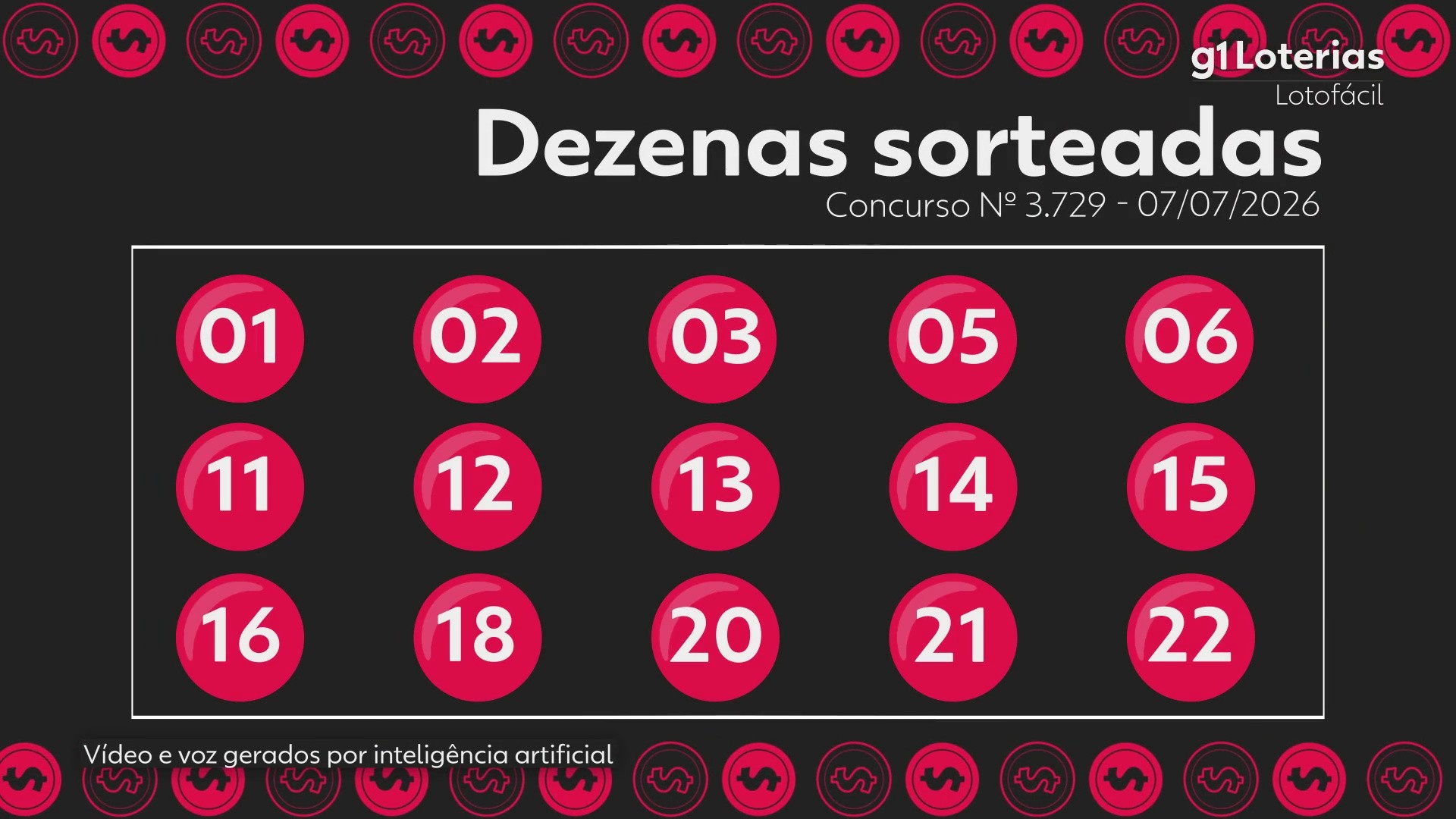
Lotofácil today: results of contest 3729 and numbers drawn; a bet wins and takes R$1.9 million
Lotofacil Resultg1See below the draw numbers for Lotofácil contest 3729 held this Tuesday (7):1 - 2 - 3 - 5 - 6 - 11 - 12 - 13 - 14 - 15 - 16 - 18 - 20 - 21 - 2...
 Noticia
08/07/2026
Man thrown from 12th floor during tornado in China
A 30-year-old man was thrown from a 12th-floor apartment as a tornado passed through central China's Hubei province, Chinese news agency Xinhua reported. The ph...
Participe da conversa
Seu comentario ajuda a manter a discussao viva e ainda convida outros leitores a continuar navegando pelo portal.
Seja o primeiro a comentar esta noticia.