Despair in Venezuela on 'crucial' day in the search for earthquake survivors
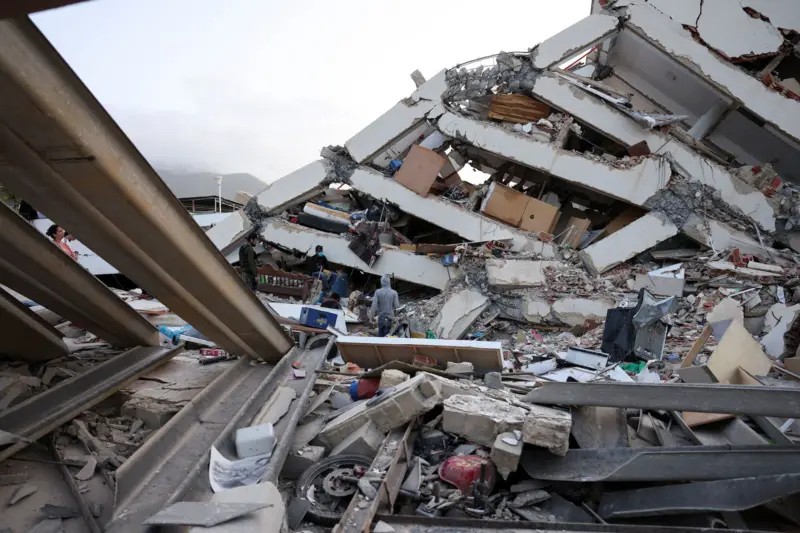
Rescue teams continue to race against the clock to rescue those missing in earthquakes.
REUTERS
Venezuela's acting president, Delcy Rodríguez, said she hopes that rescue teams will find survivors of Wednesday's fatal earthquakes, and the UN said that this Saturday (27/06) will be a crucial day for the work.
In a video published by the Venezuelan government, Rodríguez thanked all rescuers for their work on recovery efforts so far. According to her, the "most strategic" thing is rescuing the people who are still alive, which "is our priority."
"We have faith and hope that we will rescue them."
Rodríguez said that more than 200 aftershocks have been recorded since the initial earthquakes. 3,360 injured. The UN estimates that 50,000 people may be missing.
LIVE: See the latest earthquake updates
✅ Follow the g1 international news channel on WhatsApp
A state of emergency has been declared and airport, train and public transport services have been suspended.
The injured are being treated in makeshift medical facilities and a senior Venezuelan government official reported that hundreds of international rescuers have arrived in the country, with more on the way.
The medical centers that remain in operation are overloaded. Health professionals told the BBC that even before the disaster, the country was already struggling to treat patients.
SEE ALSO:
Baby born amid rubble after Venezuela earthquake
Saturday will be 'crucial'
The UN's top humanitarian aid official told the BBC that Saturday will be "crucial" for relief operations as international rescue teams arrive in the country.
Tom Fletcher - who is Deputy Secretary-General for Humanitarian Affairs and UN Emergency Relief Coordinator - said rescuers are "alerted minute by minute, hour by hour, by the sounds of survivors beneath the rubble." Venezuela's acting president put the number at 172 in an update on Friday.
But told AFP news agency, Fletcher said more than 50,000 people were missing.
An independent civilian-run missing persons website also puts the number in the tens of thousands, reporting more than 54,000 people who have not been contacted by family members.
The website also shows that 12,215 people have been located, but does not disclose in what condition they were found.
Fletcher said the global response to the fatal earthquakes has been "very good."
With the arrival of teams from Russia, Ukraine, the United States, Europe and the Middle East, "politics becomes completely in the background at this time," he said.
The UN has mobilized 39 rescue teams and recorded the arrival of almost 2,000 international rescuers in Venezuela to provide assistance.
International rescue teams continue to be sent to Venezuela;
REUTERS
The UN teams also have 111 rescue dogs.
The UN secretary said that as the organization has lost "almost half" of its humanitarian aid budget in the last 18 months, funding for rescue operations has been a challenge.
Surveys carried out by the international press showed that there are many foreign citizens among the fatal victims of the earthquake.
In Portugal, the government reported that 28 Portuguese citizens died, according to local media outlets.
Seven Chinese citizens died, reported the Xinhua news agency, citing the Chinese embassy in Venezuela.
The Spanish press reported the death of five citizens of the country and the disappearance of another 119, citing the Minister of Foreign Affairs, José Manuel Albares.
The Italian Ministry of Foreign Affairs reported the death of an Italian-Venezuelan citizen as a result of consecutive earthquakes.
Two Brazilian citizens are also among the fatal victims, the Brazilian government confirmed. Itamaraty said it is providing consular assistance to families and will not disclose the victims' personal data.
'With your own hands'
The International Red Cross said rescue efforts were being hampered by blocked roads and widespread destruction following the earthquakes.
Regional director for the Americas, Loyce Pace, told the BBC that rescue teams "had to resort to motorcycles and other means of transport [instead of ambulances] as the streets are very crowded with
Strong aftershocks continue to threaten damaged buildings, making rescue operations more dangerous.
"Time is quickly running out for any survivors who may still be under the rubble. We need to get to them as quickly and easily as possible," she says.
According to Pace, there are also extraordinary accounts of survival and humanity.
She says a Red Cross worker rescued her family from the rubble "with her bare hands," while others sang to people trapped under collapsed buildings, to reassure them that they have not been forgotten as rescue teams work to reach them.
Aerial image shows destruction in La Guaira.
GETTY IMAGES via BBC
A family told the BBC they are trying to rescue a 31-year-old man - identified as Carlos Eduardo - who is trapped under the rubble. The family has been calling for him for two days.
"About an hour and a half ago, we heard from him. He didn't speak, he just moaned," his cousin told the BBC.
Since then, the man trapped in the rubble has been unresponsive.
Rescue teams and sniffer dogs from Spain arrived at the scene, but withdrew after finding no sign of life.
However, Carlos' family remained at the scene, continuing to remove the rubble in an attempt to find him.
In another location, rescue teams managed to save a newborn baby, who was returned to his family, in an emotional moment that was applauded by the rescuers.
How the earthquakes happened
The earthquakes, with magnitudes of 7.2 and 7.5, occurred less than a minute apart, while most people were at home due to a national holiday.
The first tremor measuring 7.2 on the Richter scale hit the country's central coast region, the United States Geological Survey (USGS) reported.
The earthquake occurred at 6:04 pm local time and had its epicenter near the city of San Felipe, in the state of Yaracuy, about 280 kilometers west of Caracas.
Just 39 seconds later, the USGS recorded a second, even stronger, magnitude 7.5 earthquake. The epicenter was located near the municipality of Yumare, a little further north of the initial epicenter.
Two earthquakes hit Venezuela in less than a minute.
BBC
The tremors were also felt in the North of Brazil - in the States of Roraima, Amazonas, Pará and Amapá - but there were no victims or major damage.
One of the earthquakes was the strongest recorded in the country since 1900, according to data from the Geological Survey of the States United States.
The government agency's earthquake catalog indicates that a magnitude 7.7 earthquake struck near the coast of Venezuela on October 29, 1900, an event known as the San Narciso earthquake.
One of the crucial factors that determine the impact of an earthquake on the population is the depth at which it occurs in relation to the Earth's surface.
An earthquake occurs when two parts of the Earth suddenly move relative to each other, releasing a large amount of energy. When this energy reaches the surface, it causes tremors in the ground.
The closer to the surface, the more intense the tremors and the greater the potential for damage.
Wednesday's two earthquakes in quick succession were very shallow, occurring less than 30 km deep.
Source: G1