Crustaceans accumulated on ships threaten the normalization of navigation in Hormuz
"Four months?" commented Derek Hamm, from the company Obsessive Compulsive Divers, based in Marathon, Florida. "Wow. That's more than enough time for a lot of dirt and nasty organisms to accumulate."
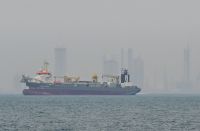
In recent months, barnacles, mussels, clams, algae and other types of flora and fauna typical of warm waters have attached themselves to hundreds of huge oil tankers anchored in the Persian Gulf.
To return the vessels to navigation conditions, it will be necessary to remove all these crustaceans, bivalve molluscs and other organisms by large teams of divers who carry out work with an unattractive name: "bottom cleaners".
"In the maritime sector, this is not something that strange," said Hamm, who works professionally in this activity.
Biofouling - a maritime sector term used to refer to the accumulation of marine organisms on ship hulls - represents a more complex problem than one might imagine. Oil tankers stuck in the Strait of Hormuz cannot resume their journey until the scale adhered to their hulls is removed.
This is an additional complication to reactivate the global flow of oil after months of war that caused the biggest energy supply crisis in history.
What is the implication of cleaning the hull of a boat
Supertankers are around 300 meters long and have a beam (width) of approximately 45 meters. This means cleaning a hull area of around 14 thousand square meters.
To carry out the work, teams of five or six divers need to dedicate between four and five hours, using manual scrapers and high pressure washers, to rid each ship of these encrustations.
With 600 ships at anchor waiting to cross the strait, the task requires an enormous amount of man hours.
"It's a simple, hassle-free job, but these ships are too big for solo divers," said Brian McCauley, owner of McCauley Mooring and Diving, a company that offers hull cleaning services in Long Island Sound.
Workers responsible for cleaning the hulls use lances to scrape off the biological encrustations adhered to the ship's structure.
When they are especially difficult to remove, as is often the case with barnacles, divers can use electric sanders or pressure cleaning equipment hydraulically powered by an onboard generator.
However, these professionals also need to be careful not to damage the ship's paint or special coating, elements that help prevent the accumulation of these scales.
A damaged coating can cause serious problems and result in violations of environmental standards, in addition to non-compliance with insurance companies' clauses related to biological fouling.
Propellers can be especially problematic, as they often have to be dismantled, cleaned and reinstalled, tasks that require considerable physical effort.
The sudden increase in demand for their services allowed cleaning crews to raise their rates by several thousand dollars. They currently charge five-figure amounts per ship, according to Aron Sørensen, director of environment at BIMCO, an international organization of ship operators.
Why is it necessary to clean boats?
The expense is worth it.
Just like airplanes, ships are designed taking fluid dynamics into account, and biological fouling changes this aspect significantly.
The presence of scale on the hull considerably reduces fuel efficiency and makes it much more expensive to move the vessel, especially when transporting oil thousands of kilometers from the Middle East to Asia or Australia.
Fuel represents around 50% of a ship's costs, said Neil Roberts, responsible for maritime and aviation at Lloyd's Market Association, an entity that provides technical expertise to Lloyd's marine insurance market.
Excessive accumulation of organisms on propellers can render them completely unusable over time, although this is more common on vessels that have remained anchored for several years, commented Carolyn Shearlock, owner of The Boat Galley, a website aimed at boating enthusiasts. Additionally, some organisms like to settle inside water inlet valves, damaging ships' cooling systems, Hamm noted.
Maritime regulations require vessels to remove barnacles and other biological fouling before arriving at port. Among barnacles, several invasive species can harbor great damage to marine ecosystems.
In addition, insurers include clauses on hull treatment to ensure that insured ships meet standards and operate as efficiently as possible.
This is not a recent concern: centuries ago, warships were built with copper-coated hulls to prevent worms from boring into the wood and allowing water to enter, which considerably increased the weight of the vessels.
"It's an ancient problem," said Roberts.
One problem among many
Some ships, in order to quickly move away from the conflict danger zone, may be towed out of the strait before going through the cleaning process. However, both inside and outside the strait, it will be necessary to remove biofouling before they can continue their journey.
Hull cleaning is just one step in a long process before ships can begin transporting hundreds of millions of barrels of oil to their destinations.
Iran announced on Friday (19) that it will force companies to register in the country to clean up the strait.
It is necessary for minesweeper ships to pass through the narrow channel to eliminate the risk of vessels exploding when entering or leaving.
Financial institutions and insurance companies must give their approval for companies to operate; a big unknown, considering that the ceasefire agreement undergoes new twists every day.
Therefore, the oil market will not be reactivated immediately, as if it were just a flip of a switch, even if the Strait of Hormuz has been opened again.
The delay begins with crustaceans. But it doesn't end there.
Source: CNN