Could "Dark Horse" constitute irregular electoral propaganda? Understand
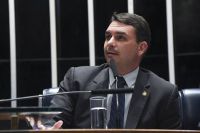
The film "Dark Horse", which tells the story of former president Jair Bolsonaro (PL), was the target of political clashes when audios of a conversation between presidential pre-candidate Flávio Bolsonaro (PL) and former banker Daniel Vorcaro, owner of the liquidated Banco Master, were released. The case even raised the discussion of possible early election propaganda.
In the conversation, published by the website Intercept Brasil, Flávio negotiated a transfer of US$ 24 million (around R$ 134 million) to finance the film. The senator demanded the transfer of installments that would not have been honored and that would have been necessary to avoid debt to actors involved in the recording.
As electoral legislation allows individuals to sponsor candidacies, but prohibits this activity by companies, the hypothesis was raised that Flávio could be held liable for abuse of economic power. A group of jurists and lawyers, and federal deputy Rogério Correia (PT-MG), even called the TSE (Superior Electoral Court) under this pretext, in an attempt to prevent the showing of "Dark Horse" until the elections.
To CNN, electoral lawyer Kaleo Dornaika explains that electoral propaganda occurs when there is an explicit request to vote. Abuse of economic power occurs in situations in which the candidate uses illicit sources of resources, such as buying votes or financing by a legal entity - a practice prohibited by legislation.
"In the case of the film, it would be necessary to demonstrate that it is a piece of propaganda linked directly to the campaign so that financing can be configured by a legal entity", he comments. "However, this understanding must be weighed against the free expression of thought, since it is, in principle, an artistic work."
Electoral lawyer Alberto Rollo compares suspicions surrounding the film with this year's Acadêmicos de Niterói carnival parade, which paid homage to President Luiz Inácio Lula da Silva (PT). For him, the presentation functioned as early electoral propaganda as it involved public money. Despite this, the school was not banned from parading.
"The parallel is that the Electoral Court will also decide [about the film]. It's not possible to say: 'Forbid it to be released in September, it can only be released in November, after the election.' I understand that this is censorship, just like [what they asked about Lula's parade] during Carnival", he points out.
Dornaika highlighted that the film has, "in principle, an artistic purpose". Even so, for him, the date chosen for the film's release could indicate an attempt to influence the electorate and raise questions with the Electoral Court.
"If, on the other hand, it is demonstrated that the purpose is to convince voters, it could be considered propaganda. The 'timing' of the launch, for example, would indicate that it was used at the time of the campaign as a way of influencing the electorate", he says.
Regarding the film's trailer, Dornaika says that "the law exceptionalizes the exaltation of personal qualities in the pre-campaign, that is, it is allowed to 'speak well of oneself' before the electoral period."
Breach of confidentiality
The PF (Federal Police) is studying ways to break the secrecy of the fund in which part of the money paid by former banker Daniel Vorcaro would have been allocated to cover "Dark Horse".
The corporation is evaluating the appropriate legal means to ask United States authorities for access to data from the Havengate fund, which would have received at least US$2 million of the US$10 million that was transferred by Vorcaro.
One way would be through the Department of Asset Recovery and International Legal Cooperation, a body linked to the Ministry of Justice. Another alternative studied is cooperation with Interpol, in what they call an international silver diffusion alert.
As CNN showed, one of the lines of investigation opened by the PF after the revelation of the conversations between Flávio and Vorcaro aims to verify whether part of the money was used to cover the expenses of former deputy Eduardo Bolsonaro (PL-SP) in the United States. This is because the Havengate Development Fund LP, based in Texas, has Paulo Calixto, Eduardo's lawyer, as one of its legal representatives.
Lindbergh and Flávio discuss the senator's audio with Vorcaro | CNN 360°
Source: CNN