Conflict between China and the US over Taiwan could have nuclear escalation, says study
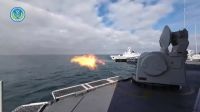
A conflict between the United States and China over Taiwan could lead to a nuclear escalation, with both militaries carrying out sweeping operations targeting rival command and communications centers, a leading defense think tank said.
In a strategic assessment carried out ahead of Asia's biggest annual defense summit in Singapore this weekend, the London-based IISS (International Institute for Strategic Studies) said the world is on the brink of a new nuclear arms race, "with the Asia-Pacific region at the center".
"Regional states and those with strategic interests are expanding their nuclear arsenals, while non-nuclear-weapon states pursue long-range conventional strike capabilities: both scenarios challenge strategic stability," the IISS assessment said.
U.S. authorities could not immediately be reached for comment.
Chinese Defense Ministry spokesperson Jiang Bin said the IISS report appears "quite inconsistent" with the actual situation, adding that the Taiwan issue is China's internal matter and the country does not allow any external interference.
Chinese Foreign Ministry spokesman Mao Ning said at a press conference that the US should deal with Taipei "with the utmost caution."
Beijing has never ruled out using force to take control of Taiwan, but has also said it prefers "peaceful reunification."
The Taiwanese government rejects Beijing's sovereignty claims.
China has intensified pressure on the region, increasing its military presence around the island, keeping Taipei on high alert for further actions after the summit.
Prospect for nuclear escalation
The 156-page IISS assessment examines the evolution of military doctrines in the region, as well as the possible development of a conflict over Taiwan.
Although American and Chinese forces had different objectives in a scenario involving Taipei - the Chinese seeking to keep the US and its allies in check, while the White House would strengthen the island's resilience - both sides could be expected to launch major operations across multiple military domains.
"A conflict with China would risk escalation, potentially to a nuclear level, given Taiwan's strategic importance to Beijing," the document states.
"Currently, there is little public evidence to suggest that both Armies understand the safeguards necessary to prevent, or the rules of engagement that would restrict, attacks by either side on each other's key centers of command, control, communications, computers, intelligence, surveillance and reconnaissance," the assessment highlights.
"The prospect of nuclear escalation will therefore continue to be a major concern in a major conflict between the US and China," the text adds.
Will China invade Taiwan? Understand possibilities of tension escalation | Out of Order
Daniel Salisbury, senior researcher at IISS, noted that there were no specific talks about nuclear weapons at the last summit between Donald Trump and Xi Jinping and that the relationship between the two superpowers is "quite difficult" on the nuclear issue.
Salisbury pointed out at a press conference that, during the Cold War, the US had a long history of talks with the Soviet Union about arms control and risk reduction measures.
However, he said any talks with China would be more complicated, given the fact that much of China's nuclear arsenal is hidden.
"This culture of dialogue simply doesn't exist at the moment, so there is much less to base this relationship on", highlighted the expert.
"The prospect of nuclear escalation simply doesn't exist at the moment, so there is much less to build on that relationship," he concluded.
Although the U.S. and Russian nuclear arsenals are still much larger than China's, U.S. officials and arms control analysts say that China is expanding and enhancing its atomic weapons capabilities faster than any other nuclear power.
A Pentagon report released in December indicated that China was on track to have 1,000 nuclear warheads by 2030.
The Federation of American Scientists estimates that Russia and the US have 4,400 and 3,700 active nuclear warheads, respectively, while China has 620.
Discussion on Taiwan and Iran at annual meeting
Taiwan, the conflict in Iran and uncertainties about US commitments to the region are expected to be central themes at the IISS Shangri-La Dialogue.
The informal conference takes place from May 29 to 31 and brings together a diverse group of ministers, generals, intelligence chiefs, diplomats, analysts and weapons manufacturers.
The event follows the summit between Chinese President Xi Jinping and his American leader Donald Trump in Beijing earlier this month, which raised concerns in Taipei about Washington's commitment to helping the democratically-ruled island defend itself.
What are nuclear weapons and how do they work?
Source: CNN