Chinese demand drives technological advances in Brazilian livestock farming
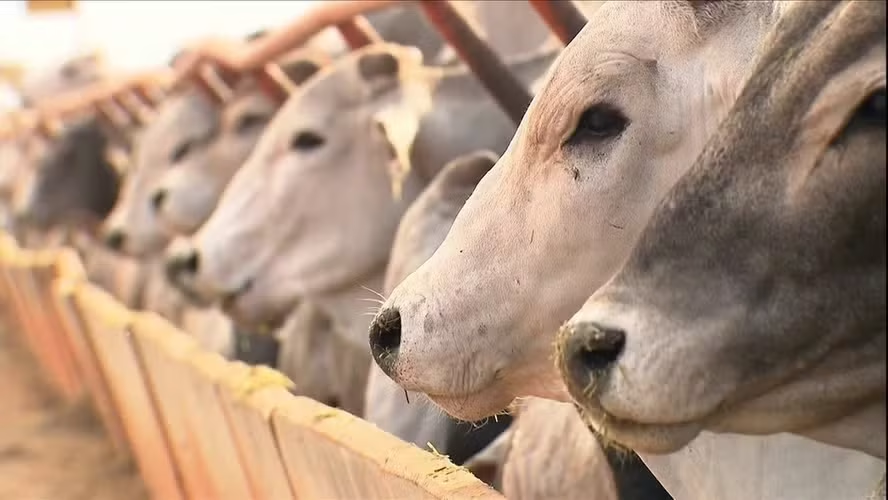
Brazilian livestock farming accelerates modernization within farms and feedlots to meet an increasingly demanding demand for quality, traceability and sustainability of beef. The advancement of technology in the field seeks to increase productivity, reduce costs and ensure greater standardization of production.
Data from IBGE (Brazilian Institute of Geography and Statistics) shows that Brazil has the largest commercial cattle herd in the world, with more than 238.1 million heads, and occupies a leading position in global beef exports. In recent years, the growth in international demand, especially from China, has further accelerated the modernization of activity.
The Asian country has consolidated itself as the main buyer of Brazilian protein and started to demand younger, heavier animals with higher quality standards, forcing the livestock chain to invest in genetics, nutrition, management and traceability.
According to a survey by ABIEC (Brazilian Association of Meat Exporting Industries), Brazil broke a historic record in beef exports last year, generating US$ 18.03 billion. China has consolidated itself as the main buyer, absorbing practically half of the total volume exported (around 1.7 million tons).
Faced with this scenario, traditional livestock farming had to give way to an increasingly technological and connected model. An example of this is the confinement located in the Sabino region, in the interior of São Paulo, which adopts technology in all fattening systems such as: sensors, electronic earrings and digital platforms that monitor the herd's performance on a daily basis.
With the help of technology, it is possible to monitor the weight gain, behavior, nutrition and health conditions of animals in real time, allowing for faster and more assertive decisions.
Confinement of MFG in the Sabino region, in the interior of São Paulo - Netto Mello / Disclosure
According to the CEO of Ponta Agro, Paulo Dias, technological transformation has completely changed the dynamics of livestock production in Brazil. "We had a great wave of technology in Brazilian livestock farming and this helped livestock farmers to make increasingly assertive decisions", he states.
The search for productivity also involves genetics and data collection within farms. Currently, many properties use industrial crossings, fixed-time artificial insemination and genetic improvement programs aimed at weight gain, precocity and carcass quality. The objective is to produce animals that reach ideal weight in less time and with less feed consumption.
The integration between technology, genetics and nutrition has made it possible to reduce the average age at slaughter in Brazil. In some more technical operations, animals already reach the ideal point of slaughter before 24 months, meeting the demands of premium markets and increasing the producer's profitability.
Technology on Property
To integrate all the operation's information, the property even has its own data center and management software that centralizes the farm's data. The systems monitor everything from diet formulation to zootechnical and financial indicators, allowing detailed control over production efficiency, animal performance and profitability of the operation.
Machine Learning, known as machine learning, allows systems to learn automatically by analyzing thousands of data generated daily on rural properties. Big Data organizes and processes information related to climate, soil, nutrition, reproduction and herd performance.
Sensors installed in electronic ear tags, automated scales and handling equipment have also gained prominence in modern livestock farming. These devices monitor data such as body temperature, movement and food consumption of animals in real time. With the help of artificial intelligence, it is possible to identify early signs of illness, stress and loss of productive performance.
Drones have also become part of this new technological reality. Unmanned aircraft monitor pastures, feedlots and productive areas, capturing images and strategic information that help producers correct errors and optimize property management.
Paulo Dias highlights that the great difference of technology in livestock farming is the transformation of data into strategic decisions. "Our business is the generation of information with value. Technology is just the means. What matters is the practical impact that this generates on farm management", said the executive in an interview with CNN Brasil.
The company also invests in Business Intelligence systems, capable of bringing together zootechnical, financial and operational information in control panels updated in real time. The technology allows you to monitor costs, animal performance, feed efficiency and operation margins with greater precision.
Food Efficiency
The use of technology has also brought important advances in animal nutrition. Diets began to be formulated with more precision and now use regionally available co-products, such as citrus pulp, soybean hulls and waste from the food industry, reducing costs without compromising performance and meat quality.
MFG Confinement Manager, Arthur Pupim, explains that feed efficiency has become one of the main competitive tools within modern livestock farming. "Today, we work towards products with good nutritional quality and also price. In the Southeast we are able to work a lot with co-products, such as citrus pulp and soy peels, and we have a significant gain with a viable recipe", he highlights.
"Today, our main technology is both in grain processing and in manufacturing efficiency and dish efficiency, which we control using management software that helps to achieve quick and simple biological efficiency of these animals", says Pupim.
New markets
Technology will be fundamental for the sector to reach new and more demanding markets, countries such as Japan and South Korea increasingly demand more sanitary control and transparency over the origin of beef.
This international pressure makes technology strategic for the expansion of Brazilian exports. Digital platforms can record the entire trajectory of the animal, from birth to the slaughterhouse, increasing health security and international consumer confidence.
In addition to productive gains, the modernization of livestock farming also meets a growing demand for sustainability. Technologies linked to nutrition, management and food efficiency help reduce waste, improve feed conversion and reduce gas emissions per kilogram of meat produced.
The Manager reinforces that this progress will be inevitable in the coming years. "I believe that the use of technology and people trained to work with technology will grow in the market and help many companies, livestock and producers to follow this new stage that the world is taking", he concludes.
CNA predicts a 4.5% drop in beef production in 2026
Source: CNN