China launches mission to prepare for the Moon; Chinese astronaut will spend a year in space for the first time
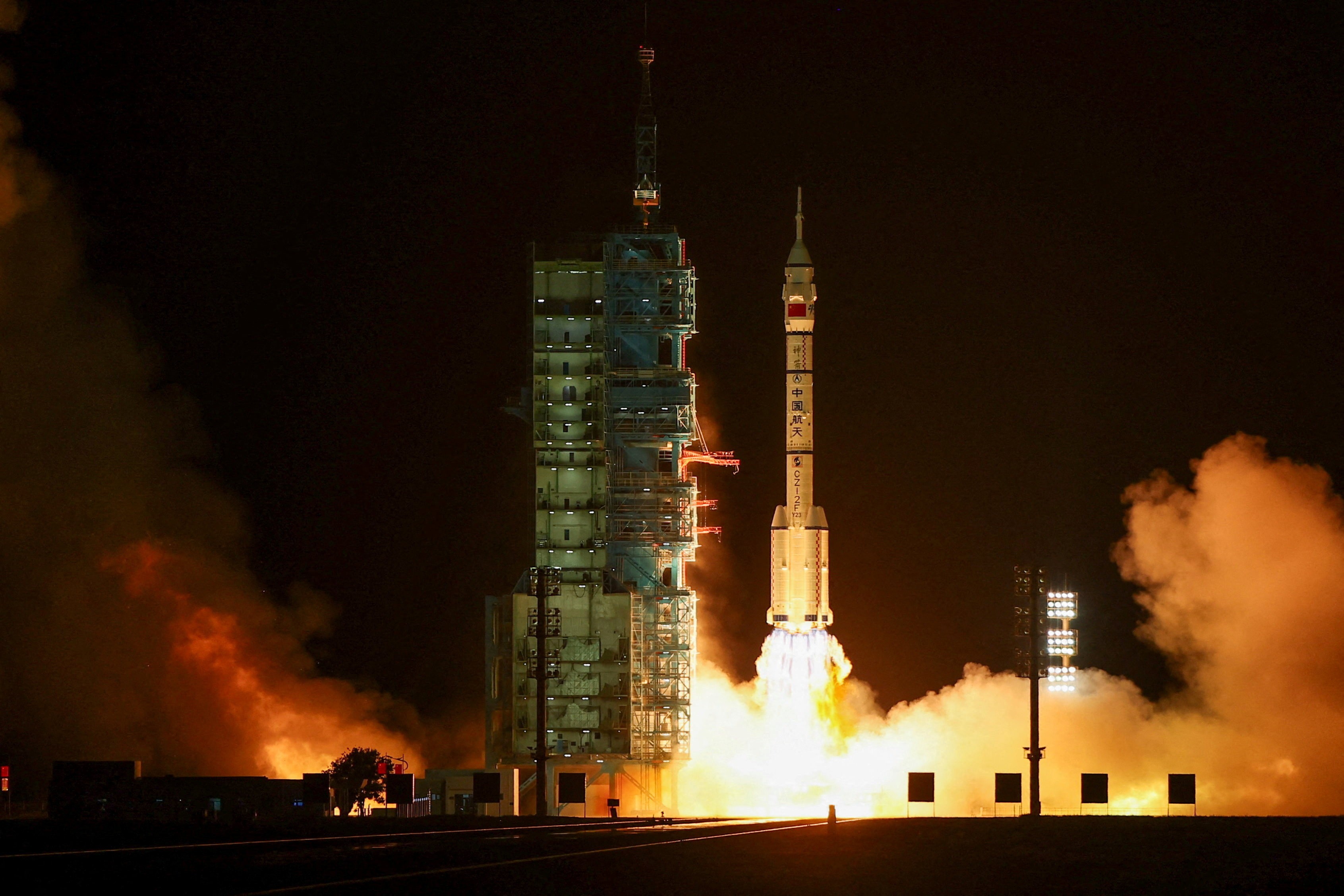
China launches mission to prepare for the Moon
China launched, this Sunday (24), its Shenzhou-23 mission, in which an astronaut will spend a year in space for the first time, a crucial step in its ambition to send humans to the Moon by 2030.
The Long March 2F rocket launch vehicle took off amid a cloud of flames and smoke at 11:08 p.m. (12:08 p.m. Brasília) from the Jiuquan launch center, located in the Gobi Desert, in northwest China, according to images shown by state broadcaster CCTV.
The rocket will take the Shenzhou spacecraft and its three crew members to the Tiangong space station ("Heavenly Palace", in Chinese), where one of them will remain for a whole year.
China launched the Shenzhou-23 space mission to the Tiangong space station from the Jiuquan Satellite Launch Center
REUTERS/Maxim Shemetov
The mission also marks the first space flight by a Hong Kong astronaut: Li Jiaying, 43, who previously worked for the police in the semi-autonomous Chinese territory.
The other crew members are Commander Zhu Yangzhu, an engineer 39-year-old aerospace; and Zhang Zhiyuan, a former air force pilot of the same age who will travel to space for the first time.
This experiment will allow scientists to study the effects of prolonged microgravity, essential for potential future missions to the Moon or even Mars.
Thanks to massive investments, the Asian giant has considerably developed its space program and is now competing with the United States and its Artemis program to return to the lunar surface.
In addition to the one-year orbital stay, the crew will carry out numerous experiments related to life sciences, materials sciences, fluid physics and medicine.
Muscle atrophy, radiation, fatigue...
The selection of the astronaut in charge of spending a year in orbit will take place later, depending on the progress of the Shenzhou-23 mission, said an official from the China Manned Space Agency (CMSA) this Saturday (23).
Astronauts Zhu Yangzhu, Zhang Zhiyuan and Lai Ka-ying, Hong Kong's first astronaut, wave during a farewell ceremony before taking part in the Shenzhou-23 space mission to China's Tiangong space station
REUTERS/Maxim Shemetov
The "main challenges" will be "the effects on humans": "loss of bone density, muscle atrophy, exposure to radiation, sleep disorders and behavioral and psychological fatigue", he explained to AFP Richard de Grijs, astrophysicist and professor at the School of Mathematical and Physical Sciences at Macquarie University, in Australia.
He also emphasized the importance of the reliability of water and air recycling systems, as well as the ability to manage potential medical emergencies far from Earth.
"China has become very competent in these areas, but duration is important. A year in orbit puts the equipment and crew in a different operational regime than the shorter Shenzhou missions," De Grijs highlighted.
Until now, crews remained at the Tiangong station for six months before being replaced.
"Dream ship"
China is still in the development and testing phase of the equipment needed to send astronauts to the Moon this decade.
This year, the orbital test flight of the Mengzhou spacecraft ("Dream Ship") is scheduled. This spacecraft will replace Shenzhou in manned missions to the Moon.
Beijing hopes to have built by 2035 the first segment of an inhabited scientific base on an Earth satellite, called the International Lunar Research Station (ILRS).
The Asian giant has invested billions of dollars in the last thirty years to bring its space program on par with those of the United States, Russia and Europe.
Its progress has been particularly visible in the last decade.
In 2019, China landed a space probe on the far side of the Moon, an unprecedented achievement worldwide, and in 2021, it landed a small robot on Mars.
China was officially excluded from the International Space Station (ISS) in 2011, the year in which the United States banned its space agency, NASA, from collaborating with Beijing.
This led the Asian giant to develop its own space station project.
Source: G1