'Brazilian' neighborhood 'breathes' in the World Cup after Trump siege
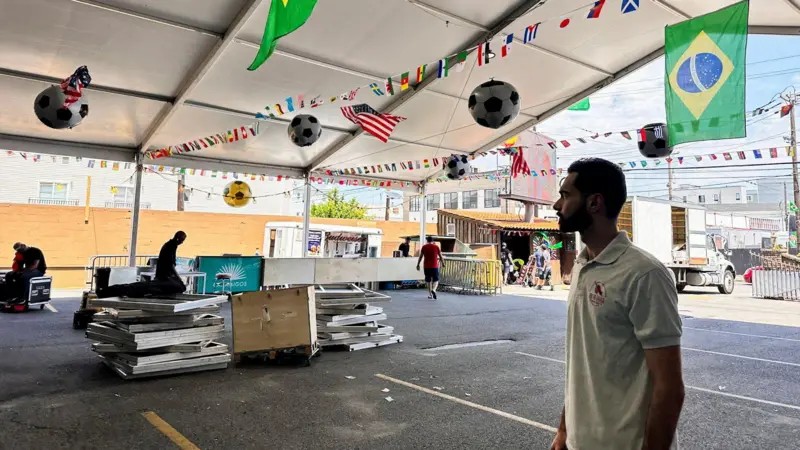
Kalani Mumbarak in the Boi no Brasa garage during preparations for the World Cup game
Reuters/Nichola P. Brown
The little flags start at the top of the windows and go down to the sidewalks. Green and yellow from Brazil. Red and green from Portugal. Yellow of Ecuador.
In the windows of the restaurants and bakeries on Ferry Street, the main artery of the Ironbound neighborhood in Newark, New Jersey, it is difficult to find an establishment without at least a flag.
The music that comes out of the speakers on the sidewalk changes from door to door - cumbia, funk, reggaeton - and the shirts passing along the street tell the story of a tournament played at the same time in three countries with 48 teams.
"In all The World Cups that I've been here for, in all these 38 years, this one surpassed them all", said José Moreira, owner of five restaurants in the region, as he prepared the hall to receive the flow of fans that would arrive hours later. "For my business, it's wonderful."
Ironbound has been welcoming immigrants for almost two centuries - Portuguese, Italians, Poles, Brazilians, Cape Verdeans, Ecuadorians. Each generation arrived without much and remade the neighborhood in their image. Today, two out of every three residents were born outside the United States.
Since 2025, the neighborhood has carried an additional title: it is officially on the Trump administration's list as a priority target for immigration enforcement.
Protesters clash with federal agents during a protest in front of the Delaney Hall detention center, in Newark, in June 2025.
Andres Kudacki/Getty Images
A tradition that began in the 1830s
The The name comes from the railways that surrounded it in the 19th century - ironbound means, in English, "surrounded by iron". The neighborhood began to receive immigrants in the 1830s, with the arrival of the Germans, followed by Poles and Italians at the end of the century.
The Portuguese arrived in the 1920s, initially coming from New Bedford and Pawtucket, attracted by work in chemical factories, breweries and tanneries. In 1926, the Diocese of Newark had already created a Portuguese-Spanish parish in the neighborhood to serve the growing community.
In January 1995, the New York Times published a full-page report on the Ironbound with a title that summed up that moment: "In Newark, Immigration Without Fear."
The text described how the same people who decades before ran down Ferry Street when an immigration van appeared had become owners of the businesses along the street.
"If you go into each business, one by one, almost all of them started illegally," Jack Santos, a restaurant owner in Ironbound, who had arrived in the country without documentation in 1966, told the newspaper. a new wave of immigrants arrived, attracted by the already established Lusophone infrastructure: churches, bakeries, associations.
Brazilians, driven by the hyperinflation crisis in Brazil, came first.
Followed by Cape Verdeans and Ecuadorians, who today represent the fastest growing groups. According to data from the 2022 US Census, around 15,000 people of Brazilian descent live in Essex County, the county where Newark is located - double the number recorded in the 2000 Census.
In the Ironbound neighborhood specifically, estimates from the real estate sector indicate that 26% of residents have Brazilian ancestry and almost half of the population speaks Portuguese at home.
"When I was a little boy, 5, 6 years old, the community here didn't even care about deportation", recalled Kalani Mubarak, son of the founder of the Boi na Brasa restaurant, which has operated in Ironbound since 1995 and was born on these streets.
"It was always a sanctuary city for immigrants.
Then Trump came with these ICE laws and they started to invade our city."
1995 NYT article titled 'In Newark, immigration without fear'
The New York Times Archives
From sanctuary to target
For decades, Newark functioned as what immigrant communities in the United States call a "sanctuary city": a place where local authorities do not actively cooperate with federal immigration enforcement. For those arriving without documentation, it was a promise of relative security.
In August 2025, the United States Department of Justice published a list of sanctuary jurisdictions that it identified as priority targets for enforcement. Newark was on the list, alongside cities such as Chicago, Los Angeles and New York.
On the ground, the consequences arrived quickly On January 23, 2025, three days after President Trump's inauguration, ICE agents carried out a raid on the Ocean Seafood Depot, a seafood warehouse on Adams Street, within the city. Ironbound. Three employees were taken into custody.
Map of Brazil painted on a wall of Ironbound symbolizes the presence of the Brazilian community in the Newark neighborhood
Giulia Granchi/BBC News Brazil
Newark Mayor Ras Baraka issued an official statement condemning the action: "ICE agents raided a local establishment in Newark, detaining undocumented residents, as well as citizens, without presenting a warrant. Newark will not stand idly by while people are illegally terrorized."
In November of the same year, the same warehouse was the target of a second operation, this time with more than two dozen agents. Around 20 people were interrogated and detained.
Fear set in in the community immediately and translated into concrete behavior.
"They were afraid to leave the house for anything and were staying at home more, ordering takeout, making their own food," he said Mubarak.
Kalani Mumbarak at the Boi na Brasa restaurant, in Newark
Personal archive
Businessman José Moreira described the same phenomenon from the point of view of someone who manages restaurants.
"Today, people are trying to stay at home more. We lost great customers, great friends, former employees and employees", he said.
According to him, immigration operations usually take place in public places, and not inside commercial establishments.
"They wait for people at the door of their homes, they don't go to business. This makes many people feel safer going to a restaurant. Because, imagine, if they had arrested someone inside a restaurant, no one else would go there."
José Moreira at one of his restaurants in Newark, Taverna Casa Nova
Giulia Granchi/BBC News Brazil
Less than two kilometers from the Boi na Brasa restaurant is the Delaney Hall detention center, with capacity for a thousand people, operated by the private company GEO Group under contract with ICE.
Newark's own mayor, Ras Baraka, was arrested by ICE in front of the center on May 9, 2025, when trying to accompany a Congressional inspection visit to the site.
Baraka had left the controlled access area and was in a public space when federal agents surrounded him, handcuffed him and took him into the center.
The trespassing charge was later dropped.
In May 2026, around 300 detainees began a hunger strike denouncing precarious conditions, lack of medical care and food spoiled.
Protests outside resulted in clashes with the police, curfew and at least 50 arrests in a single night.
The Secretary of Homeland Security denied that there was a hunger strike.
For those who live in Ironbound, the presence of the detention center a few blocks away is not abstract. "They already caught one of our customers outside the restaurant. We watched everything."
"Yeah, very sad, right? Very sad. Lots of good, hard-working people who don't even have time to do anything wrong.
He works 7 days a week, 6 days a week just to pay the bills, send money to his country to try to raise his family, take it to another level.
The World Cup as a breath of air
The World Cup brought a more festive atmosphere to the community.
Brazil played the entire group stage in the United States - New York, Philadelphia and Miami.
The final stadium is in East Rutherford, New Jersey, less than 30 kilometers from Ironbound. For the neighborhood's Brazilian and Latino community, the World Cup is not just a sporting event: it's a reason to leave the house.
"It seems like people are going out without fear, after all, they can't live indoors, it's impossible. And now the movement has increased a lot with this issue of the World Cup," said Kalani.
"I'm walking in these streets, on the main avenues here, any day of the week, everyone wearing their country's t-shirt, cap... They're all spread out on the street partying. very good."
At Boi na Brasa, where the room has capacity for a few dozen people and a garage next door has screens to accommodate more customers, Kalani estimates that around 1,500 to 2,000 people pass through the restaurant at each Brazilian game, including those watching inside and those circulating around the space.
José Moreira says that this is the best World Cup he has seen financially in almost four decades in the United States.
The impression of those who work at Ironbound is that, during the World Cup, ICE reduced pressure on the community. This is not something official or announced - but felt.
The data, however, tells a different story.
ICE detention target
On July 1, 2026, the New York Times revealed that federal immigration agents had detained more than 10,000 people in just five days - a significant jump in the pace of arrests.
According to internal documents obtained by the newspaper, ICE leaders were told to place 80% of their agents in detention operations, prioritizing arrests. The number of daily arrests practically doubled compared to the beginning of the year, reaching close to 2,400 in a single day. The population in the agency's custody exceeded 63 thousand people.
The increase, however, occurred without fanfare. Markwayne Mullin, the secretary of Homeland Security, said publicly in an interview with Newsmax that he wanted to conduct the operations "quieter" - in part to distance himself from the show operations that marked the administration of his predecessor, Kristi Noem, and which ended with the deaths of two American citizens during protests in Minneapolis. ICE didn't stop. It became more discreet.
And Ironbound was not left out. "Last week they took a person I knew, a Brazilian who had been here for a long time," said Mubarak.
"There was also a spot in a park about 1 km from here, where people without residence were gathered, and who were also immigrants. ICE took them all."
BBC News Brasil sent questions to ICE about detention statistics in Newark and about the existence of any specific guidelines for the World Cup period. By the time this report was published, there had been no response.
The January 1995 New York Times story about Ironbound described a neighborhood that had been transformed, decades earlier, by the arrival of Portuguese immigrants fleeing immigration repression.
Now, they were business owners, legal residents - and they looked at the new immigrants with a mix of empathy and pragmatism.
Three decades later, the cycle repeats itself. The Brazilians and Ecuadorians who today serve tables, work in the kitchens and deliver goods are the protagonists of a similar chapter - different in language, countries of origin and political context, but familiar in structure.
José Moreira, who arrived in the United States as a gardener in 1987 without any business and today has five, understands this trajectory from the inside.
"Here in Newark we have a mayor who loves Brazil. He is always among us, he is always talking to the people. Whoever you are in Newark, you are in Brazil.
It's a piece of Brazil," he said.
His estimate that 30,000 Brazilians live in Newark is greater than the Census records - a difference that, he himself knows, reflects the portion of the community that lives outside the official records.
When the World Cup ends, the Ironbound routine should continue with immigration operations, and the Delaney Hall detention center will continue to operate just a few blocks away.
For now, the community is trying to take advantage of the moment to celebrate the different nationalities gathered in the neighborhood - and dream of titles.
"I'm confident, very confident. The hexa is coming this year", said Kalani Mubarak.
Source: G1