Brazil's opponent, Japan has a challenge off the field: an economic enigma that has lasted 30 years
Selection's opponent: Japan draws with Sweden and faces Brazil in the second phase
After defeating Scotland in the group stage, the Brazilian team will face, this Monday (29), an opponent that arouses interest not only on the field. Japan reaches the second phase of the 2026 World Cup taking with it one of the most studied cases in the world economy.
The fourth largest economy on the planet, the country remains among the global leaders in innovation and the production of high-tech goods. At the same time, it has been experiencing modest economic growth for decades and structural challenges that limit faster expansion. (understand more below)
Do you have any suggestion for a report? Send to g1
Jacob Funk Kirkegaard, researcher at the Peterson Institute for International Economics (PIIE), explains that this scenario began to take shape after the burst of the real estate and stock market bubbles, between the mid-1980s and the early 1990s.
From then on, Japan entered a long period of low growth and very low inflation - at times, even a general drop in prices, a phenomenon known as deflation.
At the same time, the low birth rate, the reduction of the working-age population and accelerated aging began to put pressure on the job market and public accounts.
This set of factors became known among economists as "Japanification", a term used to describe economies that live for long periods with weak growth, persistently low inflation and difficulty in regaining dynamism.
More than three decades later, however, part of this situation began to change. Inflation once again approached the Bank of Japan (BoJ) target, allowing the monetary authority to abandon the negative interest rate policy. Today, the base rate stands at 1% per year.
"For the first time since population aging accelerated in the early 1990s, Japan may have a plausible path to developing sustained domestically driven wage and price pressures," says Kirkegaard.
Kazuo Ueda, president of the Central Bank of Japan (BoJ), attends a press conference following a monetary policy meeting in Tokyo, Japan, on January 23, 2026.
REUTERS/Kim Kyung-Hoon
Economic puzzle
The recent improvement, however, has not eliminated the characteristics that make the Japanese economy a unique case.
The country maintains one of the lowest unemployment rates in the world - having reached 2.5% in April -, and has a GDP per capita estimated at around US$35,700 by the International Monetary Fund (IMF).
It also remains among the most innovative economies of the planet: according to the Global Innovation Index 2025, from the World Intellectual Property Organization (WIPO), it occupies the 12th position in the ranking and leads indicators linked to industrial sophistication and cooperation between universities and companies.
In 2023, it allocated 3.44% of the Gross Domestic Product (GDP) - around US$ 145 billion - to research and development. Still, its economy has grown, on average, just 1% per year for about three decades.
It is this combination that researchers from the Center for International Development, at Harvard University, define as an "economic puzzle".
Despite modest growth, Japan has led the Economic Complexity Index since 1981, a reflection of its ability to produce high-value-added goods.
"Japan's economic history is not just about stagnation. It is also the story of an economy that redirected its productive knowledge beyond its borders", summarize the researchers.
Demography and the brake on growth
However, part of this "puzzle" involves the demographic transformation of the country.
The Organization for Economic Co-operation and Development (OECD) estimates that, in 2026, almost 30% of Japanese people will be over 65 years old, while the fertility rate remains close to 1.2 children per woman.
With fewer people of working age working, the economy's growth potential decreases and pressures on public spending increase, especially on pensions and health.
And perhaps few indicators reflect this challenge better than Japan's public debt. Even on a gradual downward trajectory, the IMF projects that it will remain above 200% of GDP in 2026, one of the highest proportions in the world.
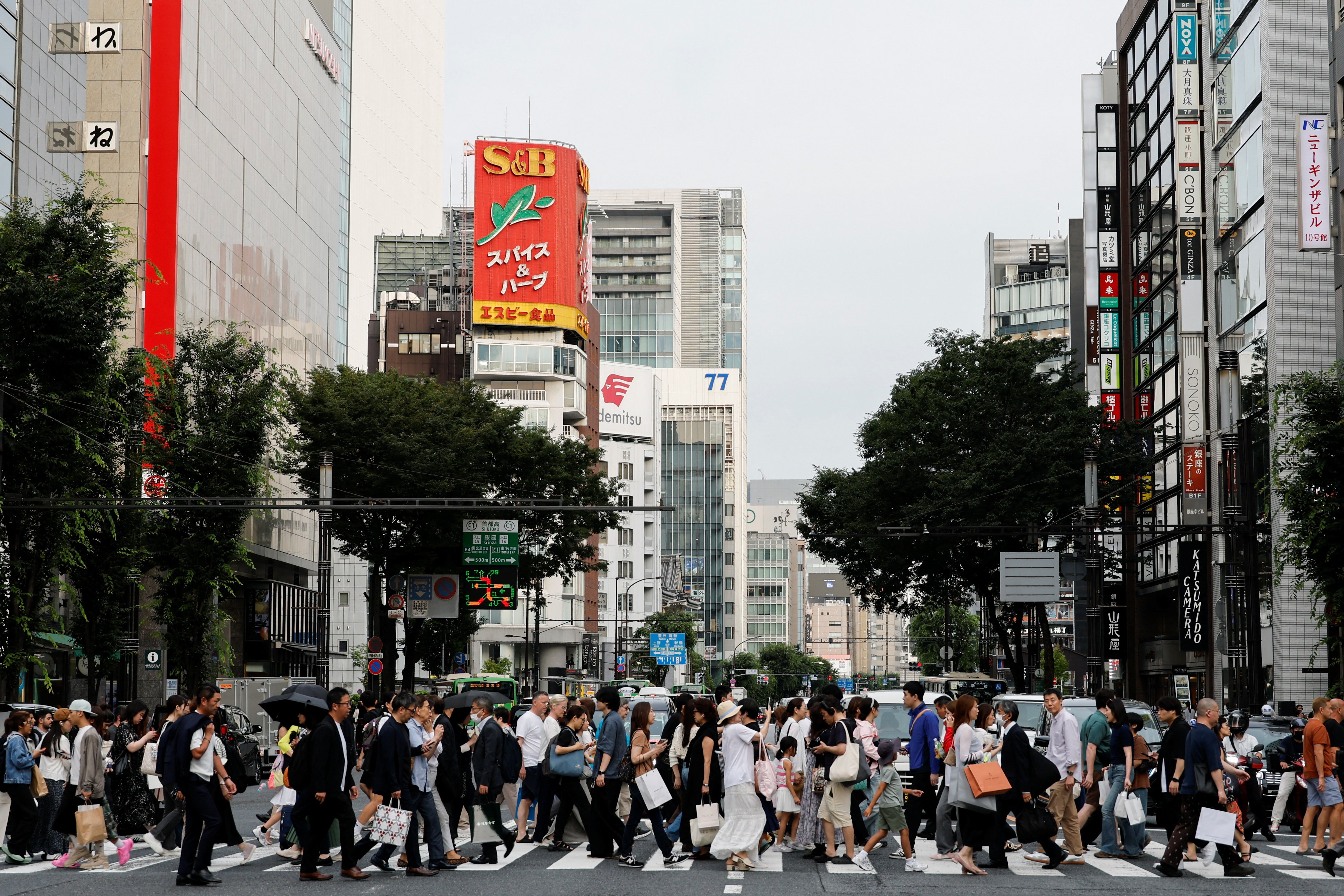
People walk through a commercial district in Tokyo, Japan, on June 16, 2026.
REUTERS/Kim Kyung-Hoon
Part of this trajectory reflects the choices made by the country to deal with the aging population.
Instead of promoting a more intense fiscal adjustment or significantly increasing the tax burden, the government began to finance an increasing portion of pension and health expenses through debt issuance.
Aging led many Japanese companies to change their growth strategy: with an increasingly smaller and aging domestic market, they increased investments abroad and began to generate increasing revenues with intellectual property, research and development and dividends from international subsidiaries.
The effects of demographic change also appear in the job market.
IMF data shows that the services sector accounts for around 70% of the added value of the Japanese economy and has some of the greatest difficulties in hiring workers. Furthermore, professionals over 60 are increasingly present in activities such as services and construction.
This scenario helps explain why productivity gains vary between different sectors of the economy.
⚙ While the manufacturing industry has advanced in recent decades with innovation and improvements in the organization of production, services aimed at the domestic market - such as health, commerce, hotels and food - have registered slower evolution.
Despite this, economist Kyoji Fukao, professor at the University Hitotsubashi states that this difference is not recent.
In a study of the structural causes of Japan's so-called "two lost decades", he argues that the productivity gains achieved by industry were not reproduced in most services, where more efficient management models were slow to be adopted.
"Productivity growth remained slow in Japan, as the most productive large companies did not increase their market share. Furthermore, job security has priority in Japan and, as a result, the costs of opening and closing establishments are high", he states.
Source: G1