Brazil's opponent in the World Cup, Japan tries to save the monarchy without breaking tradition; understand
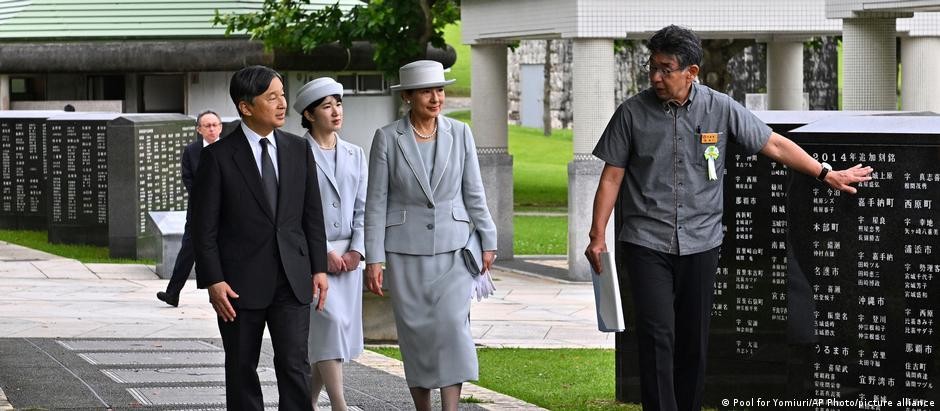
The Japanese emperor Naruhito (left) had no sons (File).
Pool for Yomiuri/AP Photo/picture alliance via DW
Japan's imperial family finds itself at a crossroads: aware of the current shortage of male heirs -the only ones legally able to occupy the throne-, it increasingly shrinks in the face of the automatic exclusion of princesses from royalty after they get married.
The situation represents a challenge for an institution millennial, seen as an element of national cohesion, and has worried politicians for more than two decades.
✅ Follow the g1 international news channel on WhatsApp
Now, seven parties, including opposition and government parties, have reached a consensus and presented a project to change the Imperial Household Law, with the aim of ensuring a sufficient number of members in the royal family. The government of Sanae Takaichi intends to forward the proposal to Parliament soon to ensure its approval in the current legislature.
The project provides for the inclusion in the imperial family of adopted men, aged 15 and over, who are descendants of the paternal lineage of ancient aristocratic families. In Japan, adoption traditionally ensures male succession. Such a solution would be a victory for conservatives, who want to avoid a woman on the Chrysanthemum Throne at all costs.
Now on g1
The second change in the law also goes in this direction. It allows women in the family to remain in the imperial household after marriage, if they wish. Currently, princesses lose their title when they get married. In this way, the imperial family could more easily fulfill its representative functions, such as the various patronages of charitable organizations and other institutions.
The parties, however, did not reach an agreement on including civil spouses and their descendants in the imperial house. This could pave the way for a succession to the throne by descendants of princesses.
Since Emperor Showa's death in 1989, the imperial family has shrunk from 21 to 16 members. The direct male line of succession only includes Crown Prince Fumihito, 60, and his 19-year-old son, Hisahito. The first is the brother of Emperor Naruhito, aged 66; the second, his nephew. This line of succession must be maintained.
Among the five single women is Aiko, the 24-year-old daughter of the current emperor. Very popular, Aiko, known as Princess Toshi, is considered the ideal candidate to assume the throne.
A survey carried out in May by the Asahi Shimbun newspaper showed that 72% of Japanese people support a female heir to the throne. However, Japanese conservatives have blocked this solution so far and have thus gained cross-party support.
Japanese Crown Prince Akishino is the emperor's younger brother. At his side is Crown Princess Kiko. Behind the couple appears their daughter, Princess Kako.
Kyodo News/AP Photo/picture alliance via DW
The main spokesperson is Takaichi, ironically, the first woman to rule Japan. "The historical fact that imperial continuity has been transmitted for 126 generations through men is unique in the world and constitutes the source of the authority and legitimacy of the emperor", said the prime minister in April, during a congress of the ruling Liberal Democratic Party (PLD).
Isao Tokoro, an expert on the history of the imperial house system, contextualized the planned legal changes in the Asahi newspaper: "Deliberate attempts are made to hide the true intentions, but the objectives behind the changes are clearly recognizable, that is, to keep everything as it is."
Return after 80 years
The eleven branches of the imperial family, with 51 members at the time, lost their aristocratic status in 1947, by order of the American occupation force after World War II. There are currently ten single men in the male line of these branches who could be considered candidates for adoption.
It would be a return after almost 80 years in which these families lived as ordinary citizens.
The current bill excludes these adopted former aristocrats from becoming emperors, but leaves it open whether their male descendants will have the right to succession. However, the president of the Chamber of Deputies, Eisuke Mori, from the PLD, has already indicated the direction of the new regulation. "If a boy is born, that child will have the right to the throne," he said. Shortly afterwards, he backtracked under pressure from opposition parties, as his declaration had exceeded the "legislative consensus".
Risk to the acceptance of the monarchy
Prince Hisahito (center) celebrated his majority on September 6, 2025, when he turned 19.
Kyodo News/AP Photo/picture alliance via DW
The intricate plan could, however, jeopardize the acceptance of the monarchy in Japan, if young ordinary citizens until then unknown people are suddenly elevated to the status of princes and begin to represent the imperial house.
One person who seems to see a risk in this is Emperor Naruhito, who, although he cannot make political statements, spoke out in an unusually direct way two weeks ago. He hopes for a "result of the discussions that finds understanding from public opinion."
But there is no sign of understanding. Even conservative newspapers expressed doubts about the reform and advocated making the gender issue more flexible for the imperial succession.
However, Japanese conservatives, who dominate Parliament, see the imperial household as the strongest symbol of the traditional patriarchal family structure, which they want to preserve against changes in social norms, such as greater gender equality. Therefore, they also reject same-sex marriage and different surnames for couples.
However, in the family of conservative Prime Minister Takaichi, it was the husband who adopted her surname. "There are traditions that can be changed, but there are also those that should not change, and exclusively male and patrilineal succession is one of them," said Akira Momochi, professor emeritus at Nihon University, in a television debate.
Source: G1