Brazil's opponent in the World Cup, Haiti defeated Napoleon and changed the direction of the USA; see curiosities
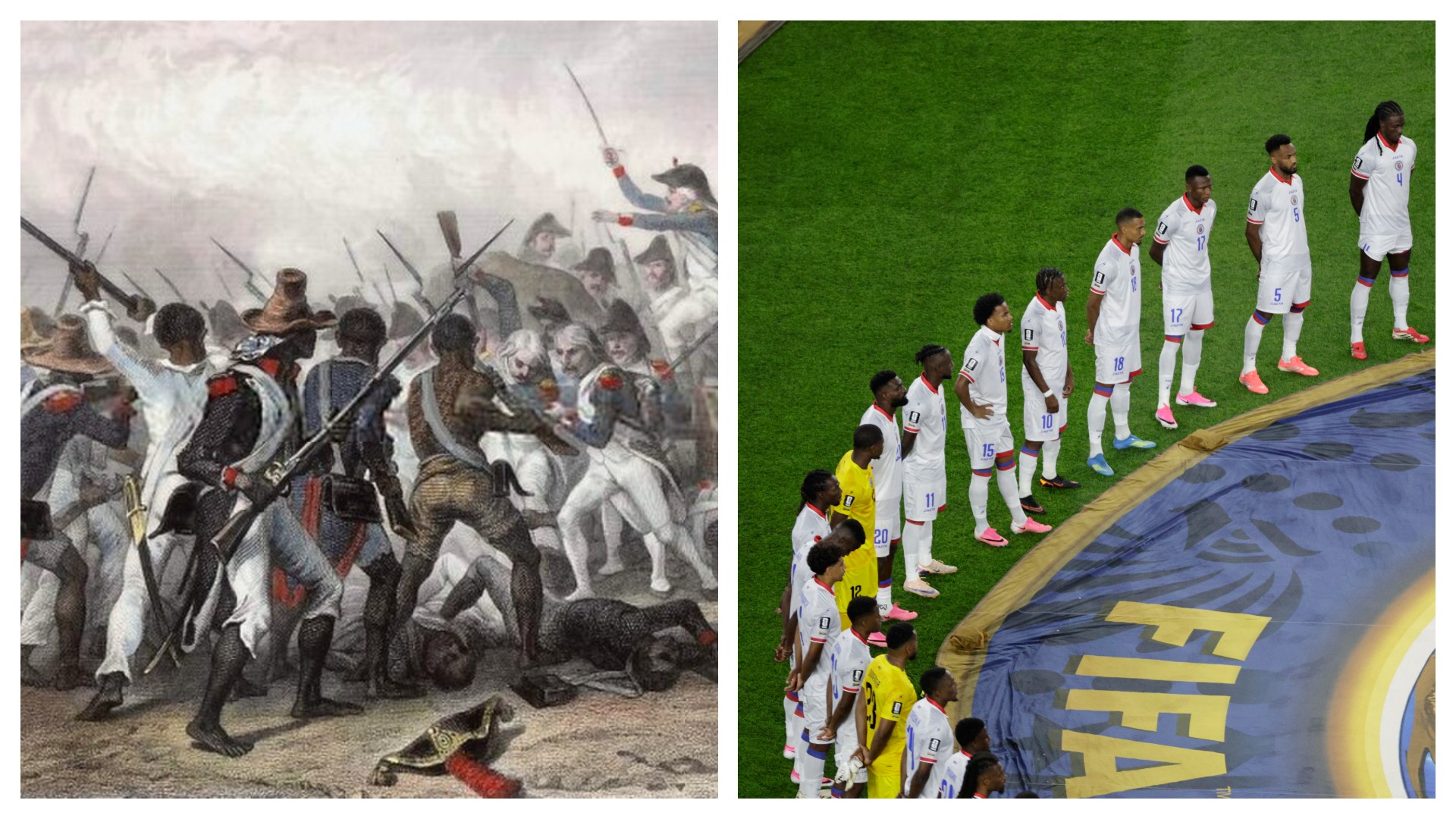
Haiti: the story of Brazil's opponent who helped Simón Bolívar and defeated Napoleon
Wikimedia comons/Reuters
Brazil has one more clash in the 2026 World Cup. This Friday (19), the team faces Haiti, in the second game of the group stage.
Favorite g1 on Google and follow the main news of the day
Considered the first independent black republic in the world, the country was born in 1804 after a revolution of enslaved people that defeated France, colonizer of the territory, and had an impact on different parts of the Americas.
Haitian history also includes support for Simon Bolívar in independence in Latin America and an influence on the size of the territory of the United States.
More recently, Haiti had a strong Brazilian military presence on its territory, when Brazil led a UN peacekeeping mission in the country.
See, below, interesting facts about Brazil's next opponent:
Follow the World Cup on ge:
World Cup 2026 Simulator
World Cup 2026 Calendar: see dates and times of all games
RESULTS: check the World Cup table
Haiti helped Simón Bolívar
Haiti helped Simon Bolívar
Public Domain
According to the historian Everaldo Andrade, professor at USP and author of the book "Haiti: two centuries of history", Haiti supported Simón Bolívar militarily and politically during the campaigns that led to the independence of South American countries.
➡Bolívar was a military man born in Caracas and is considered responsible for the independence campaigns of countries such as Venezuela, Colombia, Ecuador, Peru and Bolivia. Venezuelan.
"He supported not only politically, but with weapons, with ships, with whatever was possible", he states.
The professor also states that the aid was fundamental in influencing Bolívar on the liberation of the enslaved.
"As a result of this support, Bolívar began to defend the liberation of slaves, something he did not defend before", he explains.
Haitian revolution influenced the size of the US
In addition to playing a role in independence in America, Haiti's independence also had consequences for the US. This is because the country was responsible for making Napoleon Bonaparte, then first consul and future French emperor, sell Louisiana to the North American country.
According to Andrade, the defeat of French troops in the Caribbean weakened Napoleon's plans for the region and contributed to its sale to the Americans in 1803.
"With this defeat, Napoleon was unable to control the region and decided to sell", he explains. "Almost half of what the United States is today was gained in this purchase," he states.
At the time, the territory was much larger than the current state of Louisiana, extending from the Gulf of Mexico to regions close to the current border with Canada. (See below).
Haiti influenced the purchase of Louisiana by the USA
Public Domain
Brazilian troops in Haiti
More recently, the history of Haiti was marked by the Brazilian presence in the territory. Between 2004 and 2017, Brazilian military personnel led the United Nations Mission for the Stabilization of Haiti (Minustah), created after the departure of then president Jean-Bertrand Aristide.
According to the Brazilian federal government, over 13 years, more than 36 thousand Brazilians participated in the operation, which played a role in the country's security and reconstruction efforts after the 2010 earthquake.
➡The objective of the mission was to assist in the stability of the nation, in the country's political transition and, later, in the reconstruction after the 2010 earthquake. During this period, Brazil exercised command of the military component of the mission.
Arrival of Brazilian troops to join MINUSTAH in Haiti, in 2010
Brazilian Army/ Disclosure
Despite its leadership in the mission, it was not Brazil that had the idea of sending troops to Haiti.
"The United States proposed an intervention at the UN and Brazil took this intervention in 2004", explains Everaldo.
Learn more: 9 moments to understand the history of the operation led by Brazil
Also according to the professor, the legacy of the Brazilian presence still divides opinions in Haiti. "Brazil's presence in Haiti had positive and negative aspects," he says. For Andrade, while part of the population views Brazil with sympathy for its cultural proximity and football, others associate Brazilian action with military intervention.
"There is a sector of the Haitian population that does not like Brazil and the UN because they are people who went there to carry out violence", he stated.
Football: a few months after the soldiers arrived in Port-au-Prince, the Brazilian team faced Haiti in a friendly match, which became known as the "Game for Peace". The objective was to gain the people's sympathy in relation to Minustah.
Reporting crimes: In December 2011, the National Network for the Defense of Human Rights (RNDDH) reported that, since the arrival of Minustah in Haiti, agents had been involved "in cases of rape, robbery, murder and illegal and arbitrary detentions" and cited a dozen of them. The involvement of three Brazilians in aggression against young people was investigated.
The Brazilian football team is greeted by Haitian fans as they cross the streets of Port-au-Prince, in Haiti
Vanderlei Almeida/AFP/Arquivo
'The 1st truly free country'
Andrade explains that, more than gaining its independence, Haiti has become a reference for the black population across the American continent. This is because it was born from a revolution led by enslaved people that proclaimed the liberation of the black population, at a time when slavery was still maintained in most of the Americas.
According to Andrade, the Haitian struggle had an impact that went beyond the country's borders.
"Haiti was the first country to defend the rights of Africans, the Africanity movement and blackness", he stated.
"The blackness movement was born in Haiti. As resistance against discrimination against black people and the idea that black people are an inferior race", says the professor.
Andrade also highlights that Haiti occupied a unique position in the 19th century.
"It was the first truly free country in the Americas, it wasn't the USA, it was Haiti that proclaimed the independence and liberation of all its citizens, everyone", he says.
How is Haiti today?
A group of children plays football with a ball of plastic in the Pétion-Ville neighborhood in Port-au-Prince, Haiti
AP Photo/Odelyn Joseph
Haiti is experiencing a political and security crisis that has worsened in recent years. After the assassination of President Jovenel Moïse in 2021, the country began to be governed by transitional authorities while trying to organize new elections. At the same time, armed groups expanded their influence.
For the historian, the current problems are related to a long history of foreign interventions and political instability, in addition to the impacts of a major earthquake that hit the country in 2010. According to him, the occupation of the United States at the beginning of the 20th century, the dictatorship of the Duvalier family and successive international interventions weakened Haitian institutions.
➡The dictatorship of the Duvalier family governed Haiti between 1957 and 1986, first under François Duvalier and later with his son Jean-Claude Duvalier. The regime was marked by authoritarianism, political repression and violence.
"This dictatorship created the culture of extermination groups, of political violence, which has not disappeared", he states.
The professor also highlights that, despite the crisis, Haiti maintains popular organizations, student movements and a rich cultural life, often overshadowed by violence.
"The situation in Haiti is a result of decades of constant external interventions that prevent them from organizing themselves", he says.
Fifa asked for changes to the shirt
Fifa asks for changes to Haiti's shirt
Reproduction/Instagram
Shortly before the start of the tournament, FIFA requested that the company responsible for Haiti's uniforms, Saeta, change the team's official shirt.
The manufacturer informed that the entity determined changes in the design because it understood that some visual elements could be interpreted as a political message.
For this reason, in the team's debut against Scotland, the country entered with a modified shirt.
But what has changed? The uniform originally released by the company contained an illustration associated with the Battle of Vertières, in 1803, when former slaves defeated Napoleon's troops. Saeta did not say what was vetoed by FIFA, but the new shirt no longer has the design.
In the professor's assessment, FIFA's decision was not correct. "In fact, it is not a political symbol, it is a symbol of affirmation of nationality", he explains.
"It is violence against Haiti because it is a symbol of pride for a people who are so humiliated, so massacred. This was yet another blow", he states.
Source: G1